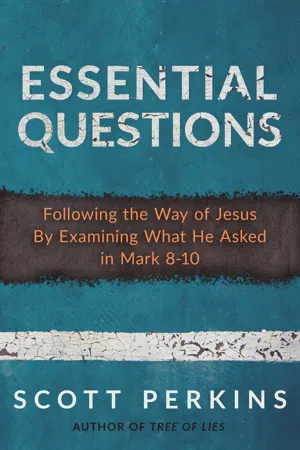
eBook - ePub
Essential Questions
Following the Way of Jesus By Examining What He Asked in Mark 8-10
- English
- ePUB (mobile friendly)
- Available on iOS & Android
eBook - ePub
Essential Questions
Following the Way of Jesus By Examining What He Asked in Mark 8-10
Information
Topic
Teologia e religioneSubtopic
Studi biblici1
Do you see anything?
Do you see anything?
Who You Are Impacts How You See
Mark 8:22-26
One of the things that the author of Mark does not get enough credit for is the intentional structure with which he has arranged the stories of Jesus. His gospel is more than just recollections written down as they came to mind in order to be passed on. In fact, there is no evidence that Mark used all the material that was available to him.1
There is precision and beauty to Mark’s writing. We see an example used for the discipleship segment of Mark. Here we find Jesus teaching the disciples about what it means to follow him, sandwiched between two stories of him healing blind men. Sandwiching is a technique of placing two seemingly similar stories at the beginning and end of a narrative with other material related to that point put in between. At the beginning and the ending of the discipleship segment, Jesus heals a blind man. He does each in a different way—the message of both is different but complementary, and the rest of the discipleship segment is a sandwich between these two stories.
When I consider the stories of Jesus healing sight, I get nervous. Especially in this first one where we read that Jesus spit on the man’s eyes. I’m going to confess to you that I have something of an eye phobia. Or maybe it would better be called eye paranoia. I don’t like the thought of anything touching or coming near my eyes. For that reason, I’ve always worn glasses because I don’t want to have to stick my finger near my eyes in order to put in contact lenses. I hate eye drops. If you’ve ever been to the eye doctor, then you are familiar with the perils of the glaucoma test. For the uninitiated, this is where you rest your chin on a strap, push your forehead against a bar and stare at a red light…and wait. A puff of air is then shot at your open eye. I pull away every time as the puff sounds. I have to grab the table, and my brain will not stop thinking, what if what comes out is not air? What if it shoots a particle of sand, or worse, some sort of dart like in an Indiana Jones movie? In fact, in a relationship, my utmost expression of trust would be to let someone touch my eyelid or put their finger close to my eye to get a stray eyelash.
So it is with that feeling of vulnerability that we start in Mark 8:22-26 with the story of Jesus being presented with a blind man and asked to end his disability:
They came to Bethsaida, and some people brought a blind man and begged Jesus to touch him. He took the blind man by the hand and led him outside the village. When he had spit on the man’s eyes and put his hands on him, Jesus asked, “Do you see anything?” He looked up and said, “I see people; they look like trees walking around.” Once more Jesus put his hands on the man’s eyes. Then his eyes were opened, his sight was restored, and he saw everything clearly. Jesus sent him home, saying, “Don’t even go into the village.”
Of interest to us right away is the fact that this seems to be the only miracle recorded for us that happens in phases. Rather than a sign of a problem, or in a lack of efficacy of Jesus, or a problem with this man’s faith, it shows the intentionality in everything Jesus does. Jesus taught through the use of parables,2 and some of those parables were presented in words while others were communicated through Jesus’ purposeful actions.3 Jesus isn’t flustered nor does he condemn this man for a lack of faith. Rather, he asks a question in the midst of performing this healing: Do you see anything?
It is likely that the disciples, whose lack of understanding Jesus was addressing, were standing close by while the conversation was happening. Maybe he was even looking at the disciples when he asked the question. I tend to get the feeling that this conversation is for more than just the blind man’s edification.
So, why is this an important question? Of all the miracles that Jesus performed, why did Mark pick this miracle of sight to be the first bookend of the discipleship segment of his story about Jesus?
The Importance of Seeing
The metaphor of the eye is one commonly used in Jewish spiritual teachings.4 Your eye, and by extension how you see, gives an indication of your spiritual state. Among Jesus’ teachings on sight, in Matthew 6:22-23 he says: “The eye is the lamp of the body. If your eyes are healthy, your whole body will be full of light. But if your eyes are unhealthy, your whole body will be full of darkness. If then the light within you is darkness, how great is that darkness!” In these verses, Jesus states the relationship fairly simply. Seeing poorly comes from a bad eye and results from a body filled with darkness. If you see with a good eye, it comes from a body full of light.
All of humanity was created to live in the image of God. This is intended to be the light within us—the true self that results when we derive our sense of identity from the One who made us. It is seen in the origin story of humanity, where Adam and Eve felt no shame as they lived naked in the presence of God. It is only when they turned away to seek worth from something else that they questioned God and hid from each other. Darkness entered them as they moved away from God. It changed how they related to each other in profound ways as they were forced to cover their new sense of shame.
Think about your own tendencies when you see people. With what frequency do you classify people based on what you can get from them? Whether what you want or need be attention, affection, affirmation, material support, productivity or submission, these desires come from an identity that is trying be complete apart from God. Without God, what is inside is a darkness that needs to be filled. People and relationships become a way to try to push back that darkness. The fruit of the bad eye is lust, greed, hatred, envy, idolatry, and other acts of the flesh that consume.
Another way that this emptiness bears fruit is if people are seen as barriers to getting what you want. As if one person having some role, possession, or relationship is keeping you from being significant. To fill the void, we compete with each other and covet what we don’t have, finding ways to feel whole or valuable.
If you need to feel more valuable than someone else, or be more productive than someone else, or be more attractive than someone else, or be more powerful than someone else, or receive affirmation from someone else, then you will not have the ability to see the other person clearly. This is the darkness of the false sense of self. It consumes like a black hole because it needs a constant reassurance of worth and meaning. Through the darkness, one cannot see beyond themselves.
Unhealthy Eyes
With this act of healing, Jesus is addressing the clarity of sight of those who are following him, and that includes us. Just as the vision of the original disciples was being confronted, we should always live in awareness of the quality of our eyes and evaluate what this says about how we are defining our sense of self. A regular evaluation of what is feeding our identity is a valuable spiritual discipline.
The disciples walking the countryside of Israel were unaware of the reality that time was running out on their comfort. Jesus’ entry into Jerusalem and his subsequent passion week—which is the focus of the final segment of Mark—was fast approaching. Discipleship is movement, and that movement is oriented toward the cross and empty tomb. As we navigate through the discipleship section, Jesus’ date with the cross will loom larger and larger.
For this reason, the disciples needed to see clearly. Yet, despite the miracles and personal, small-group teachings with Jesus—presented by Mark in the first eight and a half chapters—the disciples were still blinded to the truth of who Jesus was. Because of the hopes they had for what they would get out of the new regime Jesus was instituting, their eyes were unhealthy. Their cultural expectations had blinded them to what kind of messiah Jesus had come to be. The fact that they could not see Jesus clearly and didn’t understand their relationship to him was of pressing concern.
Israel had geared up their expectations of a messiah as a political liberator. In this context, he was going to throw off the shackles of Roman occupation in the Holy Land and restore the throne of David, Israel’s greatest king. Through this type of messiah, the people of God would be restored to what they perceived to be their rightful place as the most prosperous and powerful country on earth. The disciples were confused and fearful about much of what they were seeing, because what they saw Jesus doing and how they saw him interacting with people was filtered through that lens.
The disciples were distracted and self-focused. In their thoughts about the Kingdom Jesus was proclaiming and establishing, they became preoccupied with doing, status, power and being insiders. It is into these expectations that Jesus asked, Do you see anything?
Just like them, we use roles, relationships, and results to build up our identity. In its simplest form, we can do this in a group of people we do not know by gravitating to someone based on how they are dressed, their attractiveness, because of what they do for a living, or their role in the community. This is the unhealthy eye ascribing worth to another based on externals and using that to build a sense of respect, acceptance, or significance.
In the letter of James, this same situation is addressed. It seems that the believers James was writing to were showing favoritism based on appearance, giving seats of honor to a wealthy-looking individual while relegating the poor to places where they could not be seen. Pulling no punches, James tells this church that their bad eye comes from being dominated by evil thoughts.5 Our inability to see is a serious issue.
Some of the other forms an unhealthy eye might take are:
- Performing acts of service in order to be noticed or to receive affirmation.
- Entering into a romantic relationship with the expectation of feeling “complete.”
- Taking a leadership role in order to have a feeling of control.
- Judging success by the number of followers, newness of a car, level of income, neighborhood you live in, or some other metric.
- Classifying the worth of others by usefulness, productivity, attractiveness, experience, gender, race, nationality, or income.
These are just a few of the ways that we feed our hearts at the expense of another. Some of these things have the deceitfulness of looking good on the outside, but are done with a self-focused motivation. Yet, in all of the examples, we so easily fall into the same mindset as that of the disciples: forming expectations of Jesus that he will make this way of life work for us. We follow Jesus as a way to get the things that our hearts crave. Discipleship is treated as self-fulfillment. In this way we become blinded to who he is, what it means to be a citizen of his Kingdom, and what his purpose for our lives is.
How we see others and the lens through which we view Jesus is the product of what the source of life is for us. The bad eye is the result of a passion for self, while the good and healthy eye is founded on God dwelling within us. How you see starts with your heart.
Clearing the Lens
Bethsaida, the location where this healing story began, was a fishing village that the Roman ruler of the area, Philip the Tetrarch, had renovated into a city. It’s a convenient place to start this journey of developing spiritual sight because Andrew, Peter, and Philip—three of the twelve in Jesus’ inner circle—were from this area. In Matthew’s gospel story, Jesus calls down woe on Bethsaida because although he performed miracles among them, they failed to see and understand. The culture of indifference produced a lack of repentance.6 The people of this town were unreceptive to the gospel.
It’s in this city that we have the opening scene of the story in which Jesus asks ...
Table of contents
- Title Page
- Copyright
- Dedication
- Contents
- Acknowledgements
- Introduction Do You Still Not Understand?
- 1 Do you see anything?
- 2 Who Do You Say I Am?
- 3 What Can You Give In Exchange For Your Soul?
- 4 Why Then Is It Written That the Son of Man Must Suffer Much and Be Rejected?
- 5 How Long Has He Been Like This?
- 6 What Were You Arguing About On the Road?
- 7 How Can You Make Salt Salty Again?
- 8 What Did Moses Command You?
- 9 Why Do You Call Me Good?
- 10 What Do You Want Me to Do for You?
- Conclusion Who Will Roll the Stone Away from the Entrance of the Tomb?
- The Tree of Lies vs. The Tree of Life
- One Another Statements Found in the Bible
- Also by Scott Perkins
- Help with Developing Your Root
- Selected Bibliography
- About Scott Perkins
Trusted by 375,005 students
Access to over 1.5 million titles for a fair monthly price.
Study more efficiently using our study tools.
Frequently asked questions
Yes, you can cancel anytime from the Subscription tab in your account settings on the Perlego website. Your subscription will stay active until the end of your current billing period. Learn how to cancel your subscription
No, books cannot be downloaded as external files, such as PDFs, for use outside of Perlego. However, you can download books within the Perlego app for offline reading on mobile or tablet. Learn how to download books offline
Perlego offers two plans: Essential and Complete
- Essential is ideal for learners and professionals who enjoy exploring a wide range of subjects. Access the Essential Library with 800,000+ trusted titles and best-sellers across business, personal growth, and the humanities. Includes unlimited reading time and Standard Read Aloud voice.
- Complete: Perfect for advanced learners and researchers needing full, unrestricted access. Unlock 1.5M+ books across hundreds of subjects, including academic and specialized titles. The Complete Plan also includes advanced features like Premium Read Aloud and Research Assistant.
We are an online textbook subscription service, where you can get access to an entire online library for less than the price of a single book per month. With over 1.5 million books across 990+ topics, we’ve got you covered! Learn about our mission
Look out for the read-aloud symbol on your next book to see if you can listen to it. The read-aloud tool reads text aloud for you, highlighting the text as it is being read. You can pause it, speed it up and slow it down. Learn more about Read Aloud
Yes! You can use the Perlego app on both iOS and Android devices to read anytime, anywhere — even offline. Perfect for commutes or when you’re on the go.
Please note we cannot support devices running on iOS 13 and Android 7 or earlier. Learn more about using the app
Please note we cannot support devices running on iOS 13 and Android 7 or earlier. Learn more about using the app
Yes, you can access Essential Questions by Scott Jeffrey Perkins in PDF and/or ePUB format, as well as other popular books in Teologia e religione & Studi biblici. We have over 1.5 million books available in our catalogue for you to explore.