Scholars working in a number of disciplines – archaeologists, classicists, epigraphers, papyrologists, Assyriologists, Egyptologists, Mayanists, philologists, and ancient historians of all stripes – routinely engage with ancient textual sources that are either material remains from the archaeological record or historical products of other connections between the ancient world and our own.
Examining the archaeology-text nexus from multiple perspectives, contributors to this volume discuss current theoretical and practical problems that have grown out of their work at the boundary of the division between archaeology and the study of early inscriptions. In 12 representative case-studies drawn from research in Asia, Africa, the Mediterranean, and Mesoamerica, scholars use various lenses to critically examine the interface between archaeology and the study of ancient texts, rethink the fragmentation of their various specialized disciplines, and illustrate the best in current approaches to contextual analysis.
The collection of essays also highlights recent trends in the development of documentation and dissemination technologies, engages with the ethical and intellectual quandaries presented by ancient inscriptions that lack archaeological context, and sets out to find profitable future directions for interdisciplinary research.
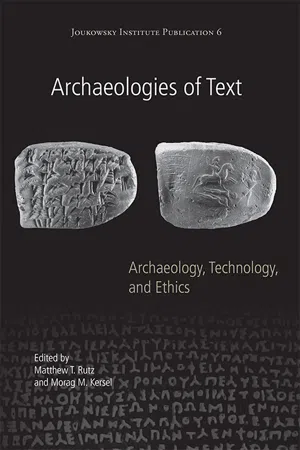
eBook - ePub
Archaeologies of Text
Archaeology, Technology, and Ethics
- 278 pages
- English
- ePUB (mobile friendly)
- Available on iOS & Android
eBook - ePub
Archaeologies of Text
Archaeology, Technology, and Ethics
About this book
Information
Subtopic
ArchaeologyIndex
Social Sciences— 1 —
Introduction:
No Discipline is an Island
No Discipline is an Island
As a discipline archaeology may be distinct, but it is hardly isolated: its scope is as broad as the disparate fields that inform its methods and perspectives, among them anthropology, art history, epigraphy, and the physical and biological sciences. Archaeology’s object of study is as varied as the material traces of human behavior, from prehistory to recent history. In contrast the study of the premodern textual record is not a single discipline at all, but rather an array of fields and sub-fields loosely allied around a common purpose: to gain insight into the human past principally through written text, a powerful if relatively recent technology for visually and physically encoding natural language, storing and transmitting information, and extending, supporting, or subverting memory. Ancient texts bear witness to the multiple uses of writing, from mediating political and economic interactions to reproducing, reflecting, and refracting culture to both literate and non-literate audiences, both of whom would have encountered text albeit in powerfully unequal ways. Writing can be viewed as occupying a particular and peculiar niche among the rich repertoire of human communication technologies that are embedded literally as well as figuratively in frameworks of material culture and the built environment, squarely in the domain of anthropological archaeology (e.g., Andrássy et al. 2009; Glatz 2012; Houston 2004a).
However, even before the practice of archaeology, certain bodies of ancient literature were carefully transmitted across space and time, and some of these corpora even managed to survive down to the present in some form, be it complete or fragmentary (e.g., Reynolds and Wilson 2013; Tov 2012). Bearing witness to this long process are the anthologies that constitute the core of the traditional canons of the world’s ancient literate cultures: classical works from Asia, Africa, Europe, and the Americas. The complex processes behind the transmission of ancient literature took many historical forms, but forces that were highly intentional as well as entirely random or accidental inevitably buffeted the texts that somehow survived. Similarly, other ancient texts survived on monuments that never quite slipped from view, but whose meanings were transformed or obscured by the interest or neglect of various shifting audiences over time. In either case, until the relatively recent advent of archaeology as a mode of inquiry (Trigger 2006 [1989]), vast bodies of text were excluded from reckonings of the distant past (e.g., Baines et al. 2008; Sanders 2006). Beginning in earnest in the fifteenth century, European antiquarians began uncovering ancient inscriptions in the classical Mediterranean world, and since that time countless premodern texts inscribed in many media have been found throughout Africa, the Americas, Asia, and beyond.
Perhaps surprisingly, archaeology and the study of the premodern textual record may be thought of as approaches that are interdependent and complementary as well as independent or even contradictory. The adoption of one of these views or the other has largely depended on a given scholar’s training, disposition, research questions, and preferred interpretive lens. In historical perspective, from the eighteenth century on the archaeological discovery of previously unknown texts led to the adaptation of existing interpretive methods, such as classical philology, to deal with new epigraphic environments. In addition this glut of new data brought about the creation of entirely new fields, such as Assyriology, Egyptology, or Maya Studies, that are devoted to recording the epigraphic record, deciphering obsolete scripts, and reconstructing the lost languages and language families encoded in those scripts. For much of the twentieth century, archaeological and epigraphic research largely moved in different directions, sometimes in parallel or complementary configurations, sometimes at odds or simply mutually uninterested. This fragmentation of research programs prompts some fundamental theoretical questions and presents a number of practical problems, and thus the relationship between archaeology and textual study periodically needs to be revisited (e.g., Kohl 2006; Moreland 2001, 2006; Zettler 2003).
Despite this complicated, sometimes fraught history, archaeological and textual research trajectories intersect necessarily and unavoidably in a number of ways. In light of this entangled relationship, we may reasonably interrogate the roles ancient texts play in archaeological discourses. First, premodern texts suggest taxonomies, both explicit and implicit, that allow scholars to assign names: names to places (e.g., historical geography, urban/non-urban/cosmic topography), names to periods (including both emic and etic reckonings of time in a given sequence), names to people (e.g., ethnolinguistic identification, titles or epithets, and actual people, that is, names of specific persons and kinship groups), as well as names to objects, architecture, and features in the built and natural environments. In addition, texts can act as informants and provide descriptions, however limited or tendentious, of how objects, features, spaces, or landscapes functioned or were perceived in a variety of ancient social contexts. Alternatively, interpreting textual finds found in situ frequently provides the basis for making inferences about who inhabited or otherwise interacted with spaces, especially in the case of archives, libraries, or other inscribed remains found associated with architecture or environmental features, such as display inscriptions, graffiti, or textual deposits. Textual documentation sometimes suggests a chronological anchor, be it relative or absolute, explicitly stated in a dated record or inferred from palaeographic, grammatical, iconographic, prosopographic, or other markers associated with a text. In terms of ancient written records’ analytical effects on academic discourses, the technology of writing itself is often ascribed as a correlate of social complexity or an attribute of civilization (e.g., Powell 2009), which in turn necessarily informs how researchers construct narratives about the past. Some ancient texts espouse specific narratives of ancient events; others are swept up in modern scholars’ narrativized reconstructions of the past. For both of these reasons, ancient writings can also act as a tether that connects the past to the present, with profound effects on popular interest in archaeological and historical research, the amount of funding available to support research, tourism and economic development or exploitation, identity politics, as well as nationalism and modern state-craft. Finally, textual research can and does recover meaningful information about the past from otherwise contextless ancient texts, either from the received canons that have a complex or scarcely known transmission history as material objects, or from more recently rediscovered textual artifacts that were dislodged from their archaeological context by whatever means.
Looked at from the opposite perspective, what role does archaeology play in discourses focused on ancient texts? In the case of some textual traditions, archaeological investigation is responsible for the creation of the corpus itself, in the sense that archaeological excavation or survey has recovered scripts, languages, and text corpora that had otherwise been lost to history. It may even be argued that the proper study of the origins of the world’s writing systems is as much a problem of prehistory (i.e., the domain of archaeology) as it is one of epigraphic and historical research (e.g., Darnell et al. 2005; Goldwasser 2011; Houston 2004b; Sanders 2006). In addition, the emphasis of archaeological research on context effectively circumscribes textual sources from any period in analytically productive ways: there are innumerable examples of excavated textual artifacts that cohere archaeologically in ways that are not apparent in the contents of the texts themselves (e.g., Cohen et al. 2010; Rutz 2013; Stocker and Davis 2004; Zettler 2008). The archaeological sequence also has the ability to provide a chronological anchor that can support, undermine, or problematize any chronological scheme suggested in the textual record. Similarly, archaeological research can affirm, contradict, or complicate the assumptions and received wisdom of living cultural traditions or purely historical modes of inquiry. Above all, archaeology can and does shed light on facets of human life around or outside the purview of even the most robustly diverse array of ancient textual documentation. Because of archaeology’s focus on the material traces of the human past, textual studies have been enriched by thinking about materials and materiality in relation to the social practice and products of ancient writing. On the one hand, archaeological research helps to place texts (ancient narratives or descriptions, as well as physical manuscripts or inscribed objects) in a world of other things, schemes of value, and webs of cultural meaning; on the other hand, textual studies have grown to include the material analysis of inscribed objects in order to understand their physical properties and composition, which in turn can elucidate textual production as a craft (a technological, cultural, and socio-economic practice) with material correlates in the archaeological record (e.g., Houston 2012; Payne 2008; Piquette and Whitehouse 2013; Taylor and Cartwright 2011). A closer analysis of inscribed materials has also made it possible to source individual inscribed objects or groups of objects (e.g., Goren et al. 2004, 2006, 2009, 2011; Powers et al. 2009). Current practices in the imaging, documentation, dissemination, and conservation of ancient inscriptions have all undergone radical transformation in recent decades (e.g., Bodel 2012; Gütschow 2012; Hahn et al. 2007; Hameeuw and Willems 2011; van Peursen et al. 2010; Powers et al. 2005; Zuckerman 2010a, 2010b). Though not solely a contribution of archaeological science, at least some of these developments were arguably catalyzed by concurrent developments in archaeological research. Finally, archaeological modes of analysis have played a central role in how scholars of all stripes conceive of and handle contextless or undocumented inscriptions. Two fundamental dimensions of this engagement are the authentication of contextless objects through non-textual means and the proposition that inscribed objects that lack context pose serious intellectual and ethical problems that cannot be ignored.
The interplay between textual research and archaeology is not only a function of a shared interest in the past, but also a common purpose: concern for the fundamental issues surrounding our access to and perceptions of the past. The purpose of this volume is to scrutinize the relationship between textual and archaeological approaches by moving beyond the tendency to treat texts and archaeological remains as independent or even casually interdependent sources of information. Central to...
Table of contents
- Cover
- Title Page
- Copyright
- Contents
- List of Figures
- List of Tables
- Notes on Contributors
- Contributor Addresses
- Acknowledgments
- Chapter 1: Introduction: No Discipline is an Island
- Chapter 2: Case in Point: The Persepolis Fortification Archive
- Chapter 3: Space, Time, and Texts: A Landscape Approach to the Classic Maya Hieroglyphic Record
- Chapter 4: Now You See It, Now You Don’t: The Dynamics of Archaeological and Epigraphic Landscapes from Coptic Egypt
- Chapter 5: Articulating Neo-Assyrian Imperialism at Tell Tayinat
- Chapter 6: The Archaeology of Mesopotamian Extispicy: Modeling Divination in the Old Babylonian Period
- Chapter 7: The Ernest K. Smith Collection of Shang Divination Inscriptions at Columbia University and the Evidence for Scribal Training at Anyang
- Chapter 8: Tracing Networks of Cuneiform Scholarship with Oracc, GKAB, and Google Earth
- Chapter 9: Ancient Relationships, Modern Intellectual Horizons: The Practical Challenges and Possibilities of Encoding Greek and Latin Inscriptions
- Chapter 10: Forging History: From Antiquity to the Modern Period
- Chapter 11: WikiLeaks, Text, and Archaeology: The Case of the Schøyen Incantation Bowls
- Chapter 12: Do Restrictions on Publication of Undocumented Texts Promote Legitimacy?
- Chapter 13: Publishing Undocumented Texts: Editorial Perspectives
Trusted by 375,005 students
Access to over 1.5 million titles for a fair monthly price.
Study more efficiently using our study tools.
Frequently asked questions
Yes, you can cancel anytime from the Subscription tab in your account settings on the Perlego website. Your subscription will stay active until the end of your current billing period. Learn how to cancel your subscription
No, books cannot be downloaded as external files, such as PDFs, for use outside of Perlego. However, you can download books within the Perlego app for offline reading on mobile or tablet. Learn how to download books offline
Perlego offers two plans: Essential and Complete
- Essential is ideal for learners and professionals who enjoy exploring a wide range of subjects. Access the Essential Library with 800,000+ trusted titles and best-sellers across business, personal growth, and the humanities. Includes unlimited reading time and Standard Read Aloud voice.
- Complete: Perfect for advanced learners and researchers needing full, unrestricted access. Unlock 1.5M+ books across hundreds of subjects, including academic and specialized titles. The Complete Plan also includes advanced features like Premium Read Aloud and Research Assistant.
We are an online textbook subscription service, where you can get access to an entire online library for less than the price of a single book per month. With over 1.5 million books across 990+ topics, we’ve got you covered! Learn about our mission
Look out for the read-aloud symbol on your next book to see if you can listen to it. The read-aloud tool reads text aloud for you, highlighting the text as it is being read. You can pause it, speed it up and slow it down. Learn more about Read Aloud
Yes! You can use the Perlego app on both iOS and Android devices to read anytime, anywhere — even offline. Perfect for commutes or when you’re on the go.
Please note we cannot support devices running on iOS 13 and Android 7 or earlier. Learn more about using the app
Please note we cannot support devices running on iOS 13 and Android 7 or earlier. Learn more about using the app
Yes, you can access Archaeologies of Text by Matthew T. Rutz, Morag Kersel, Matthew T. Rutz,Morag Kersel in PDF and/or ePUB format, as well as other popular books in Social Sciences & Archaeology. We have over 1.5 million books available in our catalogue for you to explore.