- English
- ePUB (mobile friendly)
- Available on iOS & Android
eBook - ePub
Information
Topic
MedicineSubtopic
Historical BiographiesJoan Eardley
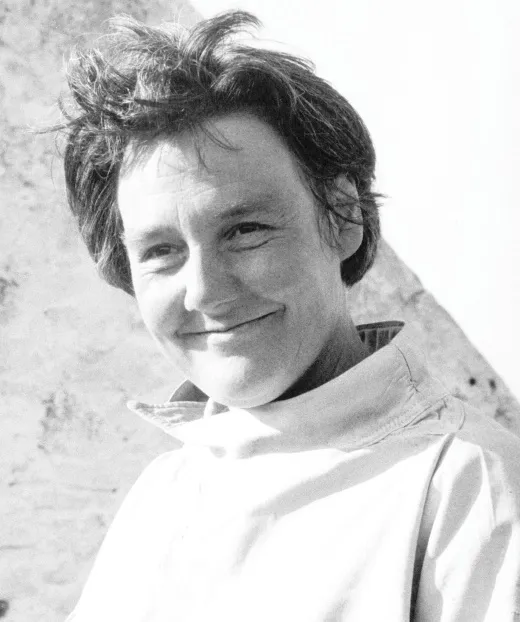
Like Kathleen Ferrier, Joan Eardley died at the height of a creative career. She was the first child of Captain William Eardley, who was billeted in Glasgow during his army service in the First World War, and met his Scottish wife there: Irena Morrison. Joan was born in 1921, not in Scotland but on a dairy farm in Warnham, near Horsham in West Sussex, where her parents struggled to make ends meet and finally gave up. Her father gained employment in the Ministry of Agriculture in Lincoln, but was still suffering from the late effects of being gassed in the trenches, and in deep depression committed suicide in 1929.
When this happened Joan was only eight, her sister Patricia six. (Joan too was to experience depression in later life.) Her mother had already moved the family to Blackheath, near Greenwich Park in London, to join her own mother and her sister Sybil, a leading light in the women’s rights movement. Great aunts visited, and Joan went to a private school, paid for by the aunts, where her growing talent for art was encouraged. On leaving school she spent two terms at an art school in Blackheath, and then another two at Goldsmith’s College of Art. Late in 1939, to avoid the threatened London bombing, the family moved again to Glasgow, and Joan continued her education at the Glasgow School of Art, where the staff were few owing to the war, and materials were in short supply.
Joan made a special friend of a fellow student, Margot Sandeman. She was lucky to have Hugh Adam Crawford as her teacher of drawing and painting. Interestingly, he talks about an artist needing to break down the typical Scottish inhibition:
If you want to be a good painter, and I mean one who matters beyond the ordinary kind of success with people around you, you have to be prepared to break down some kind of barrier within yourself. In Scotland we are all born with a constraint of this kind — we get it with our mother’s milk. Somehow we have to enter into another plane of living, to break through, or away from, Scottish morality — the vulgar idea of Godliness. There can’t be any ‘good’ or ‘bad’ or ‘yes’ or ‘no’. You have to accept that there’s a kind of necessity before which everything has to go down.1
Little of Joan’s work from this period survives, an exception being her diploma self-portrait, which was actually bought by Crawford himself. The work also won her the Sir James Guthrie Prize for portraiture.
Her home was in the Bearsden district of Glasgow, near the countryside, and she explored the West Highland Way, the Isle of Arran, and Loch Lomond, with Margot Sandeman. During the Second World War young women were required either to train as teachers or to be called up for the services. Although Joan did enrol at Jordanhill Teacher Training College, she decided to quit teaching in favour of a ‘reserved’ occupation as a joiner’s labourer in a boat-building yard. At the same time she continued painting. Works from this period include The Mixer Men: two workmen with a cement mixer. Her ‘war work’ included painting camouflage on boat hulls. She was also sending paintings to exhibitions in Glasgow and Edinburgh. Margot moved to Bletchley Park in Buckinghamshire to work as a code-breaker during the war, and Joan visited her there.
After the war Joan moved to London, where she was very short of money, but managed somehow. Although London was exciting in many ways, Joan was also homesick, and had depressive episodes. She wrote: ‘…a terrible helpless hopeless feeling has come upon me — everything seems to be such a dreadful unending struggle.’2 But she showed paintings in various exhibitions, including a West of Scotland show of young artists. She was elected a member of the Scottish Artists in 1948, and the Glasgow Herald wrote:
Among the West of Scotland painters Joan Eardley, with two large interiors, hinting at both Gilman and the Colquhoun-MacBride [MacBryde] school, is noteworthy. There is a certain dusky confusion about both works but the colour is bold and the drawing strong and personal.3
But Joan herself, when she saw this, commented to Margot:
It’s really a terrific joke the funny things that are about you in the paper — you a pseudo classical & me with works hinting at Gilman & Colquhoun & McBride [MacBryde] — people I have never even thought of when I’ve been painting. If they said Gauguin they might have been a bit nearer!4
Joan was encouraged by her mother to apply for a place at the Hospitalfield School of Art, in a large house near Arbroath, which ran a post-graduate summer school. She made many drawings and paintings locally, especially of Arbroath Harbour, but was not allowed to paint the interior of the magnificent house with its stock of antique treasures. While at Hospitalfield Joan made friends with Angus Neil, a joiner-cum-painter: the relationship grew into something like that between an older sister and younger brother (he was three years younger). He was lonely (as was she) and had mental problems: to some extent Joan looked after him, though he also modelled for her a good deal.
The warden of Hospitalfield, James Cowie RSA, had a very prescriptive view of art that cut across Joan’s perspective, but they managed to work together all the same, and she was offered a post-graduate year at the Glasgow School of Art, after which she won two scholarships that enabled her to work for several months in France and Italy.
While abroad Joan wrote to her friend Margot and her mother about her experiences in Italy, with great enthusiasm but also recounting periods of depression. These were to recur during the rest of her life. In Italy she reflected on the difference in the effect of sunlight between south and north:
…here, in this southern climate, the brilliant sun shining down upon the dusty white earth is reflected back so that t...
Table of contents
- Foreword
- Contents
- Acknowledgements
- Introduction
- Anne of Austria, Queen of France (1601–1666: 1664)
- Soeur Marie Barbier de l’Assomption (1640–1739: 1700)
- Fanny Burney (1752–1840: 1810)
- Christina Rossetti (1830–1894: 1892)
- Princess Victoria, the Empress Friedrich III (1840–1901: 1898)
- Kate Greenaway (1846–1901: 1899)
- Vanessa Bell (1879–1961: 1944)
- Rachel Carson (1907–1964: 1960)
- Kathleen Ferrier (1912–1953: 1951)
- Joan Eardley (1921–1963: 1963)
- Susan Sontag (1933–2004: 1975)
- Audre Lorde (1934–1992: 1980)
- Conclusions
- Heather Goodare: biographical note
- Picture Credits
Trusted by 375,005 students
Access to over 1.5 million titles for a fair monthly price.
Study more efficiently using our study tools.
Frequently asked questions
Yes, you can cancel anytime from the Subscription tab in your account settings on the Perlego website. Your subscription will stay active until the end of your current billing period. Learn how to cancel your subscription
No, books cannot be downloaded as external files, such as PDFs, for use outside of Perlego. However, you can download books within the Perlego app for offline reading on mobile or tablet. Learn how to download books offline
Perlego offers two plans: Essential and Complete
- Essential is ideal for learners and professionals who enjoy exploring a wide range of subjects. Access the Essential Library with 800,000+ trusted titles and best-sellers across business, personal growth, and the humanities. Includes unlimited reading time and Standard Read Aloud voice.
- Complete: Perfect for advanced learners and researchers needing full, unrestricted access. Unlock 1.5M+ books across hundreds of subjects, including academic and specialized titles. The Complete Plan also includes advanced features like Premium Read Aloud and Research Assistant.
We are an online textbook subscription service, where you can get access to an entire online library for less than the price of a single book per month. With over 1.5 million books across 990+ topics, we’ve got you covered! Learn about our mission
Look out for the read-aloud symbol on your next book to see if you can listen to it. The read-aloud tool reads text aloud for you, highlighting the text as it is being read. You can pause it, speed it up and slow it down. Learn more about Read Aloud
Yes! You can use the Perlego app on both iOS and Android devices to read anytime, anywhere — even offline. Perfect for commutes or when you’re on the go.
Please note we cannot support devices running on iOS 13 and Android 7 or earlier. Learn more about using the app
Please note we cannot support devices running on iOS 13 and Android 7 or earlier. Learn more about using the app
Yes, you can access Foiled Creative Fire by Heather Goodare in PDF and/or ePUB format, as well as other popular books in Medicine & Historical Biographies. We have over 1.5 million books available in our catalogue for you to explore.