![]()
![]()
11
SEED STRATEGY
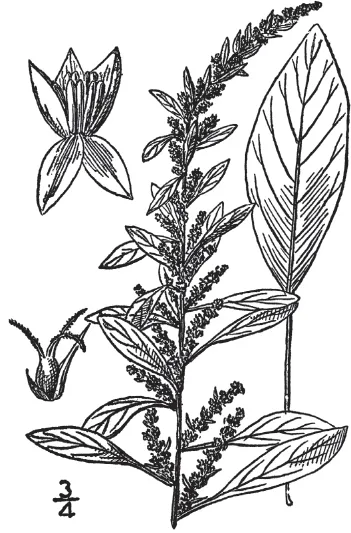
Water hemp (Amaranthus tuberculatus). A supremely invasive species, water hemp has invaded farmlands across North America in recent years. Individual plants can produce as many as 4.8 million seeds, ensuring wherever it lands, Amaranthus tuberculatus is there to stay. credit: © The Board of Trustees of the Royal Botanic Gardens, Kew
THERE ARE PLENTY of tough, bad weeds out there, but none more extreme than water hemp. A recent unwelcome guest in farmland across North America, it has taken root with a vengeance. In just four years, Amaranthus tuberculatus has raced to develop full immunity to RoundUp, leaving farmers very few remaining choices for eradication. Soon, it will be immune to every herbicide available to agriculture.
Even more extreme is the plant's seed production. A single plant can release as many as 4.8 million seeds, barely a millimeter in diameter. They have no tufts to carry them airborne, but the seeds are so plentiful and tiny they get into everything, including farmers' machinery. Giant combines become one of the primary spread mechanisms, along with waterfowl, who eat and then excrete the seeds far and wide. The tiny seeds also travel in flowing water—or they stay put in the soil surrounding the plant, ensuring there is no way the water hemp will ever leave.
The plant serves as an interesting example for our study of seed strategy for our businesses. Because it is an annual, meaning each plant lives and dies in a single-year cycle, it's in a rush to produce massive growth. Rapid evolution is also a part of its plan, allowing it to circumvent farmers' herbicides and other threats.
All of this is served by the plant's massive priority on production of seed. Dandelions produce fifteen thousand seeds throughout their five- to ten-year lifecycle. We have seen them acting aggressively in our lawns, as they spread rapidly thanks to tufted, highly mobile seeds blowing everywhere on the breeze. Now imagine that multiplied by a factor of fifteen hundred to get a sense of the overwhelming cyclone of seeds water hemp unleashes to subdue all competitors and challenges.
I chose the species as the lead to this chapter for a reason: it is an example of seed strategy at its most extreme. And it demonstrates the absolute power of seeds to overwhelm markets, competitors, and any obstacles to growth.
The Salisbury Study
Sir Edward James Salisbury was a prominent British botanist during the twentieth century. The former director of the Kew Royal Botanic Garden from 1943 to 1956, Salisbury was a beloved author of books on plants in the wild and for gardening. He found all aspects of plants fascinating, but had a particular interest in their seeds.
Salisbury was also taken with naturalist Charles Darwin's fascination with weeds, noting they were an example of greatly accelerated evolution. Over a twenty-five-year period, Salisbury studied the output and nature of seeds from 249 plant species, counting and weighing seeds from half a million plants. The work became a celebrated book, The Reproductive Capabilities of Plants, which led to a fascinating study of the mobility of seeds and their strategic effects for certain plants.
His study involved setting up a ten-foot ladder in a stilled room, dropping various seeds, and timing their descent. The assumption was the slower the descent, the greater the range of dispersal. He found buddleia or butterfly bush (Buddleja davidii) seeds, outfitted with tiny helicopter-blade wings, took just five seconds to hit the floor. The seeds of common groundsel (Senecio vulgaris), a close relative to the dandelion, took eight seconds. Coltsfoot (Tussilago fanfare) seeds lofted for twenty-one seconds before hitting the floor. The rosebay willowherb (Chamerion angustifolium) seeds floated in the air for nearly a minute before touching ground.19
Some seeds are meant to travel with the wind, while others hitchhike on or within animals. Birds eat berries and seeds, excreting the intact morsel with a packet of fertilizer throughout their travels. Other seeds attach with sticky filaments or barbed burrs that entangle themselves in fur and feathers as animals pass by. Flowing water can carry seeds for miles while others disperse through explosive action.
Weeds employ ingenious methods and designs to create enormous fields of seed dispersion and rapid expansion of their domains. That is precisely what we need to do for our businesses, too.
Marketing That Spreads
Our mission now is to build a powerful process for growth—our own unique process—in which we can apply the ferocity of the weed mindset in our execution. So far, the weeds have told us to deal with what is and to allow our actions to lead our emotions. They've emphasized that, to win in the field, we must execute with audacity and resilience. And they've been pointing the way toward following our own ferocious process.
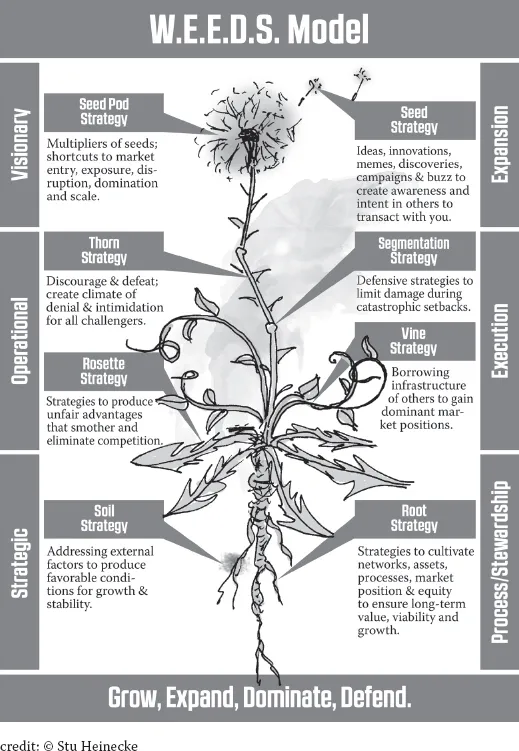
The weeds are blunt and simple in their message. And they continue that here, as we develop the first of eight levels of our process within the W.E.E.D.S. model, seed strategy. Their message:
Spread an overwhelming amount of seeds that bring devastatingly unfair advantages to your business.
In the W.E.E.D.S. model, seeds are anything that creates awareness and intent in others to transact with us. They include products, services, brands, innovations, discoveries, memes, referrals, social and traditional media buzz, reputations, social movements, ideas, concepts, designs, word of mouth, articles, speeches, books, marketing, natural or recurring events, proposals, fascinations, stories, timing, free trials, gifts, interviews, thought leadership, experiences, market upsets, viral content, evangelism, insights, e-commerce, tracking pixels, philanthropy, relationships, sales calls, customer buzz and reviews, podcasts and blogs, names and domains, and courses.
Most of what passes as marketing and sales activity is bland and uninspiring. We see sales reps using automated connection requests and email sequences that are utterly out of touch with the humanity of the people they're trying to reach. Most advertising falls far short of inspiring any of us to take any action. It's just unwelcome background noise that brings zero value to anyone's life.
If weeds were marketers, they would be pushing us to do far, far better. They would tell us to be audacious and offer insightful value in every customer- and market-facing thing we do. They would tell us to reach levels of fascination that none of our competitors can match. That is what gets people talking and thinking and ready to act. That is what gets people excited about who you are and what you have to offer. That is what produces marketing that spreads.
Giving Our Seeds Wings
If we follow the example of weeds, what, in our world, corresponds to the wings weeds give their seeds? What adds special purpose or a more compelling nature to our stories, ideas, products, sales calls, innovations, and more? How do we avoid producing seeds that simply fall to the ground, creating no spread in our marketplace?
Think about the best stories, innovations, products, gifts, free trials, and other marketing seeds you've ever encountered. What made them stand out? Which stories or products have inspired you to bring them up in conversation? There are three critical attributes that cause people to react to marketing stimuli: audacity, fascination, and insight. If a concept, or an article, or an event contains any of the three, it gets our attention. If it contains two or three of those elements, people can't help but continually talk about it.
Fortunately, I've seen a lot of this in action. I've even written books about it and was named the father of a marketing form (contact marketing) that uses all three to great effect. Contact marketing uses micro-focused campaigns to create contact at the highest levels of the companies that can change our scale. The campaigns are certainly audacious. One involved placing a full-page ad in The Wall Street Journal, at a cost of $10,000, to reach Oracle founder Larry Ellison. It resulted in a $350 million sale and a 3.5 million percent ROI. Another used a $28 Facebook ad to connect with the right buyer at Walmart headquarters. It produced a $20 million result and a 69,500,000 percent ROI.
Audacity shows courage. It draws people to us. Delivering compelling and useful insight has the same effect. If people learn something just by interacting with us, we become a valuable and trusted resource, someone people are always willing to follow and engage.
Fascinations are also powerful magnets that draw people to us. In my contact campaigns, I often use my cartoons. I'm one of The Wall Street Journal cartoonists and have used cartoons in marketing throughout my career, so I use them well. Assuming I've hit the target with the cartoon, recipients keep them for years, perhaps the rest of their careers. Combining audacity with the cartoons, I often deliver them as giant foam boards, featuring a cartoon about the recipient and messaging on the rear panel pushing for a critically important meeting.
Others use visual metaphors. Turnaround specialist and top sales blogger Dan Waldschmidt sends thousand-dollar swords to CEOs of companies that have just missed earning estimates. The sword comes with a handwritten note explaining, “Business is war and I noticed you lost a battle recently. If you ever need a few extra hands in battle, we've got your back.” So far, he's getting a 100 percent response to the campaign, generating multiple assignments worth a million dollars or more apiece.
Waldschmidt's swords generate weed-like growth by delivering on the promise of audacity, fascination, and insight. Ditto for the outreach campaigns to Ellison and Walmart. There is an irresistibility to the campaigns, but also to the people behind them. In all three cases, the marketers behind the campaigns simply could have asked for meetings, but those requests would have fallen straight to the ground. Adding wings drastically lifted the spread and effect of their seeds.
My Own Seed Strategy in Action
In the following sections, I share many examples of seed strategy in action. But let's start by examining how it's applied to the marketing of this book.
This is a book about growth strategy as inspired by weeds, but it's also a startup business. To succeed, it must quickly build a recognized brand around the world, and it is in a critical race to generate sales. And like any business using weed strategy to grow, it has some pretty fascinating, unfair advantages built in.
The first of those is the weeds themselves. Weeds are despised around the world, but also admired for their capacity to spread and grow. I believe this casts weeds as the reluctant hero, the archetype that drives many stories. We are programmed to react to characters who start in a tough spot but ultimately triumph. Weeds have that part nailed.
Because of its theme, the early spring release date is significant, timed to coincide with the release of weeds themselves, all over the Northern Hemisphere. The idea is to have all of the weeds in the world act as memes for the book. I want people to notice weeds showing up in their yards and suddenly realize, “Oh yeah, but there's that book . . .” And if that works, I hope to see it renew every year, like Christmas music, suddenly popular again when the right time of year arrives.
It's audacious and ties to our fascination with how weeds grow and spread. And it offers obvious insight and value, because we all want our businesses to grow like weeds.
As we move through the W.E.E.D.S. model in this section, I will explain more about how weed strategy has been applied to the book. But now, let's take a look at how others have given their seeds wings, and applied utterly unfair advantages to their customer/market-facing activities.
Stories: The Ultimate Seeds
The movie industry thrives by telling stories, but really, all businesses blossom by telling their stories, too. And the more their stories read like a Hollywood blockbuster, the more likely we are to engage. Most screenplays start with an unlikely hero setting out on a perilous journey to achieve an impossible goal. Setbacks ensue, and the goal seems even more out of reach. B...