
eBook - ePub
Management and Supervision for Working Professionals, Third Edition, Volume II
- 272 pages
- English
- ePUB (mobile friendly)
- Available on iOS & Android
eBook - ePub
Management and Supervision for Working Professionals, Third Edition, Volume II
About this book
The practical set of methods and tools contained in the two volumes of Management and Supervision for Working Professionals provides the reader with the knowledge and means to become an effective manager or supervisor. Volume I emphasizes organizational structure, planning, and leadership, while Volume II emphasizes communication, instruction, and daily management responsibilities such as performance ratings, unions, and health and safety.
LESSON 1
COMMUNICATIONS PART I
UPWARD, DOWNWARD, AND SIDEWARD - ARE YOU LISTENING?
Learning Objectives
Fundamental Management Information
Lesson Discussion
I. | The Communication Process |
II. | One-Way Versus Two-Way Communication |
III. | Human Barriers to Communications |
IV. | Downward Communications Systems |
V. | Upward Communications Systems |
VI. | Horizontal Communications Systems |
VII. | Communication Problems |
VIII. | Grapevines |
IX. | Types of Communications |
X. | The Art of Speaking |
XI. | The Art of Listening and Perceiving |
XII. | Building your Communications Skills |
XIII. | Communication Difficulties |
XIV. | Public Policy and Community Relations |
XV. | Summary |
Case Problems
Practical Exercises
Self-Testing Examination
Answers to Self-Testing Examination
Answers to Case Problems
LEARNING OBJECTIVES
When you have successfully completed this lesson, you should:
- Understand how the communication process works.
- Recognize the importance of the concept of one-way versus two-way communications and why two-way communications are necessary.
- Recognize the many human barriers to communication and how to avoid them.
- Understand that communications go upward, downward, and in a horizontal manner and know the types of communications that go in these directions.
- Recognize the variety of communications problems that exist and know how to compensate for them.
- Recognize that a grapevine will exist in the organization and what it is to continually provide proper information if grapevine problems are to be avoided.
- Understand the art of oral communications and the techniques of speaking, listening, and perceiving.
FUNDAMENTAL MANAGEMENT INFORMATION
Influencing people through appropriate communications is the process of guiding their activities to achieve the goals and objectives of the organization. Influencing people includes leading, motivating, and controlling groups and individuals. Communication is the process of sharing information with others to achieve a desirable result. The manager must understand the communications process, the role of feedback, and the importance of verbal versus nonverbal communications. The individual speaks or writes, the other person or persons receive the message, the receiver perceives what is said, and some positive action is taken. This occurs in a positive communications process. In a negative communications process the message is received, but is misinterpreted and a negative or non-response is the result of the original communication.
Barriers to communication include: (1) Too little information to carry out the prescribed tasks; (2) Information overload; (3) Too complex information; (4) Inadequate technical or people-type training for the communicator; (5) Lack of understanding of someone else’s culture; (6) Lack of knowledge of the audience; (7) Environmental problems interfering with the communication; (8) Use of ambiguous or multi-meaning words.
Feedback can be either verbal or nonverbal. Verbal feedback can be requested. Nonverbal feedback can be determined by observing facial questions, gestures, body motions, looking at the eyes and seeing if they are glazed, averted, or attentive.
Selectivity is a means of screening communications to accept or reject that which is of importance to the receiver. Selectivity can become a serious barrier to communications.
Perception of a message is the process by which an individual gives meaning to the communication. Perceptual defense is the screening out of environmental stimuli in order to concentrate on what is important. Constant oral and visual stimuli can overwhelm you and affect the appropriate perception of the message. Some individuals have a specific set of ideas established in advance. If the message does not fit within these boundaries, the message is rejected. Further, a conclusion may be based on incomplete, hastily gathered information. If the communication is incomplete the individual may erroneously fill in the blanks and react in an inappropriate manner. The individual may interpret the message improperly because of a highly specialized and restrictive perspective.
The difference between ineffective and effective communications in an organization may be based on its structure, the grapevine, the verbal and nonverbal communications, and the level of upward, downward, and sideward communications. Organizational communications are carried out through: (1) Advertising and promotional campaigns; (2) Employee communications; (3) Media relations; (4) Training programs; (5) Public relations; (6) Governmental relations; (7) The grapevine.
Organizations can enhance upward communications by:
- Using employee attitude and opinion attitude surveys.
- Using suggestion boxes.
- Using the open-door policy of management.
- Using informal gripe sessions.
- Using task forces to evaluate problems and programs.
- Using exit interviews.
The good communicator is of necessity a good listener. This type of person will allow others to formulate ideas without interruption, ask stimulating questions, encourage all to participate, be a sympathetic listener, avoid premature judgments, and then briefly summarize the individual’s thoughts and give credit when the ideas are good.
LESSON DISCUSSION
I. THE COMMUNICATIONS PROCESS
Communication is basic to existence. Communication consists of the ways in which we express ourselves to other individuals and the techniques used to understand this expression. The first line supervisor must be able to communicate effectively in order to lead people and to achieve the necessary objectives of both the individuals and the organization. The effectiveness of a supervisor will depend largely upon his/her ability to interpret and relay information from a higher level in the organization to the working force and also relay the problems of the working force to the higher levels. The first line supervisor must be clearly understood - whether - the supervisor uses written or spoken words, or body language. The supervisor is the medium whereby information moves from management to workers and then is used. The supervisor, besides being a good communicator, must also recognize the various barriers to communication and be able to remove them when necessary.
In order to avoid frustration, misunderstanding, and trouble, the supervisor must know what needs to be said, understand what the individual is willing to hear, and use the right method for a positive response to the communication. The supervisor must accept the fact that not all communication are clearly understood. Many communications are open to personal interpretation. Communications must be clearly expressed in a simple and straightforward manner. The feedback which is received from workers will help the supervisor in determining the best way to communicate.
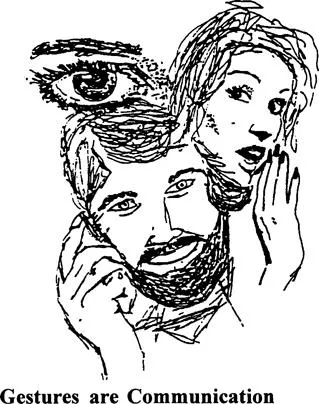
Communication consists of gestures, spoken words, and written words as well as the emotional or conscious state of the sender, receiver, or listener. The gestures, which are made up of facial expression, physical actions, and other nonverbal signs, can change the entire meaning of a communication. When a student answers a question, but seems to be off in another world, he or she is really saying, “I’m only paying partial attention to you and the rest of my concern is elsewhere.” When a parent says something to a child and says it with a smile, the child understands love. When a parent says something to a child and exhibits anger, the child has an entirely different feeling. The color combinations used in the communication and the types of material used can also affect how the communication is received. The spoken and written word will be described more fully in another portion of this lesson and the following lesson. The emotional state of the communicator is also important because if the communicator is calm the message is more likely to be received calmly. Whereas if the message is an excited one the listener will recognize the excitement. The emotional state of the receiver must likewise be considered. The listener may hear somethin...
Table of contents
- Cover
- Title Page
- Copyright Page
- About the Author
- Introduction
- Table of Contents
- Lesson 1 Communications Part I Upward, Downward, and Sideward - Are You Listening?
- Lesson 2 Communications Part II Meetings, Memorandums, Business Letters, and Reports
- Lesson 3 The Supervisor as a Teacher
- Lesson 4 Disciplinary Action, Complaints, and Grievances
- Lesson 5 A Supervisor’s Problem Cases
- Lesson 6 Performance Ratings
- Lesson 7 The Supervisor and Civil Rights
- Lesson 8 The Supervisor and the Union
- Lesson 9 The Supervisor’s Role in Health and Safety
- Index
Trusted by 375,005 students
Access to over 1.5 million titles for a fair monthly price.
Study more efficiently using our study tools.
Frequently asked questions
Yes, you can cancel anytime from the Subscription tab in your account settings on the Perlego website. Your subscription will stay active until the end of your current billing period. Learn how to cancel your subscription
No, books cannot be downloaded as external files, such as PDFs, for use outside of Perlego. However, you can download books within the Perlego app for offline reading on mobile or tablet. Learn how to download books offline
Perlego offers two plans: Essential and Complete
- Essential is ideal for learners and professionals who enjoy exploring a wide range of subjects. Access the Essential Library with 800,000+ trusted titles and best-sellers across business, personal growth, and the humanities. Includes unlimited reading time and Standard Read Aloud voice.
- Complete: Perfect for advanced learners and researchers needing full, unrestricted access. Unlock 1.5M+ books across hundreds of subjects, including academic and specialized titles. The Complete Plan also includes advanced features like Premium Read Aloud and Research Assistant.
We are an online textbook subscription service, where you can get access to an entire online library for less than the price of a single book per month. With over 1.5 million books across 990+ topics, we’ve got you covered! Learn about our mission
Look out for the read-aloud symbol on your next book to see if you can listen to it. The read-aloud tool reads text aloud for you, highlighting the text as it is being read. You can pause it, speed it up and slow it down. Learn more about Read Aloud
Yes! You can use the Perlego app on both iOS and Android devices to read anytime, anywhere — even offline. Perfect for commutes or when you’re on the go.
Please note we cannot support devices running on iOS 13 and Android 7 or earlier. Learn more about using the app
Please note we cannot support devices running on iOS 13 and Android 7 or earlier. Learn more about using the app
Yes, you can access Management and Supervision for Working Professionals, Third Edition, Volume II by Herman Koren in PDF and/or ePUB format, as well as other popular books in Business & Human Resource Management. We have over 1.5 million books available in our catalogue for you to explore.