This book vividly illustrates all the promising and potential machine learning (ML) and deep learning (DL) algorithms through a host of real-world and real-time business use cases. Machines and devices can be empowered to self-learn and exhibit intelligent behavior. Also, Big Data combined with real-time and runtime data can lead to personalized, prognostic, predictive, and prescriptive insights. This book examines the following topics:
Cognitive machines and devices
Cyber physical systems (CPS)
The Internet of Things (IoT) and industrial use cases
Industry 4.0 for smarter manufacturing
Predictive and prescriptive insights for smarter systems
Machine vision and intelligence
Natural interfaces
K-means clustering algorithm
Support vector machine (SVM) algorithm
A priori algorithms
Linear and logistic regression
Applied Learning Algorithms for Intelligent IoT clearly articulates ML and DL algorithms that can be used to unearth predictive and prescriptive insights out of Big Data. Transforming raw data into information and relevant knowledge is gaining prominence with the availability of data processing and mining, analytics algorithms, platforms, frameworks, and other accelerators discussed in the book. Now, with the emergence of machine learning algorithms, the field of data analytics is bound to reach new heights.
This book will serve as a comprehensive guide for AI researchers, faculty members, and IT professionals. Every chapter will discuss one ML algorithm, its origin, challenges, and benefits, as well as a sample industry use case for explaining the algorithm in detail. The book's detailed and deeper dive into ML and DL algorithms using a practical use case can foster innovative research.
1Research Scholar, SRM Institute of Science and Technology, Kattankulathur, Tamil Nadu, India
2SRM Institute of Science and Technology, Kattankulathur, Tamil Nadu, India
DOI: 10.1201/9781003119838-1
Contents
Introduction
Convolutional Neural Network (CNN)
Distinctive Properties of CNN
Activation Functions for CNN
Loss Function
Datasets and Errors
Bias and Variance
Overfitting and Underfitting
Understanding Padding and Stride
Padding
Stride
Parameters and Hyper Parameters
CONV Layer
Filter
Feature Map
Convolution Operation
Key Points about Convolution Layers and Filters
Pooling Layer
Key Points about Pooling Layer
Types of Pooling
Forward Propagation
Calculating the Parameters
Activation Shape and Size
Backward Propagation
Optimizers
Other Ways to Improve the Performance of CNN
Image Data Augmentation
Deeper Hidden Layers
Early Stopping
Application of CNN
Image Classification
RCNN and Object Detection
Region-Based Convolutional Neural Network (R-CNN)
Fast R-CNN
Faster R-CNN
You Only Look Once (YOLO)
Transfer Learning
Transfer Learning for CNN
Fine-Tuning or Freezing?
Neural Style Transfer (NST)
Introduction
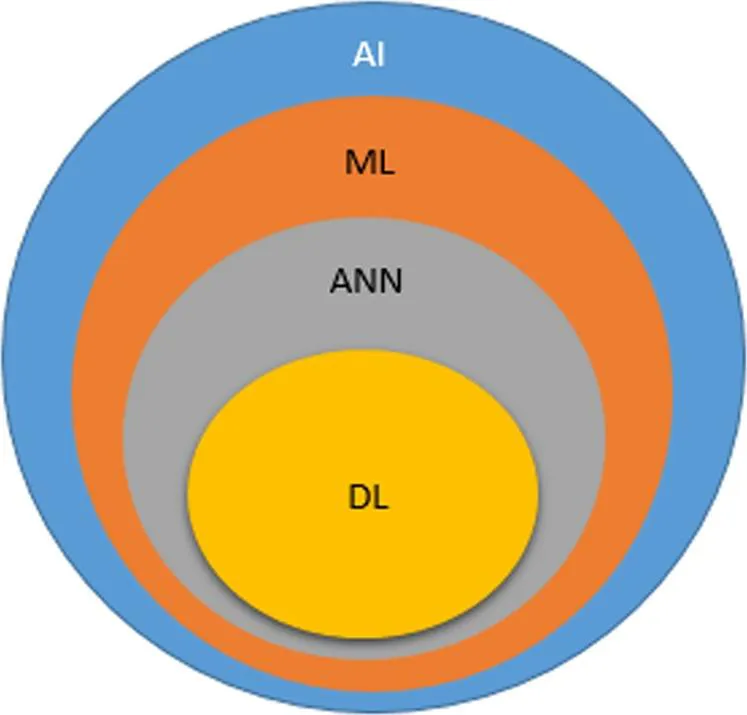
Emergence of artificial intelligence (AI) has made machines “Smart.” By “Smart,” we mean the ability of the machine (possibly a computer) to process the given data with rationality, like an intelligent human being, and take a suitable decision. AI achieves this intelligence with the help of its subsets of algorithms (see Figure 1.1).
Figure1.1 Subsets of Artificial Intelligence
AI is a broader field that includes machine learning (ML), artificial neural network (ANN), and deep learning (DL) as its subsets. AI is achieved by ANN, which is a network of artificial neurons resembling a biological neuron and the nervous system. ML enables the machines to process the data, make decision, and optimize the results based on experience. ML primarily requires a feature engineer to do the feature engineering process. Also, ML works its best for structured dataset (mostly comprises numerical data) but is proven inefficient for unstructured types.
To process the unstructured and continuous data like video, speech, etc., we need more complex neural network. Here comes in the DL with better results on processing the unstructured data. One of the biggest advantages of DL is that it features engineering automatically, that is, no manual feature selection is required. Also, ML requires manual intervention when the algorithm is struck with optimization problem, which is also automated in DL. DL plays the key role in implementing and visualizing the actual AI. Deep learning, however, requires a large amount of dataset for the purpose of training, which in turn requires a deep network of layers of neurons to process the features and hence the name “deep learning.”
DL comprises many algorithms for different types of data. Of those, convolutional neural network (CNN) is mainly used to process images and solve computer vision problems. The idea of CNNs can be traced back to 1980, when K. Fakushima proposed “neocognition” – a hierarchical multi-layered neural networks, which is self-organized and unaffected by the translation operation in the dataset (shift in positions of patterns). It was primarily created for pattern recognition.
The first standard CONVNet was introduced by Yann LeCunn in 1998, in his research article titled “Object Recognition with Gradient Based Learning.” It is important to note that Yann LeCunn has cited Fakushima’s article in his research work, and the CONVNet of LeCunn has a structure similar to neocognition with back propagation added to the network. Thenceforth, multiple improvements and the extension were made to it.
Convolutional Neural Network (CNN)
Convolutional neural network is primarily used for operations like image classification, segmentation, and other computer vision operations. CNN is also called shape/space invariant artificial neural network (SIAAN) based on its shared weights and translation invariance properties. The key idea behind CNN is to capture the local patterns through convolution operation.
In general, each CNN architecture has a common working flow. A CNN consists of multiple layers of convolution and pooling and a fully connected ANN. A layer in CNN may comprise one convolution layer and one pooling layer together as a single layer if the count of convolution layer and pooling layer is same. Most commonly used type is two convolution layers followed by a single pooling layer.
The number of layers in a CNN architecture depends on the complexity of the application. The output of the last layer is passed to an ANN. The convolution layers and the pooling layers always perform the same operation of learning the input image. The fully connected networks perform the required operations, such as regression, classification, etc.
At each convolution layer, a local pattern is obtained by applying filters throughout the image. Filters can also be mentioned as kernels. The Initial/lower-level layers of the CNN obtain the elementary pattern of the image ...
Table of contents
Cover
Half Title
Title Page
Copyright Page
Contents
Contributor List
Chapter 1: Convolutional Neural Network in Computer Vision
Chapter 2: Trends and Transition in the Machine Learning (ML) Space
Chapter 3: Next-Generation IoT Use Cases across Industry Verticals Using Machine Learning Algorithms
Chapter 4: A Panoramic View of Cyber Attack Detection and Prevention Using Machine Learning and Deep Learning Approaches
Chapter 5: Regression Algorithms in Machine Learning
Chapter 6: Machine Learning-Based Industrial Internet of Things (IIoT) and Its Applications
Chapter 7: Employee Turnover Prediction Using Single Voting Model
Chapter 8: A Novel Implementation of Sentiment Analysis Toward Data Science
Chapter 9: Conspectus of k-Means Clustering Algorithm
Chapter 10: Systematic Approach to Deal with Internal Fragmentation and Enhancing Memory Space during COVID-19
Chapter 11: IoT Automated Spy Drone to Detect and Alert Illegal Drug Plants for Law Enforcement
Chapter 12: Expounding k-Means-Inspired Network Partitioning Algorithm for SDN Controller Placement
Chapter 13: An Intelligent Deep Learning-Based Wireless Underground Sensor System for IoT-Based Agricultural Application
Chapter 14: Predicting Effectiveness of Solar Pond Heat Exchanger with LTES Containing CuO Nanoparticle Using Machine Learning
Index
Trusted by 375,005 students
Access to over 1.5 million titles for a fair monthly price.
Study more efficiently using our study tools.
Frequently asked questions
Yes, you can cancel anytime from the Subscription tab in your account settings on the Perlego website. Your subscription will stay active until the end of your current billing period. Learn how to cancel your subscription
No, books cannot be downloaded as external files, such as PDFs, for use outside of Perlego. However, you can download books within the Perlego app for offline reading on mobile or tablet. Learn how to download books offline
Perlego offers two plans: Essential and Complete
Essential is ideal for learners and professionals who enjoy exploring a wide range of subjects. Access the Essential Library with 800,000+ trusted titles and best-sellers across business, personal growth, and the humanities. Includes unlimited reading time and Standard Read Aloud voice.
Complete: Perfect for advanced learners and researchers needing full, unrestricted access. Unlock 1.5M+ books across hundreds of subjects, including academic and specialized titles. The Complete Plan also includes advanced features like Premium Read Aloud and Research Assistant.
Both plans are available with monthly, semester, or annual billing cycles.
We are an online textbook subscription service, where you can get access to an entire online library for less than the price of a single book per month. With over 1.5 million books across 990+ topics, we’ve got you covered! Learn about our mission
Look out for the read-aloud symbol on your next book to see if you can listen to it. The read-aloud tool reads text aloud for you, highlighting the text as it is being read. You can pause it, speed it up and slow it down. Learn more about Read Aloud
Yes! You can use the Perlego app on both iOS and Android devices to read anytime, anywhere — even offline. Perfect for commutes or when you’re on the go. Please note we cannot support devices running on iOS 13 and Android 7 or earlier. Learn more about using the app
Yes, you can access Applied Learning Algorithms for Intelligent IoT by Pethuru Raj Chelliah, Usha Sakthivel, Susila Nagarajan, Pethuru Raj Chelliah,Usha Sakthivel,Susila Nagarajan in PDF and/or ePUB format, as well as other popular books in Computer Science & Artificial Intelligence (AI) & Semantics. We have over 1.5 million books available in our catalogue for you to explore.