eBook - ePub
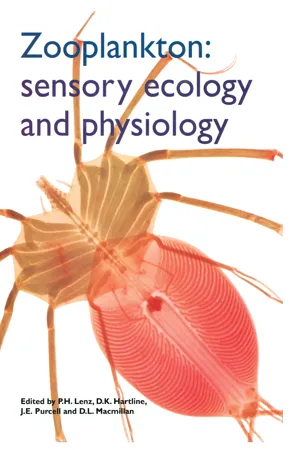
Zooplankton
Sensory Ecology and Physiology
- 570 pages
- English
- ePUB (mobile friendly)
- Available on iOS & Android
eBook - ePub
Zooplankton
Sensory Ecology and Physiology
About this book
Zooplankton is a major work of reference for researchers in plankton biology, physiology and behavior, which combines behavioral and psychological approaches to the study of plankton on present and interdisciplinary investigation of sensory processes in pelagic environments. The breadth of perspective thus achieved provides valuable insights into the larger scale ecological processes of biological productivity, community structure and population dynamics.
Technological advances in almost all aspects of biological research have opened up opportunities for a re-examination of the sensory ecology of planktonic organisms. In this wide-ranging collection, leading researchers in planktonic behavior and physiology address the rapidly developing interface between these two major areas. The studies presented range from the laboratory to the field and from the cell to the whole organism, but share the common goal of understanding the special sensory world of organisms that live in pelagic environments and how their behavior and physiology relate to it.
Information
CHEMOSENSORY PHENOMENA DURING SEXUAL INTERACTIONS IN GELATINOUS ZOOPLANKTON
RICHARD L. MILLER
Department of Biology, Temple University, Philadelphia, PA 19122
Gelatinous zooplankton reproduce in an environment inimical to fertilization success because of the high potential for gamete dilution and the often wide dispersion of reproductive adults. Organisms in this group that shed sperm externally but fertilize internally face additional barriers to high fertilization success. Special reproductive adaptations probably exist to counter this problem. However, most of the inferences made about fertilization success in marine organisms are based on results using benthic species, gelatinous zooplankton being very difficult to capture and maintain in sexual condition. As a result, very little has been done to determine what sort of adaptations to enhance fertilization rates exist in gelatinous species. Furthermore, there is little direct evidence supporting mutual approach of the sexes that would bring the ripe gametes closer together. Close approach may be accomplished by a number of physical agencies, however, and possibly by gamete adaptations such as long-lived sperm or special egg investments which trap sperm. Chance contact chemoreception (which leads to mutual spawning, sperm transfer during psuedocopulation, or true copulation) coordinates reproductive behavior in some species. Free-spawned gametes may be mixed and more widely dispersed as the result of active spawning behaviors which are temporally coordinated by environmental factors such as light and temperature. Sperm chemotaxis has been described in gelatinous zooplankton, though its effect on fertilization rates is, at present, unknown. Except for sperm behavior in response to egg or tissue-associated factors, other chemosensory interactions or adaptations that might increase fertilization rates in gelatinous zooplankton have yet to be described.
INTRODUCTION
Investigation of fertilization success in benthic, free spawning organisms (both eggs and sperm shed directly into the sea before fertilization), has progressed considerably since the initial study by Pennington (1985) using sea urchins. Study of this topic in free spawning planktonic organisms, particularly in gelatinous members of the zooplankton, where wide dispersal of free spawning individuals is common, is considerably less advanced. In general, environmental stimuli that coordinate spawning act directly on the adults or reproductive tissues (Yoshida, et al., 1980) in many species, but other factors that might improve fertilization success are, at best, p...
Table of contents
- Cover
- Half Title
- Title Page
- Copyright Page
- Table of Contents
- Introduction
- Neuroethology of Zooplankton
- Predation, cover, and convergent evolution in epipelagic oceans
- Chemosensory ecology of oyster larvae: benthic-pelagic coupling
- The teleost octavolateralis system: structure and function
- Integration of hydrodynamic information in the hindbrain of fishes
- Dynamic response properties of broad spectrum olfactory interneurons in the crayfish midbrain
- Small-scale fluid dynamics of olfactory antennae
- Visualization and quantitative analysis of biological flow fields using suspended particles
- Active marine predators: the sensory world of cephalopods
- Eye design, vision and invisibility in planktonic invertebrates
- Physiological mechanisms in the control of bioluminescent countershading in a midwater shrimp
- New observations on the bioluminescence of the pelagic shrimp, Sergia lucens (Hansen, 1922)
- UV light in the deep sea: in situ measurements of downwelling irradiance in relation to the visual threshold sensitivity of UV-sensitive crustaceans
- Ultraviolet visual sensitivity in the larvae of two species of marine atherinid fishes
- Compound eyes and ocular pigments of crustacean larvae (Stomatopoda and Decapoda, Brachyura)
- Sensory physiology and behaviour of blue crab (Callinectes sapidus) postlarvae during horizontal transport
- Neural development in the planktonic and early benthic stages of the palinurid lobster Jasus edwardsii
- Sensory potential and feeding in rotifers: structural and behavioral aspects of diet selection in ciliated zooplankton
- Characteristics of mate-recognition pheromone in Brachionus plicatilis (Rotifera)
- Lectin binding to surface glycoproteins on Coullana spp. (Copepoda: Harpacticoida) can inhibit mate guarding
- Mating behaviour of Dioithona oculata in swarms
- The role of photoreception in the swarming behavior of the copepod Dioithona oculata
- Effects of sediment loading on food perception and ingestion by freshwater copepods
- The escape behavior of Pleuromamma xiphias in response to a quantifiable fluid mechanical disturbance
- Physiological and behavioral studies of escape responses in calanoid copepods
- Sensory specialization along the first antenna of a calanoid copepod, Pleuromamma xiphias (Crustacea)
- Optimal swimming behavior of Zooplankton
- Food search and swimming speed in Daphnia
- Migrating Daphnia have a memory for fish kairomones
- Swimming of Daphnia galeata x hyalina in response to changing light intensities: influence of food availability and predator kairomone
- On the trait-specificity of the response of Daphnia genotypes to the chemical presence of a predator
- A behavioral bioassay employing Daphnia for detection of sublethal effects: response to polarized light
- Virtual plankton: a novel approach to the investigation of aquatic predator-prey interactions
- Defensive strategies in planktonic coelenterates
- Electrical responses to water-soluble components of fish mucus recorded from the cnidocytes of a fish predator, Physalia physalis
- A mechanism for fatigue of epithelial action potentials in the hydromedusa, Polyorchis penicillatus: a case of non-neuronal habituation
- Sensory ecology of scyphomedusae
- Behavioural response of the scyphozoan jellyfish Aurelia aurita (L.) upon contact with the predatory jellyfish Cyanea capillata (L.)
- Observations on the anatomy and behaviour of the cubozoan Carybdea rastonii Haacke
- Field behavior of Tripedalia cystophora (Class Cubozoa)
- Unconventional signalling in tunicates
- Morphology of wing mechanoreceptors involved in the wing retraction reflex in the pteropod mollusc Clione limacina
- Sensory ecology of salps (Tunicata,Thaliacea): more questions than answers
- Chemosensory phenomena during sexual interactions in gelatinous zooplankton
Trusted by 375,005 students
Access to over 1.5 million titles for a fair monthly price.
Study more efficiently using our study tools.
Frequently asked questions
Yes, you can cancel anytime from the Subscription tab in your account settings on the Perlego website. Your subscription will stay active until the end of your current billing period. Learn how to cancel your subscription
No, books cannot be downloaded as external files, such as PDFs, for use outside of Perlego. However, you can download books within the Perlego app for offline reading on mobile or tablet. Learn how to download books offline
Perlego offers two plans: Essential and Complete
- Essential is ideal for learners and professionals who enjoy exploring a wide range of subjects. Access the Essential Library with 800,000+ trusted titles and best-sellers across business, personal growth, and the humanities. Includes unlimited reading time and Standard Read Aloud voice.
- Complete: Perfect for advanced learners and researchers needing full, unrestricted access. Unlock 1.5M+ books across hundreds of subjects, including academic and specialized titles. The Complete Plan also includes advanced features like Premium Read Aloud and Research Assistant.
We are an online textbook subscription service, where you can get access to an entire online library for less than the price of a single book per month. With over 1.5 million books across 990+ topics, we’ve got you covered! Learn about our mission
Look out for the read-aloud symbol on your next book to see if you can listen to it. The read-aloud tool reads text aloud for you, highlighting the text as it is being read. You can pause it, speed it up and slow it down. Learn more about Read Aloud
Yes! You can use the Perlego app on both iOS and Android devices to read anytime, anywhere — even offline. Perfect for commutes or when you’re on the go.
Please note we cannot support devices running on iOS 13 and Android 7 or earlier. Learn more about using the app
Please note we cannot support devices running on iOS 13 and Android 7 or earlier. Learn more about using the app
Yes, you can access Zooplankton by Petra. H. Lenz, Petra. H. Lenz,P Lenz,D K Hartline,J Purcell,D Macmillian in PDF and/or ePUB format, as well as other popular books in Biowissenschaften & Ökologie. We have over 1.5 million books available in our catalogue for you to explore.