This chapter provides an introduction to supply chain planning concepts. Using the APICS Supply Chain Operation Reference (SCOR) model, we will walk you through the business process decomposition within the demand and supply planning business process.
1Introduction to Supply Chain Planning
SAP Supply Chain Management (SAP SCM) uses a functionality call supply chain planning (SCP), which helps businesses balance supply and demand. Businesses choose to implement SCP primarily because of the market volatility in an extended supply chain environment, where the supply chain extends beyond the company’s walls and toward customers and suppliers. This, in turn, requires organizations to not only effectively plan their resources internally, but also to collaborate with external business partners in order to proactively react to any market supply chain situations that may arise. In today’s global economy, companies differentiate their operating models by integrating and coordinating with their internal and external business partners to fulfill customer demands.
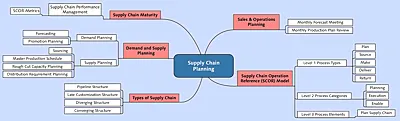
In this chapter, we will walk through five distinct topics related to SCP (see Figure 1.1). First, we will discuss the sales and operations planning process, then explain how the SCOR model supports the SCP process. Next, we will discuss different types of supply chains in the context of a fictitious company, ABC Technology, before breaking down the processes for demand and supply planning. We’ll end the chapter with a brief overview on supply chain maturity.
Figure 1.1Learning Points for the Chapter (Mind Map)
To better understand what SCP is, and how it works, we need to break down the concepts we’ll use a little more. A supply chain refers to an integrated system that synchronizes a series of interrelated business processes in order to accomplish the following:
-
Procure raw materials
-
Transform these raw materials into finished products
-
Add value to the finished products
-
Promote and distribute finished products to customers
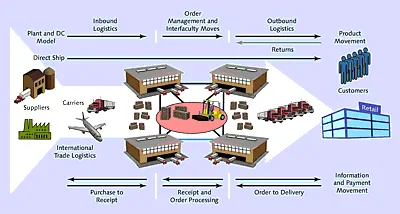
The main objectives of a supply chain are to enhance operational efficiency, increase profitability, and improve on its competitive position in the marketplace. Typically, a supply chain consists of multiple end-to-end business processes, as shown in Figure 1.2:
-
Inbound logistics
Supports the procurement of raw materials from a supplier, internal control of the production process, and warehouse storage. This process is also called purchase-to-receipt, where products are brought from suppliers for further manufacturing processes or distribution.
-
Order management and interfaculty movements
Consists of capturing customer orders and fulfillment. The process may require transfers of inventory within the network to meet customer orders. This process is also called order-to-cash, which begins with order capture and ends with customer billing.
-
Outbound logistics
Relates to the physical distribution of outbound logistics activities, which includes customer order, receipt and processing, inventory deployment, storage and handling, and order consolidation. This process can also form part of order-to-delivery, with a primary focus on transportation.
Combining these business processes, the supply chain consists of a web of network and business relationships among partners. Successful integration of an entire supply chain depends heavily on proper SCP and execution of business processes. The following looks at both:
-
Supply chain planning (SCP)
SCP consists of predicting future requirements to balance supply and market demands.
-
Supply chain execution (SCE)
SCE is the flow of tasks involved in the supply chain, such as order fulfillment, procurement, warehousing, and transporting. Since this book focuses on SCP, we will only discuss the SCE integration points further on, in relevant chapters and sections.
Figure 1.2Company’s Supply Chain: Physical Goods and Information Flows
This chapter looks at the demand and supply software components that constitute supply chain planning and provide a planning framework using the SCOR model. We will also highlight the importance of the sales and operation planning process and of supply chain performance management (SCPM) for an organization to progress in the supply chain maturity curve. We’ll lay a theoretical foundational background on supply chain planning concepts before introducing you to the SAP Advanced Planning and Optimization (APO) component.
Terminology
Please note that the terminology we use in this chapter primarily relates to the industry terms in general, and not necessarily a specific SAP application unless otherwise indicated.
It’s important to understand that SCP is a cross-functional effort in an organization where sales, marketing, finance, and operations collaborate towards a consensus-based demand and supply plan. Grasping this concept will help you better understand the different types of supply chains that exist, and why each has its own unique needs. This collaborative planning process within an organization is called sales and operations planning, which we’ll explain in the next section.
1.1Sales and Operations Planning
In general, sales and operations planning is a monthly business process that enables a company to determine the one plan that will allow the organization to meet its operational, sales, and financial goals. The sales and operations planning process is typically the responsibility of a specific sales and operations planning team, which includes the company’s decision makers and line managers in marketing, sales, finance, operations, and customer service.
The sales and operations planning process enables the company to effectively manage its customers’ demand within the company’s operational capacity. Sales and operations planning generates a uniform and agreed-upon set of numbers used to drive the business. It specifically integrates strategic, tactical, and operational planning.
Sales and Operations Planning Horizons
A com...