Travel and expense are usually not considered core processes, but they still consume significant resources in time and money for most organizations. Traditional solutions are characterized by low levels of efficiency, effectiveness, and user satisfaction, so let’s explore how Concur can serve modern organizations better.
1 Introducing Concur Travel and Expense
Before we get into the nitty gritty of processes and Concur configuration, we want to use this chapter to explore why implementing or optimizing Concur makes good business sense and to provide a high-level overview of Concur’s travel & expense (T&E) processes. We’ll start with the usually less than ideal current state in most organizations, then build a compelling vision for the future, provide a teaser of Concur’s functionality, and eventually present a framework for building a business case for Concur.
1.1 Typical Issues and Constraints of T&E Processes
When was the last time you heard an employee in your organization say this? “I love doing my expenses. It’s a quick and easy process.” When was the last time your CFO or finance director was satisfied with the level of expenses and the efficiency of processing them? If the answer to either of these questions is “I can’t remember,” then this book is for you.
The bulk of businesses and public and charity sector organizations today are using last-generation T&E solutions (typically solutions designed for users in the accounting department, lacking a modern user experience [UX] and scope). Or they may use modern IT solutions like Concur without the processes designed to make use of their possibilities. In many cases, we find even more outdated solutions based on spreadsheets or paper. T&E processes in these organizations of all sizes and industries usually fall short of expectations in three main areas:
- Efficiency of the process
- Effectiveness of the process
- User experience
1.1.1 Efficiency Problems
Inefficient processes within the finance or procurement departments are problems usually acknowledged and tackled first when reevaluating T&E processes. The reason for this is easy to see: Whoever is responsible for the processing of expenses or procurement of travel can demonstrate a cost reduction in their own part of the organization if efficiency increases. The problems most likely to be high on the agenda are as follows:
- Filing of paper receipts
- High level of data-capturing work in accounting (most notably double capturing of data—cases in which the expense processing team keys in the same data that employees have already captured elsewhere)
- Lack of integration between the expense and finance systems
- Time-consuming reporting
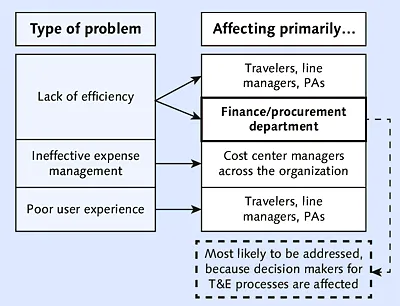
Efficiency problems experienced by the organization’s business travelers, line managers, or personal assistants who create or review expense claims on behalf of others are usually further down on the agenda, because the cost caused by these people is distributed across the whole organization. Line managers in the finance department, who can make decisions about the T&E process, are more likely to ignore these issues, because their own cost centers are barely affected.
The same holds true for ineffectiveness and poor UX in travel and expense processes, affecting both line managers across the organization and individual travelers. Again, decision makers in the finance department are not directly affected very much, unless they are pressured by internal customers such as the sales or customer service departments, in which we usually find a large number of frequent travelers.
Figure 1.1 illustrates this dilemma: Managers who make decisions about travel and expense processes are usually based in the finance department. Because this is not typically a department with lots of travel, these managers are affected primarily by inefficiencies in the back-office process. Therefore, it is not a coincidence that these processes are usually covered quite well in traditional expense management solutions.
Figure 1.1 Groups Affected by Typical Issues of Traditional T&E Processes
1.1.2 Ineffective Management of T&E
Ineffective management of T&E leads to unnecessarily high expenses and makes it difficult for employees to travel when and where they need to.
Typical examples of ineffective management in the expense process include the following:
- Inaccurate data or receipts resulting in unrecoverable domestic value-added tax (VAT)
- No process at all for foreign VAT recovery
- Slow reimbursements leading to high demand for advance payments
- Inaccuracies leading to overpayment of mileage
- Lack of easy-to-use reporting for line managers to manage spending in their teams
- Lack of insightful analytics to improve expense strategy
- Weak fraud detection
Typical examples of ineffective management in the booking and travel process include the following:
- Higher ticket prices due to a slow booking and approval process
- Limited choice driving up travel cost and/or time
- Little guidance for travelers in making the best choices before and during the trip
- Agents making bookings without knowing the full context of the trip
- Poor management of discounts; affected by poor analytics and bookings from the main system
- Poor policy compliance, unless driven by the travel management company (TMC)
- Inadequate analytics to feed into individual choices and policies
Many organizations recognize some of these problems and address them through many manual checks, approvals, and reports. However, this makes the process even more inefficien...