What comes after SAP Business Suite? Can the "new SAP" can meet your existing business requirements—and if so, how? This book is your big-picture introduction to how SAP solutions address your day-to-day business and IT processes in the post-SAP Business Suite landscape. Learn about up-and-coming SAP applications, from SAP S/4HANA, to SAP C/4HANA, to SAP IBP. Follow a central business case to get a clear idea of how the new SAP portfolio can work for you, now and in the years ahead!
Highlights include:
1) SAP S/4HANA
2) SAP HANA
3) SAP C/4HANA
4) SAP Integrated Business Planning
5) SAP Ariba
6) SAP SuccessFactors
7) SAP Lumira
8) SAP Analytics Cloud
9) SAP Cloud Platform
10) SAP Leonardo
11) Administration
12) Digital transformation
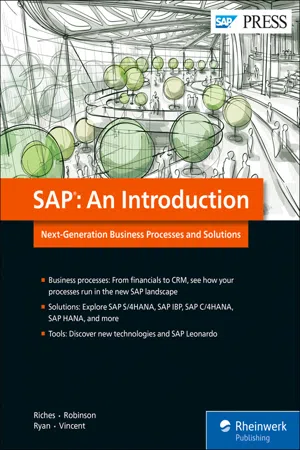
eBook - ePub
SAP: An Introduction
Next-Generation Business Processes and Solutions
- 537 pages
- English
- ePUB (mobile friendly)
- Available on iOS & Android
eBook - ePub
SAP: An Introduction
Next-Generation Business Processes and Solutions
About this book
Information
Part I
Customer Experience
1 Customer Experience with SAP C/4HANA
We’ll begin our journey through the modern SAP world with a topic that is increasingly at the epicenter of the business world: the customer. SAP has been developing and acquiring customer experience (CX) software since 1999, so although many consider this a new area, it’s a well-established part of SAP’s product suite.
Improving customer experience (CX) is now a strategic objective for many of the world’s largest and most successful firms. In this chapter, we’ll explore the factors that are compelling firms to rethink their customer strategies, how they are approaching this change, and the role that SAP can play in supporting this.
CX refers to the feelings invoked in customers through their interactions with a company, its people, services, products, and brands. Companies that can deliver consistently positive and valuable experiences to their customers are winning in today’s marketplaces.
The role of technology recently in developing and advancing CX has been profound; a new generation of customer relationship management (CRM) applications fueled on huge volumes of data and harnessing digital channels and technologies is helping firms to understand, serve, and interact with their customers more effectively than ever. This marks a step-change from first-generation transactional CRM systems, which brought order and structure to customer data and processes but often did little to actively improve CX.
What’s Right for You?
As we explore the topic of CX, we’ll draw distinctions between business-to-consumer (B2C) firms and business-to-business (B2B) firms because their challenges, requirements, and outlooks are different. B2C businesses are selling to private individuals often at significant scale, requiring a different business model, structure, data, processes, and technologies than their B2B counterparts.
In this chapter, we’ll cover the SAP C/4HANA suite. SAP has made no secret of its intention to be a leading player in the CX software marketplace and continues to back this up with acquisitions alongside significant internal research and development. The SAP C/4HANA product suite includes sales, service, marketing, commerce, contact center, and industry-specific applications, delivered as a series of separate but integrated products.
Out with the Old
SAP’s CX product suite has been through multiple evolutions and rebrandings. Let’s take a quick look at these now to clear up any misunderstanding.
SAP Customer Relationship Management (SAP CRM) was SAP’s first specialist CX software suite, available as an on-premise solution only. This suite included Sales, Service, Marketing, Contact Center, Mobile, and Commerce modules.
As SAP shifted to a cloud-first strategy, it acquired Hybris in 2013 and quickly saw an opportunity to use Hybris as the brand name for their entire CX suite. The Hybris portfolio was a mixture of organically developed and acquired CX applications—some of which were on premise and some of which were cloud only.
In 2018, SAP launched SAP C/4HANA, a cloud-first product suite that includes many of the applications previously available under the Hybris brand. For certain industry-specific requirements, SAP still markets and sells SAP CRM as an on-premise option, but SAP C/4HANA is its primary CX portfolio.
SAP C/4HANA is made up of five main cloud solutions: SAP Sales Cloud, SAP Service Cloud, SAP Marketing Cloud, SAP Commerce Cloud, and SAP Customer Data Cloud. Each cloud is made up of one or more underlying applications, which we’ll discuss throughout the chapter.
Integration is a core pillar of SAP’s CX product strategy; customer journeys today are complex sequences of events that take place over a number of different channels and technologies. The ability to share information between applications in real time is an imperative for firms looking to build rich and rewarding positive CXs.
During the chapter, we’ll break down the major components of the SAP C/4HANA suite by looking at marketing, sales, commerce, and customer service. For each area, we’ll explore current challenges and industry trends before explaining what the SAP C/4HANA suite offers in relation to these. To start, let’s use a case study to introduce some of the concepts and terms we’ll deal with during this chapter.
1.1 Business Case
Bault Robotical has a clear set of commercial priorities and objectives on the CX front. The company determined the following three main goals:
- Deliver 20% year-on-year revenue growth by finding and winning new customers, increasing average order values, and increasing repeat business from existing customers.
- Reduce the number of customers defecting to the new digital start-ups entering the market by improving CX, and becoming more customer-centric.
- Deliver improved levels of employee engagement and motivation by equipping them with the tools they need to be successful.
The commercial division was poorly served by enterprise applications and technology, which was having a negative impact on Bault Robotical’s CX. The only dedicated application in use, SAP CRM, was focused predominantly on the contact center. Bault Robotical had previously attempted to develop in-house a sales force automation (SFA) solution and a customer-facing website, however, both projects had run into technical integration challenges and significant user adoption issues. The SFA solution was switched off, and very few customers were using the website, which provided only basic order-creation capabilities. The marketing department had effectively outsourced much of its work to agencies that had the technology required to support them.
The on-premise SAP CRM application required three separate in-house IT staff to provide a complete support model and Bault Robotical was considering outsourcing this to save cost. A recent acquisition of a US-based robot manufacturer revealed it was using Salesforce, and there was pressure on the head office to allow the company to keep it, in the absence of any meaningful alternative.
The most commonly used business application was SAP ERP 6, accessed via SAP GUI, which was where the sales team would enter orders, the contact center would manage complex service requests, and the marketing department would download data.
The IT challenges could be categorized as follows:
- No dedicated CX applications to support specialist functions such as marketing, commerce, and sales
- A high cost to maintain on-premise SAP CRM from a people and infrastructure perspective
- No commercial IT template to roll out when acquiring new firms
- Poor levels of user engagement and attitude toward in-house IT from the commercial business
- Poor CX and engagement generated from the limited technology that was used in the front line
- No single view of the customer due to limited and siloed business applications
To address these challenges, Bault Robotical went through a software selection process and determined SAP C/4HANA as the new CX suite to move forward with based on the following criteria:
- All commercial teams and departments must be able to share customer insight and data through an integrated set ...
Table of contents
- Dear Reader
- Notes on Usage
- Table of Contents
- Preface
- Introduction
- Part I Customer Experience
- 1 Customer Experience with SAP C/4HANA
- 2 Sales and Service with SAP S/4HANA
- Part II Operations
- 3 Supply Chain Planning with SAP Integrated Business Planning
- 4 Sourcing and Procurement with SAP S/4HANA and SAP Ariba
- 5 Manufacturing with SAP S/4HANA
- 6 Supply Chain Management with SAP S/4HANA
- 7 Asset Management with SAP S/4HANA
- 8 Research and Development with SAP S/4HANA
- Part III Financials
- 9 Financial Accounting with SAP S/4HANA
- 10 Management Accounting with SAP S/4HANA
- Part IV Human Resources
- 11 Core Human Resources and Talent Management with SAP SuccessFactors
- 12 Contingent Workforce Management with SAP Fieldglass
- 13 Travel and Expense Management with SAP Concur
- Part V Data
- 14 Database and Platform
- 15 Data Warehouse
- 16 Analytics
- 17 Enterprise Information Management
- Part VI Integration and Administration
- 18 Application Integration
- 19 Administration
- Conclusion
- The Authors
- Index
- Service Pages
- Legal Notes
Trusted by 375,005 students
Access to over 1.5 million titles for a fair monthly price.
Study more efficiently using our study tools.
Frequently asked questions
Yes, you can cancel anytime from the Subscription tab in your account settings on the Perlego website. Your subscription will stay active until the end of your current billing period. Learn how to cancel your subscription
No, books cannot be downloaded as external files, such as PDFs, for use outside of Perlego. However, you can download books within the Perlego app for offline reading on mobile or tablet. Learn how to download books offline
Perlego offers two plans: Essential and Complete
- Essential is ideal for learners and professionals who enjoy exploring a wide range of subjects. Access the Essential Library with 800,000+ trusted titles and best-sellers across business, personal growth, and the humanities. Includes unlimited reading time and Standard Read Aloud voice.
- Complete: Perfect for advanced learners and researchers needing full, unrestricted access. Unlock 1.5M+ books across hundreds of subjects, including academic and specialized titles. The Complete Plan also includes advanced features like Premium Read Aloud and Research Assistant.
We are an online textbook subscription service, where you can get access to an entire online library for less than the price of a single book per month. With over 1.5 million books across 990+ topics, we’ve got you covered! Learn about our mission
Look out for the read-aloud symbol on your next book to see if you can listen to it. The read-aloud tool reads text aloud for you, highlighting the text as it is being read. You can pause it, speed it up and slow it down. Learn more about Read Aloud
Yes! You can use the Perlego app on both iOS and Android devices to read anytime, anywhere — even offline. Perfect for commutes or when you’re on the go.
Please note we cannot support devices running on iOS 13 and Android 7 or earlier. Learn more about using the app
Please note we cannot support devices running on iOS 13 and Android 7 or earlier. Learn more about using the app
Yes, you can access SAP: An Introduction by Matthew Riches,Ben Robinson,Gareth Ryan,Ian Vincent in PDF and/or ePUB format, as well as other popular books in Computer Science & Computer Science General. We have over 1.5 million books available in our catalogue for you to explore.