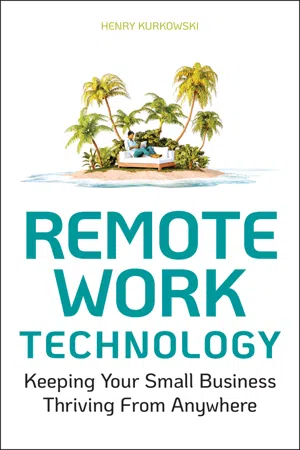
Remote Work Technology
eBook - ePub

Remote Work Technology

Keeping Your Small Business Thriving From Anywhere

  1. English
  2. ePUB (mobile friendly)
  3. Available on iOS & Android
eBook - ePub

Remote Work Technology

Keeping Your Small Business Thriving From Anywhere

About this book

Your small business survival guide for the remote work environment

In Remote Work Technology: Keeping Your Small Business Thriving From Anywhere, experienced SaaS and telecommunications entrepreneur Henry Kurkowski delivers a step-by-step walkthrough for using SaaS technology and communication apps to power your small business from anywhere on the planet.

You'll learn how to capitalize on the ability to hire a geographically distributed workforce and excel at serving clients at a distance. You'll also discover why and how you need to alter your approach to management and spot the common pitfalls that litter the way to a truly distributed business.

This important book includes:

  • Valuable case studies of businesses that embraced the reality of remote working during and after the COVID-19 pandemic and cautionary tales of unexpected challenges that arose during the transition.
  • Discussions of how to incorporate remote workers into efficient workflows to increase your business' productivity
  • Explorations of how to support your employees when you can't just pop into their office

Perfect for small business founders, owners, and managers, Remote Work Technology is also a must-read guide for independent contractors who work directly with small businesses and entrepreneurs.

Frequently asked questions

Yes, you can cancel anytime from the Subscription tab in your account settings on the Perlego website. Your subscription will stay active until the end of your current billing period. Learn how to cancel your subscription.
No, books cannot be downloaded as external files, such as PDFs, for use outside of Perlego. However, you can download books within the Perlego app for offline reading on mobile or tablet. Learn more here.
Perlego offers two plans: Essential and Complete
  • Essential is ideal for learners and professionals who enjoy exploring a wide range of subjects. Access the Essential Library with 800,000+ trusted titles and best-sellers across business, personal growth, and the humanities. Includes unlimited reading time and Standard Read Aloud voice.
  • Complete: Perfect for advanced learners and researchers needing full, unrestricted access. Unlock 1.4M+ books across hundreds of subjects, including academic and specialized titles. The Complete Plan also includes advanced features like Premium Read Aloud and Research Assistant.
Both plans are available with monthly, semester, or annual billing cycles.
We are an online textbook subscription service, where you can get access to an entire online library for less than the price of a single book per month. With over 1 million books across 1000+ topics, we’ve got you covered! Learn more here.
Look out for the read-aloud symbol on your next book to see if you can listen to it. The read-aloud tool reads text aloud for you, highlighting the text as it is being read. You can pause it, speed it up and slow it down. Learn more here.
Yes! You can use the Perlego app on both iOS or Android devices to read anytime, anywhere — even offline. Perfect for commutes or when you’re on the go.
Please note we cannot support devices running on iOS 13 and Android 7 or earlier. Learn more about using the app.
Yes, you can access Remote Work Technology by Henry Kurkowski in PDF and/or ePUB format, as well as other popular books in Technology & Engineering & Information Technology. We have over one million books available in our catalogue for you to explore.

CHAPTER 1
You Can't Go to the Office: Where Do You Go from Here?

Indianapolis, April 3, 2006 – Public safety officials are still concerned about Sunday's storm damage to the Regions Bank tower downtown. The straight-line winds blew out windows on several floors and peeled away parts of the building's facade.
While the wind is responsible for the initial damage to the city's third tallest building, wind will keep the area around it closed for at least another day. Channel 13 Meteorologist Jude Redfield says the wind speeds are expected to be up to 25 miles per hour through Tuesday afternoon. That means falling glass and debris from the Regions building are still a big safety concern.
Three sides and 16 floors of the building are damaged and it will be a while before the tower is repaired. Spokesperson Myra Borshoff says that is bad news for tenants.
“For the foreseeable future, this building will not be occupied…Right now, our focus is securing the building and making it safe.”
In the short term that means protecting pedestrians and drivers from falling glass and metal. And, Borshoff says, that means keeping the area around the tower off-limits.
“I would say for at least for the next few days, those streets will not be available and you should probably plan to leave 15 to 20 minutes early.”
Mayor Bart Peterson agrees. “When we are sure nothing is going to fall off the buildings, then we will reopen the streets.”
But the businesses and their employees who work at One Indiana Square will have to wait longer. Getting back to business for them means finding temporary office space elsewhere. Susan Matthews, with the building's management, says they are doing their best to help. “We are in the process of contacting tenants, assessing their needs, and helping them find space.”
Building owner Mickey Maurer says they'll do what is necessary. “That's part of being local. We're here. We told those tenants we'd stand behind them, and we've got a plan, we've got an army put together, and we will stand behind them.”
Hotels and office buildings in the downtown area have reached out, offering their extra space. One Indiana Square has about 30 tenants and 1,000 employees. Among those are accounting firms who are eager to get back to work with tax day just two weeks away.
Lynsay Clutter-Eyewitness News, Area around Regions Tower to stay closed, WTHR, April 4, 2006

Disaster Strikes

Imagine that you are awakened in the wee hours of the morning to be told that there was a fire in the middle of the night. Although nobody was harmed, your workplace has been severely damaged and is unusable. What is the first thing that pops into your head? Does your mind dart to worry about the various company files and assets that were in the office? Is the anxiety of upcoming project deadlines lumping in your throat? Do you race your thoughts around trying to figure out how to keep the team working and the company operational?
All of these are valid concerns, and there is no correct order of priority. This type of scenario has happened countless times around the world. Sudden man-made and natural disasters have interrupted the flow of business for centuries. In the preceding news report from WTHR in Indianapolis, you can see a good example in which roughly 1,000 workers of over 30 businesses were suddenly displaced without warning.

How Long Will the Crisis Last?

The building mentioned in the Eyewitness News story from April 2006 is the third largest building in Indianapolis. The storm that hit the downtown area was identified by meteorologists as a derecho. A derecho is a series of fast-moving wind storms or thunderstorms with powerful straight-line winds that can rival the force of hurricane winds. That storm hit downtown Indianapolis late on Sunday, April 2. By Monday, businesses were told that the building was unstable and unsafe for anyone to gain entry. In fact, the surrounding streets were also closed off due to falling debris. Over the course of a weekend, dozens of businesses were turned upside down and displaced.
Nearly three months would go by for many of those tenants who were without a place to work and were unable to access their company assets or client files. That Monday morning, the business owners and managers were coping as best they could. Many were hoping that they would be out of their office for just a few weeks at most. Few, if any, realized that it would be months before they could return.
WTHR had a follow-up report when many workers returned to the building to open up their offices and called it a kind of homecoming. That second report was published 10 weeks later on June 10, 2006. They also reported on that day that there were still many offices that remained under repair and unable to open for business.

COVID-19

The 2020 pandemic forced businesses around the globe to close their offices. Most of those businesses either figured out how to work remotely or stopped operations for a period of time. People who thought that such a long-term interruption of day-to-day business couldn't happen to them suddenly found themselves dealing with it as their new reality. This begs the question, how many businesses were ready for an emergency in which the whole company needed to suddenly work remotely?

BEST PRACTICES

Get a company continuity plan in place for your business to make sure your company can survive and thrive in case of various types of crises.

Prepping the Whole Team

I have worked on the board of trustees for a nonprofit organization where I and several other board members were tasked to come up with a detailed continuity plan for the organization. A continuity plan is a vital document that outlines various courses of action to help a company not only survive but continue to thrive when disaster strikes. Of course, such plans are something that you want in place before your interruption in business occurs so that you are not left scrambling or arguing over the correct decisions to make in the midst of your crisis event.
With nonprofit or for-profit businesses, putting such plans in place demonstrates good stewardship and that you take your responsibilities to the stake holders of the organization seriously. Part of that plan needs to be a remote work contingency.
A large portion of the workforce already has the ability to work from home due to the proliferation of broadband. In fact, according the US Census Bureau, just prior to the COVID-19 crisis, about one third of workers had worked remotely and roughly half of information workers are able to work from home. However, being able to do work from home on a long-term basis and actually doing so are very different things. Historically, there has been some pushback from management on overseeing a remote and distributed workforce.

Management Work Policy

According to the International Workplace Group, an international provider of office space, business lounges, and conference centers, more than 50 percent of companies surveyed in 2019 did not have a remote work policy in place.1 When asked the reason, they simply cited that it was a long-standing company policy. In other words, they prefer managing their people in person.
Many times, the reason companies avoid working remotely is due to the company culture. There is a camaraderie that comes with being in the same room and bouncing ideas off each other. There is an energy in that room that cannot be duplicated in a video conference.
Other times, remote working is frowned upon due to employer preferences in management styles, and sometimes it is simply that management does not like change. In working with thousands of sma...

Table of contents

  1. Cover
  2. Table of Contents
  3. Title Page
  4. Foreword
  5. Introduction
  6. CHAPTER 1: You Can't Go to the Office: Where Do You Go from Here?
  7. CHAPTER 2: The Remote Workspace: Set Up Your Mind and Your Space
  8. CHAPTER 3: Office Technology: Stay Connected and Competitive
  9. CHAPTER 4: Choosing Technology: Getting the Right Digital Tools for You
  10. CHAPTER 5: Time Management: The Result Is What Matters Most
  11. CHAPTER 6: Group Tasks: Keeping the Teamwork in Your Team
  12. CHAPTER 7: Client and Team Meetings: Making the Most of It
  13. CHAPTER 8: The Watercooler Has Moved—Engagement and Socializing Remotely
  14. CHAPTER 9: Generational Struggles
  15. CHAPTER 10: Creating the Right Remote Team Culture
  16. CHAPTER 11: Operations and Administration
  17. CHAPTER 12: The Complete Package
  18. Index
  19. Copyright
  20. Dedication
  21. About the Author
  22. Acknowledgments
  23. End User License Agreement