Big Data Analysis for Green Computing
eBook - ePub

Big Data Analysis for Green Computing

Concepts and Applications

  1. 174 pages
  2. English
  3. ePUB (mobile friendly)
  4. Available on iOS & Android
eBook - ePub

About this book

This book focuses on big data in business intelligence, data management, machine learning, cloud computing, and smart cities. It also provides an interdisciplinary platform to present and discuss recent innovations, trends, and concerns in the fields of big data and analytics.

Big Data Analysis for Green Computing: Concepts and Applications presents the latest technologies and covers the major challenges, issues, and advances of big data and data analytics in green computing. It explores basic as well as high-level concepts. It also includes the use of machine learning using big data and discusses advanced system implementation for smart cities.

The book is intended for business and management educators, management researchers, doctoral scholars, university professors, policymakers, and higher academic research organizations.
Frequently asked questions

Yes, you can cancel anytime from the Subscription tab in your account settings on the Perlego website. Your subscription will stay active until the end of your current billing period. Learn how to cancel your subscription.
At the moment all of our mobile-responsive ePub books are available to download via the app. Most of our PDFs are also available to download and we're working on making the final remaining ones downloadable now. Learn more here.
Perlego offers two plans: Essential and Complete
  • Essential is ideal for learners and professionals who enjoy exploring a wide range of subjects. Access the Essential Library with 800,000+ trusted titles and best-sellers across business, personal growth, and the humanities. Includes unlimited reading time and Standard Read Aloud voice.
  • Complete: Perfect for advanced learners and researchers needing full, unrestricted access. Unlock 1.4M+ books across hundreds of subjects, including academic and specialized titles. The Complete Plan also includes advanced features like Premium Read Aloud and Research Assistant.
Both plans are available with monthly, semester, or annual billing cycles.
We are an online textbook subscription service, where you can get access to an entire online library for less than the price of a single book per month. With over 1 million books across 1000+ topics, we’ve got you covered! Learn more here.
Look out for the read-aloud symbol on your next book to see if you can listen to it. The read-aloud tool reads text aloud for you, highlighting the text as it is being read. You can pause it, speed it up and slow it down. Learn more here.
Yes! You can use the Perlego app on both iOS or Android devices to read anytime, anywhere — even offline. Perfect for commutes or when you’re on the go.
Please note we cannot support devices running on iOS 13 and Android 7 or earlier. Learn more about using the app.
Yes, you can access Big Data Analysis for Green Computing by Rohit Sharma, Dilip Kumar Sharma, Dhowmya Bhatt, Binh Thai Pham, Rohit Sharma,Dilip Kumar Sharma,Dhowmya Bhatt,Binh Thai Pham in PDF and/or ePUB format, as well as other popular books in Computer Science & Industrial Engineering. We have over one million books available in our catalogue for you to explore.

Information

1 Multi-Criteria and Fuzzy-Based Decision Making Applications in Environment Pollution Control for Sustainable Development

Meenu Gupta and Kashish Garg
Chandigarh University
Rachna Jain
Bharati Vidyapeeth’s College of Engineering
DOI: 10.1201/9781003032328-1

CONTENTS

  1. 1.1 Introduction to Fuzzy
  2. 1.2 Introduction to MCDM
    1. 1.2.1 MADM
    2. 1.2.2 MODM
    3. 1.2.3 Needs of Fuzzy MCDM
  3. 1.3 Literature Survey
  4. 1.4 Fuzzy Control System
    1. 1.4.1 Fuzzy Classification
    2. 1.4.2 De-Fuzzification
  5. 1.5 Mathematical Programming Using Fuzzy Models
    1. 1.5.1 Fuzzy Linear Programming
    2. 1.5.2 Fuzzy Integer Linear Problems
    3. 1.5.3 Fuzzy Dynamic Programming
    4. 1.5.4 Mathematical Programming as a Tool for Fuzzy Rule Learning Process
  6. 1.6 MCDM with Fuzzy AHP
    1. 1.6.1 Analytical Hierarchy Process
    2. 1.6.2 Need for Fuzzy AHP
    3. 1.6.3 Case Study of Fuzzy AHP
    4. 1.6.4 Application of Fuzzy AHP: Air Pollution Control
  7. 1.7 Comparison between AHP and Fuzzy AHP
  8. 1.8 Conclusion
  9. References

1.1 Introduction to Fuzzy

Lotfi A. Zadeh introduced fuzzy logic in the year 1965. Fuzzy logic is capable of dealing with imprecise and incomplete data. It uses linguistic variables to deal with inaccurate data in a precise manner. It has been observed that fuzzy logic can be used in the development of various applications such as smart systems for decision making, determination, identification, pattern identification and recognition, optimization, operation and control [1].
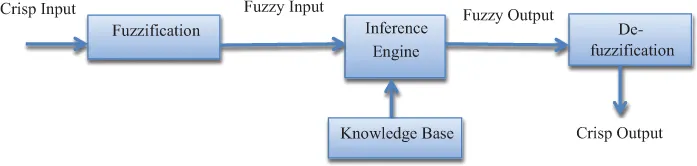
Fuzzy logic contains four main processing frameworks [2] as shown in Figure 1.1:
FIGURE 1.1 Working structure of fuzzy logic system.
  • Fuzzification
  • De-fuzzification
  • Knowledge base
  • Inference engines
The fuzzification process converts the crisp sets into fuzzy sets. For a graphical representation of fuzzy sets, various membership functions are used for the purpose. Knowledge base consists of if-then verbalizations that are provided by the experts [1]. The inference engine will stimulate the human prospects by taking fuzzy inference as input the if-then rules that anteriorly set in knowledge base framework. De-fuzzification, with the help of the inference engine, changes the fuzzy sets into a value (output).

1.2 Introduction to MCDM

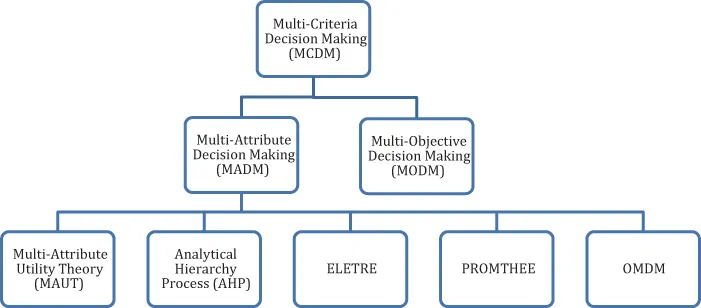
Multi-criteria decision making (MCDM) plays a vital role in evaluating multiple criteria involved in decision making. It comes handy when one needs to select the best and optimum criteria from various conflicting approaches. These criteria can be chosen by providing weights to the standards. To evaluate the multiple criteria’s essential aspect, the structure of the problem needs to be considered. Decision making is a process in which the alternatives are chosen based on judgments and pearls of wisdom of decision-makers. Decisions taken collectively (also known as group MCDM) are proved to be often impartial, unbiased, and productive than the decisions made individually [3]. In collective decision making, the decisions made by all the individuals are considered and combined to solve the given problem. The most crucial part of the decision-making approach is identifying and examining all the criteria according to the assessment criteria. The alternatives must be ranked to gain knowledge about the most suitable option and to evaluate the respective priority of each option. Figure 1.2 shows the classification of MCDM.
FIGURE 1.2 Classifications of MCDM methods [3].
MCDM refers to deciding the presence of multiple and incompatible criterias. A multi-criteria decision problem can consist of either numerous attributes, objectives or both. MCDM is classified into two parts, as shown in Figure 1.2: the first is MODM (multi-objective decision making) [4], and the second is MADM (multi-attribute decision making). MCDM has many applications, such as water resources planning, risk prediction, job evaluation, air pollution forecasting and business failure prediction [5].

1.2.1 MADM

MADM is used to solve the selections-related problem which is collected from a finite number of alternatives. This method proceeds with attribute information to arrive at a particular choice.

1.2.2 MODM

MODM is a special kind of problem which includes the design of various choices or alternatives available which helps to optimize and amplify the different objectives of the decision-maker. Consider an example of making a development plan for the government of a developing country [6]. The government would have various purposes while composing the acceptable policy such as maximizing the national welfare and minimizing the dependence on peregrine avail to reduce unemployment rate [3].
Mathematical representation of MODM problems is as follows [4]:
Max[f1(x),f2(x),,fk(x)](1.1)
:gi(x)0,j=1,,m(1.2)
where x is an n-dimensional decision variable vector. The problem consists of n decision variables, m constraints and k objectives. Any or all of the functions may be nonlinear. These problems are also known as vector maximization problems.

1.2.3 Needs of Fuzzy MCDM

Fuzzy logic can give an approximate value even if the information is incomplete. In the case of complex problems, traditional methods related to non-fuzzy approach usually rely on mathematical estimates and calculations. Linearization of nonlinear problems is one of the examples which often gives bad functioning and is not very economical. Therefore, fuzzy systems surpass traditional MCDM techniques [7]. Decision-making problems are usually vague and uncertain in nature. Conventional MCDM methods cannot deal with this uncertainty. Therefore, the fuzzy set theory is applied to handle the possibility. Fuzzy MCDM techniques are decision analysis techniques merged with fuzzy techniques. Fuzzy techniques are commonly used with MCDM to deal with uncertainty and increase the accuracy of decision making [8]. Fuzzy MCDM is widely used in applications like energy, environment, source management, supplier selection and planning.

1.3 Literature Survey

Different experts have different perceptions about the acceptable limits and the insufficiency in the parametric data of various air pollutants. As a result, it is seen that there are some built-in deficiencies while modeling out the perceptions of different experts. These mixed reviews can lead to various problems, so keeping that in mind, many researchers have started in building some applications using soft computing techniques which helps in the estimation of air quality indices [9]. Fuzzy logic plays an essential role in the process of converting the expert’s experiments into mathematical languages, which indirectly helps in magnifying the usage of the model [10,11]. Many researchers have suggested predicting air quality indexes and monitoring air emissions using fuzzy logic. Many MCDM techniques have been used to study the impact of air pollution on socioeconomic development in various regions [12]. Some of them are listed below. In Ref. [13], the authors used MCDM as a technique to improve air quality in communities. They implemented Delphi method, analytical hierarchy process and fuzzy logic theory for reducing air pollution in urban areas.
The authors in [14] discussed the problem to surveying the impact of air pollution as an MCDM problem. They used a novel MCDM technique that is TOPSIS (Technique for Order of Preference by Similarity to Ideal Solution) to understand the importance of every pollutant that is contributing to air pollution. Their method outperforms the traditional TOPSIS methods involving Bayesian regularization and the back-propagation (BP) neural network to optimize the weight (in the training process). They named the novel TOPSIS approach as smart MCDM technique. In contrast to conventional TOPSIS, here the entropy method is used to calculate the initial weights. In conventional TOPSIS, the masses were obtained from an expert’s perspective [15]. The model was integrated with the Bayesian regularization and BP neural network architecture to boost the weights in the training loop [16]. In Ref. [9], the authors monitored the concentrations of SO2 gas and PM10 for 4 years and used PROMETHEE/GAIA multi-criteria techniques for ranking pollution ...

Table of contents

  1. Cover
  2. Half Title Page
  3. Series Page
  4. Title Page
  5. Copyright Page
  6. Table of Contents
  7. Preface
  8. Editors
  9. Contributors
  10. Chapter 1 Multi-Criteria and Fuzzy-Based Decision Making: Applications in Environment Pollution Control for Sustainable Development
  11. Chapter 2 Security and Privacy Requirements for IoMT-Based Smart Healthcare System: Challenges, Solutions, and Future Scope
  12. Chapter 3 The Rise of “Big Data” on Cloud Computing
  13. Chapter 4 Effect of the Measurement on Big Data Analytics: An Evolutive Perspective with Business Intelligence
  14. Chapter 5 Performance Analysis for Provisioning and Energy Efficiency Distributed in Cloud Computing
  15. Chapter 6 Using Internet of Things (IoT) for Smart Home Automation and Metering System
  16. Chapter 7 Big Data Analysis and Machine Learning for Green Computing: Concepts and Applications
  17. Chapter 8 Fundamental Concepts and Applications of Blockchain Technology
  18. Chapter 9 Mental Disorder Detection Using Machine Learning
  19. Chapter 10 Blockchain Technology for Industry 4.0 Applications: Issues, Challenges and Future Research Directions
  20. Index