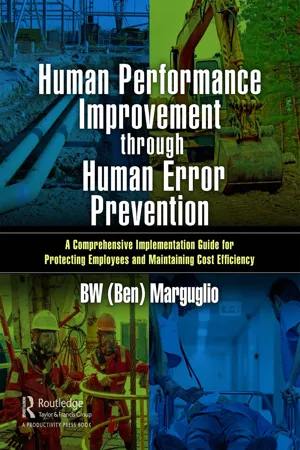
Human Performance Improvement through Human Error Prevention
eBook - ePub

Human Performance Improvement through Human Error Prevention

A Comprehensive Implementation Guide for Protecting Employees and Maintaining Cost Efficiency

  1. 686 pages
  2. English
  3. ePUB (mobile friendly)
  4. Available on iOS & Android
eBook - ePub

Human Performance Improvement through Human Error Prevention

A Comprehensive Implementation Guide for Protecting Employees and Maintaining Cost Efficiency

About this book

This book is a simulation of a live course on human performance improvement/human error prevention (HPI/HEP) created by the preeminent authority on HPI/HEP. It presents the greatest breadth of scope and specificity on this topic. This book comprises a focused, challenging human error prevention training course designed to improve understanding of error causation. It will dramatically reduce human error and repeat deviations, and it digs below the surface of issues and looks to fix the real causes of human error and mistakes.

In addition, this book presents a complete seminar from the thought leader acclaimed by hundreds of clients, and includes unique principles, practices, models, and templates. Information is comprehensive and can be directly implemented. The principles and practices of human error prevention are universally applicable regardless of the type of industrial, commercial, or governmental enterprise, and regardless of the type of function performed within the enterprise. The application of the information in this book will significantly contribute to improved productivity, safety, and quality.

After fully using this book, you will understand:

  • Human error prevention/reduction terminology and definitions.
  • The relationships among culture, beliefs, values, attitudes, behavior, results, and performance.
  • The roles of leadership in establishing and maintaining a quality/safety-conscious work environment.
  • The one fundamental precept explaining the importance of human error prevention/reduction.
  • The two most critical elements of human error prevention/reduction.
  • The three levels of barriers to human error.
  • The four types of things in which the barriers may exist at each barrier level.
  • The five stages of human error.
  • The six "M"s that can emit or receive hazards activated by human error.
  • The seven universally applicable human error causal factors.
  • The Rule of 8 by which to prevent human error and mitigate its effects.
  • Techniques for making barriers effective and the spectrum of barrier effectiveness.
  • The relationship of human error prevention/reduction to the total quality/safety function.
  • Error-inducing conditions (error traps) and behaviors for counteracting these conditions.
  • Non-conservative and conservative thought processes and behaviors in decision-making.
  • Coaching for preventing the recurrence of human error.
  • Root cause analysis techniques for identifying human error causal factors.
  • The nine types of corrective action.
  • Human error measurement.
  • Strategies for a human error prevention/reduction initiative.
  • How to design, implement, and manage a human error prevention/reduction initiative.

Information

Year
2021
Print ISBN
9780367672393
Edition
1
eBook ISBN
9781000397215

Chapter 1

Major Learning Objectives

Introduction
  • Precepts
  • Terminology
  • Culture
  • Quality culture
  • Quality-conscious work environment
  • Leadership responsibilities
  • Daisy chain
  • Blame spiral
  • Initially, we’ll cover the most important precept and a few other important ones. However, there are lots of other precepts that will be presented throughout this course.
  • The management- and technique-specific terms and words that are applicable to HPI through HEP will be defined. You’ll be able to understand and use these terms and words with accuracy and precision.
  • If you’re advanced with regard to terminology, the ā€œTerminologyā€ section may be somewhat of a review. However, I strongly suspect that you’ll get new perspectives on some words and terms and, therefore, that you’ll also better understand the subsequent material in which the words and terms are used.
  • Recognizing that ā€œcultureā€ is at the foundation of any improvement, human performance improvement or otherwise, we’ll cover the meaning of ā€œcultureā€, progress to the attributes of a ā€œquality cultureā€, keeping in mind that we mean quality of production, of safety and health, of environmental protection, etc. Then, we’ll progress to the still more specific attributes of the ā€œquality-conscious work environmentā€ through which quality culture is implemented.
  • We’ll cover the responsibilities of leaders in transitioning to and maintaining a quality-conscious work environment. We’ll discuss some of the problems in making the transition and methods of overcoming these problems.
  • The daisy chain of information, beliefs, values and attitudes leading to behavior and results will be covered from different perspectives.
  • When the quality-conscious work environment and daisy chain break down, we get the ā€œblame spiralā€. We’ll discuss how that happens and its adverse effects.
Introduction (Cont’d)
  • Human error
  • Human error classifications by:
    • – Action–inaction
    • – Timing of the adverse effect
    • – Level of significance of the adverse effect
    • – Causal factor
  • We’ll cover that which constitutes human error and that which does not. And why.
  • We’ll cover how human error can be classified in the ways shown on the screen (Read the four bullets.), and we’ll cover the reasons for and importance of each type of classification.
  • We’ll compare the taxonomies of human error causal factors created by Professor James Reason, Dr. Joseph Juran and by me.
  • A ā€œtaxonomyā€ is a scheme of classification of things within a given field of interest.
  • James Reason is Professor Emeritus of Psychology at the University of Manchester, England. He is also a speaker and author. He is most highly acclaimed for his creation of models describing the nature of accidents. Professor Reason’s work will be referred to in later slides, but at those points, without meaning any disrespect, his accolades will not be repeated.
  • Dr. Joseph Juran (1904–2008) was an engineer, management consultant, speaker and author on quality management. He was an honorary member of the American Society for Quality and one of the greatest contributors to the quality body of knowledge. Dr. Juran’s work will be referred to in later slides, but at those points, without meaning any disrespect, his accolades will not be repeated.
1 st Field of Focus – Hazards and Barriers
  • Process risk management
    • – Prerequisites to process risk management
      • 1 source of operational loss
      • 2 levels of risk
      • 3 types of barriers
      • 4 things in which barriers exist
      • 5 stages of error
      • 6 ā€œMā€s
      • 7 human error causal factors
    • – Process risk management – the Rule of 8
    • – Techniques for process barrier effectiveness
    • – Training processes
      • ADDIE
      • Beyond ADDIE
  • ā€œHazards and Barriersā€ is the first of the ā€œFour Fields of Focusā€ or major areas of interest for error prevention, error detection and mitigation of the adverse effects of hazards activated by error.
  • The word ā€œhazardā€ has a very broad meaning – anything that can cause or contribute to an adverse effect. A hazard can apply to the quality of production, quality of safety and health, quality of environmental protection, of security, including cyber-security, of emergency preparedness and response, etc.
  • Hazards and barriers will be covered as they apply to process risk management.
  • You’ll learn to use or at the very least to facilitate the use of a technique for the management of risk in administrative and technical processes, but first you’ll learn the seven prerequisites to the effective use of this technique which I call the ā€œRule of 8ā€. The seven prerequisites are: (From the slide, read the seven prerequisites to the Rule of 8.)
  • In discussing the second prerequisite, the word ā€œriskā€ means exposure to a hazard. You’ll learn the constituents of risk levels, the relationship of ā€œrisk levelsā€ to problem ā€œsignificanceā€ and the difference between ā€œsignificanceā€ and ā€œpriorityā€.
  • Given that barriers for prevention, detection and mitigation are used to reduce the initial level of process risk, we’ll cover techniques by which to improve the effectiveness of these barriers.
  • Obviously, the enterprise training system is or should be a major contributor to the prevention of human error, but the training processes that comprise the system, themselves, may have hazards for which barriers are required.
  • We’ll cover ADDIE, a sequence of activities to make the training system effective – analysis, design, development, implementation and evaluation.
  • We’ll also cover a technique by which to concurrently improve the effectiveness of the training processes and the effectiveness of the processes that are the subjects of the training
1st Field of Focus – Hazards and Barriers (Cont’d)
  • Component risk management
    • – Failure mode & effects analysis
  • Hardware system risk management
    • – Abilities, etc.
    • – Processes needed to achieve the abilities
    • – Probabilistic risk analysis – with event trees, fault trees and probability statistics
  • Facility risk management
    • – Probabilistic risk analysis – with event trees, fault trees and probability statistics
  • At this point, we’ll transition FROM hazards and barriers in the context of risk management for processes TO hazards and barriers in the context of risk management for components, for hardware systems and then for the facility as a whole.
  • We’ll cover the types of abilities that should be incorporated into the design of hardware items and the types of administrative and technical processes in which there must be barriers in order to achieve these abilities.
  • We’ll cover Failure Mode & Effects Analysis (FMEA), which is essential to component risk management. You’ll learn how to perform or at the very least how to facilitate FMEA.
  • Then, we’ll transition to hazards and barriers in the context of risk management for hardware systems and for the overall facility. We’ll cover the fundamentals of Probabilistic Risk Management using an event tree, fault trees and probability statistics.
1st Field of Focus – Hazards and Barriers (Cont’d)
  • Human barriers
    • – Types of human barriers
  • Range of barrier dependability
  • Full scope of the quality function in terms of hazards and barriers
  • Having addressed barriers that exist in administrative and technical processes, and in hardware items, we’ll then cover the types of barriers that exist in humans.
  • We’ll cover barrier dependability or effectiveness for different types of barriers ranging from automated passive hardware barriers, the most effective, to various types of administrative barriers that are less effective.
  • And, finally, we’ll complete the coverage of the 1st Field of Focus, Hazards and Barriers, with a model showing how the full scope of the enterprise quality function can be described in terms of hazards and barriers.
  • This ā€œ1st Field of Focus, Hazards and Barriersā€, is critical. Errors allow hazards to uneconomically exist and errors activate hazards and, of course, barriers prevent and detect error and also mitigate the adverse effects of hazards activated by error.
2nd Field of Focus – Error-Inducing Conditions, Error-Likely Situations and Counteracting Behaviors
  • Types of error traps
  • Sources of error traps
  • 25 behavioral techniques for counteracting error traps
    • – Process and hardware item design techniques – e.g., poka-yoke
    • – Individual techniques
    • – Group techniques
  • The 2nd Field of Focus or major area of interest is ā€œError-Inducing Conditions and Error-Likely Situations (ā€˜error traps’) and Counteracting Behaviorsā€.
  • We’ll cover various types of error traps that may exist in the process task, in the work environment, and in the inherent and acquired traits of humans. An example of an error trap in a task is a requirement to perform the task within a short time constraint.
  • We’ll cover dozens of different types of behaviors by which to counteract error traps such as to reduce the likelihood of initiating error.
  • Persons working alone or working as a group can use these counteracting behaviors – persons at all levels, managers, supervisors and individual contributors.
  • We’ll stress the point that these counteracting behaviors can only help to prevent error, but that they cannot mitigate adverse effects, as can barriers. Therefore, rarely can an error-inducing condition or error-likely situation be the single root cause of a significant adverse effect. Almost always, the root causes must include the absence or ineffectiveness of one or more barriers. This is a very important principle.
  • Subsequent to the occurrence of an adverse effect, these counteracting behaviors can help to prevent further error which could exacerbate the adverse effect.
3rd Field of Focus – Bad and Good Decision-Making Thought Processes and Behaviors
  • Field decisions
  • Bad decision-making thought processes and behaviors
    • – Biases
    • – ā€œSatisficingā€
    • – Operational loafing
    • – Groupthink
  • Good decision-making thought processes and behaviors
    • – Designated challenger
    • – Situational awareness and focus
    • – Precautionary principle
  • Questions to ask before making a decision
  • The 3rd Field of Focus is ā€œBad and Good Decision-Making Thought Processes and Behaviorsā€.
  • Bad decisions that are also non-conservative constitute errors with higher levels of severity of the adverse effects and/or with higher probabilities of occurrence of the adverse effects. In other words, non-conservative decisions result in higher levels of risk or higher levels of actual adverse effects.
  • We’ll cover the significant differences between field decisions and analytical decisions.
  • We’ll cover various types of thought processes and behaviors that can contribute to non-conservative decisions, such as the dozens of types of biases, ā€œsatisficingā€, the six types of operational loafing, and groupthink, the most serious. Being conscious of these, you’ll be in a better position to avoid them.
  • We’ll cover the thought processes and behaviors that lead ...

Table of contents

  1. Cover
  2. Half Title
  3. Title Page
  4. Copyright Page
  5. Table of Contents
  6. Preface
  7. Acknowledgment
  8. Author
  9. Welcome
  10. 1 Major Learning Objectives
  11. 2 Introduction
  12. 3 1st Field of Focus: Hazards and Barriers
  13. 4 2nd Field of Focus: Error-Inducing Conditions, Error-Likely Situations and Counteracting Behaviors
  14. 5 3rd Field of Focus: Non-Conservative and Conservative Decision-Making Thought Processes and Behaviors
  15. 6 4th Field of Focus: Prevention of the Recurrence of Error
  16. 7 Strategies
  17. Appendix A: Words and Terms Used in the Course
  18. Appendix B: Format and Writing Conventions for a Procedure/Process Description Document
  19. Appendix C: Types of Contents of a Procedure/Process Description Document
  20. Appendix D: Types of Design Requirements for Hardware Items and a Facility
  21. Appendix E: Elements of a Design Calculations Management System
  22. Appendix F: Elements of a Software/Firmware Management System
  23. Appendix G: Elements of an Inspection and Test Management System
  24. Appendix H: Elements of a Records Management System and Types of Records
  25. Appendix I: Cross-References for a Configuration Management System
  26. Certificate of Completion

Trusted byĀ 375,005 students

Access to over 1.5 million titles for a fair monthly price.

Study more efficiently using our study tools.

Frequently asked questions

Yes, you can cancel anytime from the Subscription tab in your account settings on the Perlego website. Your subscription will stay active until the end of your current billing period. Learn how to cancel your subscription
No, books cannot be downloaded as external files, such as PDFs, for use outside of Perlego. However, you can download books within the Perlego app for offline reading on mobile or tablet. Learn how to download books offline
Perlego offers two plans: Essential and Complete
  • Essential is ideal for learners and professionals who enjoy exploring a wide range of subjects. Access the Essential Library with 800,000+ trusted titles and best-sellers across business, personal growth, and the humanities. Includes unlimited reading time and Standard Read Aloud voice.
  • Complete: Perfect for advanced learners and researchers needing full, unrestricted access. Unlock 1.5M+ books across hundreds of subjects, including academic and specialized titles. The Complete Plan also includes advanced features like Premium Read Aloud and Research Assistant.
Both plans are available with monthly, semester, or annual billing cycles.
We are an online textbook subscription service, where you can get access to an entire online library for less than the price of a single book per month. With over 1.5 million books across 990+ topics, we’ve got you covered! Learn about our mission
Look out for the read-aloud symbol on your next book to see if you can listen to it. The read-aloud tool reads text aloud for you, highlighting the text as it is being read. You can pause it, speed it up and slow it down. Learn more about Read Aloud
Yes! You can use the Perlego app on both iOS and Android devices to read anytime, anywhere — even offline. Perfect for commutes or when you’re on the go.
Please note we cannot support devices running on iOS 13 and Android 7 or earlier. Learn more about using the app
Yes, you can access Human Performance Improvement through Human Error Prevention by BW (Ben) Marguglio in PDF and/or ePUB format, as well as other popular books in Business & Human Resource Management. We have over 1.5 million books available in our catalogue for you to explore.