- English
- ePUB (mobile friendly)
- Available on iOS & Android
eBook - ePub
Trusted by 375,005 students
Access to over 1.5 million titles for a fair monthly price.
Study more efficiently using our study tools.
Information
CHAPTER I
THE MANY MIZNERS
I was neither the fattest nor the thinnest; the blondest nor the blackest; the oldest nor the youngest; I was just the next to the last; and the last was something that mother evidently had not put her mind upon.
Papa Mizner was the best wrong guesser the world had probably ever produced, and when he moved from San Francisco to Benicia (which was still the State Capital), he crowned his misjudgment with mud to the ears. God evidently made Benicia late Saturday afternoon, and must have had a tea date with a chorus girl and was in a hurry, for it was a mess.
He started sprinkling alum on it when we arrived. Mama and Papa Mizner tried to keep the population up by having the “Many Mizners,” but the shrinkage was so rapid that they sort of lost hope and gave it up with Wilson’s birth.
I don’t think anyone could describe the Mizner house. The original parlor, sitting room, hall, and three bedrooms had been brought around Cape Horn, each piece marked and set together by more or less unskilled labor. Additions were rapidly added at the back, each one larger than the first. From the air it must have looked like a telescope, with the smaller end toward the street. The porch was entirely covered with vines, and the planting of great trees and shrubs crowded it in on either side. After luncheon when the front door (with a coffin plate inscribed “L. B. Mizner”) opened and vomited forth the family, people must have thought it was a subway exit. Tons of the family oozed forth, and strangers passing must have gasped in wonderment as to where in hell they could have come from. As time went on, cottages sprang up in the shadow of the foliage.
When years later somebody asked me where I was born, and I told them Benicia, they said, “For God’s sake, where was your mother going?”
I think perhaps right here is the place to tell where mother came from, and how the Mizners came to California, because the only thing that could be of interest in this yarn is: that two dignified, respectable people could have been the parents of so many outlaws.
The first Mizner we know anything about was a tax collector under Henry the Eighth. He evidently got his fingers jammed in the cash register, for he seems to have left England for Ireland between two days. They came to America early in 1700.
To excuse Papa Mizner’s judgment of Benicia, the Mizners were among the first founders of the town of Elizabeth, New Jersey.
Lawrence Mizner must have been full of larceny, for he left a fortune of three hundred thousand dollars, which, in 1788, was considered very large. He left it all to my grandfather, who married Mary Bond, and moved to Illinois.
The family were always pioneers, and it makes one wonder if the police were not just behind them, because they were always moving West.
My grandfather died at the age of twenty-three, leaving two children; Lansing Bond Mizner (Papa Mizner), and Mary Mizner, who later became Mrs. Floyd-Jones.
My grandfather’s widow promptly married one General Semple, who was appointed minister to the United States of Colombia, where Papa Mizner learned Spanish.
He left Shurtleff College in Alton, Illinois, at the age of seventeen, to go into the Mexican War, where he was made a major before he was eighteen. He translated the surrender of some of the most important battles.
The following letter was received from his uncle upon his return to Illinois:
“San Francisco, California, January 4, 1847.
“Dear Nephew:
“I did not write to you last Spring, not for want of a disposition, but for want of time and paper.
“Permit me now to remind you that California is under the United States Government, and that everything has changed much since I left St. Louis.
“I arrived in California the twenty-second day of December, 1845, little more than one year ago, with one little horse, no money, and no clothes but a suit of leather.
“What a change one little year can make. Without a friend to urge me forward, I went to work at carpentering; then I took half of a farm and sowed wheat.
“On the ninth day of June, last, I joined a party of revolutionists. On the tenth we took about two hundred horses and eighteen prisoners. The prisoners were released. On the fourteenth we took the fortified town of Sonoma, with thirty-three men. I continued in the service until the fifteenth of August; got a printing press and commenced publishing the ‘Californian,’ and within the last few days purchased and paid for a site for a city on the Bay of San Francisco (five miles); one-half in partnership with General Vallajo, the wealthiest and best educated man in California; and have about four hundred dollars in cash left, and owe no man anything but good will.
“I have the confidence of all in power except one or two, and I have got them afraid of me, with my industry and knowledge of business. My property is worth two hundred thousand dollars, and popularity enough to get into any office in the gift of the people.
“Now, my dear boy, if you have finished your studies and can get to this country, with a small library and your knowledge of the Spanish language, and my influence, you can make ten thousand dollars a year at the practice of law.
“I will take much pleasure in forwarding your interests.
“Still your uncle,
“ROB’T SEMPLE.”
“L. B. Mizner, Esq.,
“Vandalia, Illinois.”
Mama Mizner’s people were Watsons, from County Clare. My great-grandfather arrived in Pennsylvania in 1753. Grandfather John Watson married the grandniece of Sir Joshua Reynolds. She became the mother of Ella Watson, later to be known as Mama Mizner.
Lansing Bond Mizner and Ella Watson were married on the twenty-second day of September in 1855.
It was during the reign of the Vigilantes, who were cleaning up the criminal element of California, and San Francisco was in a “ferment.”
Mother has often described to me the slanting light on three bodies that had just been hanged at the street corner, and I often wonder if it had any pre-natal influence.
It was years later when Mama Mizner was reproving us for some misdemeanor that she said, “Lord, Lord, when you were all young I had some ambition for you; I thought at one time you would be presidents of the United States, bishops, and men of ability and respect; but, now the only ambition I have for you is to keep you out of State prison.”
CHAPTER II
CHILDHOOD
I am quite sure that I remember things that happened eight or ten years before I was born, but there are those who do not seem to think it possible; therefore, I think it better that I depend upon “eye say” rather than “ear say.”
It was the nineteenth day of May, 1876, that a great hubbub was going on in the Mizner household. I had been tied with a long clothes line to a century plant early in the morning; Ying was beating up a birthday cake in a big yellow bowl; Mary Hamilton came into the kitchen in great excitement. In a moment Ying stepped out on the kitchen stoop and, looking up at the skies, announced to the world “another keed.”
I knew, instinctively, that he would not have made any such announcement if it were a girl, for the Chinese have a lack of appreciation of daughters.
Simultaneously, a grim-visaged nurse appeared and did more bustling. The doctor’s buggy, with an old bay horse, had been tied to the hitching post for hours. Some time later Papa Mizner appeared with the little doctor.
I wondered then, and we have wondered ever since, why he congratulated my father.
Wilson was making his vocal debut, which would prove in later years that he could win any argument by out-yelling his opponents.
The tribal roll call now read: Lansing, Mary Ysabel (known as Min), Edgar, William, Henry, myself, and Wilson. There were two or three of the older ones that “cooled off” when they were kids, and Murray, who was older than Lansing, “snapped to the Great Beyond” when he was seventeen years old, when I was less than two.
Ying Lee was the cook, who at this time had been with us for over twenty-five years. Mary Hamilton, who had brought us all into the world, had been with us even longer.
The dear little childish pranks that mother had sighed herself through were those that might make a reformatory gasp; but her placidity was never ruffled for long, for behind it was the most divine sense of humor that I have ever known.
Some years must have passed.
I well remember having a tortoise shell cat named Portia, which I loved dearly. As the barnyard was full of chickens, and “Offty Goofty” (one of the stable men) was constantly setting hens, it gave me an idea.
I wrapped Portia up very carefully in a newspaper, which I thought resembled a shell, expecting to sit on her until I had kittens. I did not sit on anything else for days, and I don’t think Portia and myself ever understood each other again, because after that I liked dogs better.
The older boys spent much of their time hunting, as the surrounding tubes were covered with ducks and geese; the chaparral was full of quail; and the hills were thick with deer.
The first sporting event I remember was at the time of the Gordon Bennett balloon race, which started from San Francisco. It was late in the afternoon when I sighted the first balloon with a loud yell. William rushed in to get his rifle to prove what a good shot he was, but before he got his second aim Papa Mizner had hit him a good clip and admonished him in no mean terms.
The cemetery hill rose to a height of two or three hundred feet, about three hundred yards from the house. Mrs. Linch’s tomb stood on top. It was composed of three great blue granite blocks, one set upon the other, with the single name “Linch” in raised letters on the middle block.
When father was out of town it made the most wonderful target, and to this day is covered with great blue blotches and several of the letters have disappeared.
Edgar was the best rifle shot but William could bring in a buckboard full of ducks and geese that would swamp the Mizner tribe for a week.
At this time Benicia was the educational center of California. Across the street from the front door stood St. Catherine’s Convent; across the street to the right, St. Mary’s school for girls; across the corner was St. Augustine’s Military Academy; and there were two other girls’ schools in the town. Fifty percent of the parents of the “inmates” knew the family, so that Mama Mizner always felt it her duty to have ten or fifteen, or even twenty, of these brats in for a “squared.” No one ever consulted Ying as to supplies, and how he ever kept the trough full for these razorback hogs, no one will ever know.
There was a slide between the kitchen and dining room (this was before the days of pantries). After a run on waffles or hot biscuits had tried Ying’s energy to the last, he would open the slide just a crack and holler, “No more!” slamming the slide to again before he was hit with a plate.
Mother was giving a very formal dinner. There was a long wait after the roast and Mary Hamilton and the butler whispering, and occasionally peeking through the slide. Finally, Ying snapped back the slide; there was again more whispering. The argument was getting heated, and in a disgusted voice Ying shouted, “The cow ate it!”
The tank house was a heavy trestle, supporting a huge V-shaped iron tank, which was taken from the bow of a deserted sailing vessel. It had numbers painted on the side, and a weight attached to a floating powder keg showed you that it was nearly empty, and that the wind had better “come up.” If the wind did “come up” it overflowed. The lower part had been clapboarded in—this was the “tank house.”
It was where juvenile court was held. On one side was a work bench, where tools were kept; on the other side big racks for vegetables; and in the center was space to “fight it out.”
When arguments grew too violent, mother would merely say, “Take your disputes to the tank house.” No reference was ever made to the outcome.
Although we were on the edge of the village, we owned several ranches, which were in the near vicinity, and the homeplace itself took up a couple of blocks. At the bottom of the hill a stream ran through the place, and on the edge of it stood a very large arbor, or trellis, with fig trees and vines. In the center was a large circular fountain with a bowl-shaped bottom, where we used to keep terrapin we caught in the marshes.
I must have been about five when I over-reached myself and slid in. Without making any effort to save me, Henry started yelling bloody murder, which finally brought Ying and Mary Hamilton to the rescue. After they were through wringing and squeezing me out, somebody inquired of Henry why he had not saved me, and his answer was a perfect excuse: “I had on my best suit.”
Further down the gulley there was a windmill, which was sufficiently high to make a splendid vantage point for throwing rocks across the back road onto the Chinese vegetable man’s shanty. If we made a hit, we could jump off the top into a pear tree. For years father wondered why the pear tree was always broken down.
Although I never saw mother take a stitch of sewing, I never met the woman after a misdeed that she did not have a thimble on to rap me on the dome with.
I must have been about ten when some distant cousins of my father’s arrived to spend the weekend. They stayed nineteen months. When they left they gave us a silver-plated soup tureen, with goat heads for handles.
Cousin Edgar was just a pompous little old ass, a General in the United States Army, who was always posing for photographs, and wanted to have his picture taken with every new plume, braid, or medal.
Cousin Emma was a thorn in our side, because she loved these two nasty, impossible brats, who became members of the household.
We were all brought up with written laws, that were placarded in the dining room. The first and foremost was on the subject of tattling. If I tattled on Wilson for stealing apples out of the convent yard, I got a clubbing that went with that crime, and Wilson went free. But, our rules and regulations could not hold guests to account.
Hector and little Emma, our two “dear little cousins,” could not keep their traps closed on any subject, good or bad, and, although we were not punished physically, we were in bad odor. This leakage of information did not make them any more popular. They had been billeted upon us six months. Hector had his birthday. Dear Cousin Emma gave him a gold-mounted black riding whip, which she spent much of the rest of the time wearing out on him. She always dressed him as Little Lord Fauntleroy, with a big red silk sash about his middle.
Several weeks later Hector was taking the clubbing with loud shouts and screams, when suddenly the bright idea came into his mind to throw the whip down one of the holes in the old-fashioned “Chic Sales.” I don’t know why anyone should have seen it, but someone discovered it. The hushed excitement, and the sight of the red sash being removed from his waist and tied under his armpits so that he could be lowered down the hole to recover his beautiful birthday present, pleased us no end.
At the end of a year and a half’s visit he had so gotten on o...
Table of contents
- Cover
- Title Page/About the Book
- Contents
- FOREWORD
- CHAPTER I THE MANY MIZNERS
- CHAPTER II CHILDHOOD
- CHAPTER III BOYHOOD
- CHAPTER IV PAIRING OFF
- CHAPTER V HOME BREAKING
- CHAPTER VI DIPLOMACY
- CHAPTER VII FESTIVITIES
- CHAPTER VIII ON MY OWN
- CHAPTER IX BROKE
- CHAPTER X THE MARTINS
- CHAPTER XI A CHANGE OF LIFE
- CHAPTER XII THE FIRST LAP
- CHAPTER XIII DYEA
- CHAPTER XIV FLIGHT
- CHAPTER XV ON TO DAWSON
- CHAPTER XVI STAKING IN SOCIETY
- CHAPTER XVII THIRTEEN ABOVE LOWER
- CHAPTER XVIII UP AND DOWN AGAIN
- CHAPTER XIX CALIFORNIA HERE I COME
- CHAPTER XX IN A ROYAL PALACE
- CHAPTER XXI ART AND LITERATURE
- CHAPTER XXII HISTORY
- CHAPTER XXIII KILLING TIME
- CHAPTER XXIV ICEMAN, SAVE MY CHILD
- CHAPTER XXV MY TRAGEDY
- CHAPTER XXVI ALADDIN’S PALACE
- CHAPTER XXVII ME AND THE POPE
- CHAPTER XXVIII I BECOME A NEW YORKER
- CHAPTER XXIX MARRIAGE
- CHAPTER XXX PORT WASHINGTON
- CHAPTER XXXI A BACHELOR’S HOUSEHOLD
- CHAPTER XXXII THE LAST TIE
- About The Author
- Copyright
Frequently asked questions
Yes, you can cancel anytime from the Subscription tab in your account settings on the Perlego website. Your subscription will stay active until the end of your current billing period. Learn how to cancel your subscription
No, books cannot be downloaded as external files, such as PDFs, for use outside of Perlego. However, you can download books within the Perlego app for offline reading on mobile or tablet. Learn how to download books offline
Perlego offers two plans: Essential and Complete
- Essential is ideal for learners and professionals who enjoy exploring a wide range of subjects. Access the Essential Library with 800,000+ trusted titles and best-sellers across business, personal growth, and the humanities. Includes unlimited reading time and Standard Read Aloud voice.
- Complete: Perfect for advanced learners and researchers needing full, unrestricted access. Unlock 1.5M+ books across hundreds of subjects, including academic and specialized titles. The Complete Plan also includes advanced features like Premium Read Aloud and Research Assistant.
We are an online textbook subscription service, where you can get access to an entire online library for less than the price of a single book per month. With over 1.5 million books across 990+ topics, we’ve got you covered! Learn about our mission
Look out for the read-aloud symbol on your next book to see if you can listen to it. The read-aloud tool reads text aloud for you, highlighting the text as it is being read. You can pause it, speed it up and slow it down. Learn more about Read Aloud
Yes! You can use the Perlego app on both iOS and Android devices to read anytime, anywhere — even offline. Perfect for commutes or when you’re on the go.
Please note we cannot support devices running on iOS 13 and Android 7 or earlier. Learn more about using the app
Please note we cannot support devices running on iOS 13 and Android 7 or earlier. Learn more about using the app
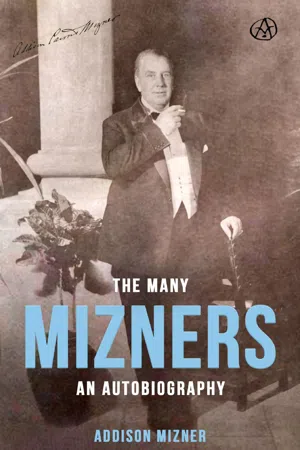
Yes, you can access The Many Mizners by Addison Mizner in PDF and/or ePUB format, as well as other popular books in Social Sciences & Social Science Biographies. We have over 1.5 million books available in our catalogue for you to explore.