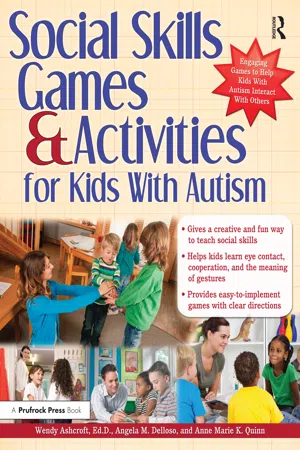
Social Skills Games and Activities for Kids With Autism provides complete instructions for using fun, engaging games and activities to teach social skills to children with autism spectrum disorders. The games include directions for assessing skills such as asking for toys, getting the attention of others, reading nonverbal gestures, understanding perspectives, and cooperating to solve problems. Using the principles of Applied Behavior Analysis, the book takes teachers through motivating, prompting, shaping, modeling, and reinforcing social skills while playing the games and helping students learn to participate in other activities such as demonstrating the social skill in role plays and the natural environment. Perfect for teachers struggling to help their students with autism learn to interact socially with their peers, these games are sure to become a much-loved part of students' daily routines.
eBook - ePub
Social Skills Games and Activities for Kids With Autism
- 216 pages
- English
- ePUB (mobile friendly)
- Available on iOS & Android
eBook - ePub
Social Skills Games and Activities for Kids With Autism
About this book
Information
CHAPTER 1
Social Skills and Children With ASD
DOI: 10.4324/9781003238034-1
Social Skills
Social interactions fill our lives. A typical day with others can start with greetings and exchanges at breakfast, conversing about the previous day, cooperating and collaborating on projects at school, participating in afterschool recreation activities, relating events of the day during dinner, and associating with family members in the evening.
Elliott, Racine, and Busse (1995) have defined the skills needed for such interactions as learned responses that enable people to interact in ways that result in positive, and avoid negative, responses from others. Most people learn these skills during their development. Immediately after birth, typically developing children perceive and analyze the responses of people to their actions. They observe how their mothers respond with attention to their cries, and they soon learn to communicate their needs for food and care. Before they are even 2 years old, even if their speech isn’t intelligible, they look at others and imitate social exchanges. Soon, they learn to make requests and comments, wait, take turns, and share. Most of these skills are learned in the context of their natural environment by watching others, imitating and experimenting, and responding to the feedback they receive from others.
However, social interactions are complex, and it takes practice and work to maintain positive social relationships. In the early stages of social development, young children may struggle with learning social behavior. For example, children may be confused about when it is acceptable to interrupt conversations or make requests. They might walk between people who are conversing or ask for things when someone is busy with an important task. Or they may ask questions that are appropriate to ask at home to strangers and make statements that others consider to be offensive.
Even as adults, we can misinterpret the intentions, communications, and actions of other people. We might misread raised eyebrows as surprise when the person is really taking offense. Or we might see a stare as a need for further explanation rather than a communication of boredom. There are also times that we are perplexed by the reactions of other people to our communications. For example, we sometimes compliment a person who then cries, or scold a child who then laughs, or joke with a person who then becomes angry.
When the reactions of others make sense to us, we have usually gained some knowledge of the previous history or current state of another person. The history or state influences their responses, so it might be that the complimented person is exhausted and relieved or that the scolded child who laughs is anxious and is relieving the anxiety by laughing. A person who has been bullied or abused may take a joke seriously and become angered by its insensitivity.
Under the best of circumstances, it can be difficult to maintain and enjoy relationships with others. As we’ll discuss in the next chapter, children with autism spectrum disorders have characteristics that make it especially challenging to develop the special friendships that make childhood so rich and wonderful.
Children With Autism Spectrum Disorders
Autism spectrum disorders (ASD) are complex conditions defined by specific behavior patterns and characteristics. Children with ASD have impairments in communication and social interaction. In addition, they have restrictive, repetitive, and stereotypic patterns of behavior as well as narrow interests and activities. Because these disorders are defined by certain sets of behaviors, it is known as a “spectrum disorder,” one that affects individuals differently and to various degrees. ASD includes children with widely varying differences in these attributes, and we find each child with an ASD to be a unique, fascinating, and wonderful individual.
Autism is considered to be of neurological origin, and brain scans show structural differences between the brains of children with ASD and children who are developing typically. No single cause has been identified and it is likely that the origin of ASD will eventually be linked to combinations of genetic and environmental factors. There is evidence that autism runs in some families, thus giving strength to the supposition that there is some genetic predisposition to ASD. However, so far, researchers have not been able to determine that genetic factors alone cause autism. A number of environmental stresses have been identified. These include exposure to environmental toxins or chemicals, viral infections, metabolic imbalances, advanced parental age, maternal illness during pregnancy, and certain difficulties during birth. These factors, by themselves, do not cause ASD, but, in combination with genetic risk factors, they seem to increase risk.
In the past decade, there has been tremendous growth in the number of children diagnosed with ASD. In fact, one study reported a 1,148% increase between 1987 and 2007 (Cavagnaro, 2007). Although there are still some who believe this growth is due to increased awareness and broad diagnoses, most careful research shows that there is a true increase. The prevalence is now estimated at 1 in 88 (Centers for Disease Control and Prevention, 2012).
ASD is generally diagnosed before the age of 3 and usually affects a person throughout life. Some people with ASD are able to live independent lives but others may have needs requiring a lifetime of support. There is no simple medical test that can be used to diagnose ASD. However, using the guidelines in the text revision of the fourth edition of the American Psychiatric Association’s Diagnostic and Statistical Manual (DSM-IV-TR, 2000), a physician can make a medical diagnosis based on an assessment of symptoms, diagnostic tests, developmental history, and input from people who know the child.
To determine if a child with ASD is eligible for services under the Individuals with Disabilities Education Improvement Act (IDEA, 2004), a multidisciplinary evaluation team comprised of various school professionals must determine that the disorder interferes with the child’s ability to succeed in the general education setting and curriculum. Although states vary in the actual requirements, most multidisciplinary teams need evaluation results from the physician, a speech-language pathologist, and an educational or psychological diagnostician (IDEA, 2004).
In this book, we have provided suggestions for teaching children who have the following three kinds of ASD: classic autism, Asperger’s syndrome, and Pervasive Developmental Disorder–Not Otherwise Specified. Classic autism (also referred to as autistic disorder) includes children who have significant language delays, social and communication challenges, unusual behaviors and interests, and sometimes an accompanying intellectual disability. Asperger’s syndrome (AS) is a form of autism also characterized by social challenges and unusual behaviors and interests. Most children with AS do not have language delays or intellectual disabilities, but still can have difficulties with social communication. The third group is composed of children who have diagnoses of Pervasive Developmental Disorder–Not Otherwise Specified (PDD–NOS). Generally, these children have fewer and milder difficulties with social, communication, and behavior challenges.
We designed this book for teachers and parents who have children who range from about 5–12 years old. However, it may be useful for some younger children who have good language skills and some older children with language delays. We believe the games and activities can be adjusted to meet the interests of the particular children you teach.
For simplicity, we will use the term teacher throughout. But parents who are able to gather friends and playmates for their children will easily be able to follow the guidelines and implement the games and activities at home.
The Characteristics of Autism Make Social Interactions Challenging
Several of the characteristics of individuals with ASD described by Ashcroft, Argiro, and Keohane (2010) are helpful in understanding more about children with ASD and why children on the spectrum have difficulty with social interactions. Considering these characteristics helps us understand some of the challenges children with ASD have in learning the social skills needed to interact effectively and comfortably with others.
CHARACTERISTIC
Individuals With ASD Often Have Difficulty Communicating With Others, Both in Conveying Information and in Understanding What Others Say
The exchange of information is important to social interaction and many children with ASD have trouble with both sides of the exchange. They may have delayed (or even absent) verbal language, interfering with their ability to convey information. In addition, they often have difficulty understanding what others say to them. This is especially true of abstract concepts, but may even include limited ability in following simple directions.
Interacting with others is more effective when children use words to explain what they want to do. Obviously, it is more acceptable to use words to make polite requests than it is to scream and point. Relating to others is also enhanced when children have the vocabulary needed to make comments, express feelings, give information or directions, and to show interest in or care for others.
Understanding language is also critical to interacting with others and to the development of appropriate social skills. Early on, being able to follow directions allows children to learn to follow social conventions (sitting when it’s appropriate to sit, waiting for desired things and attention, speaking with an appropriate volume, or even staying quiet in a place such as a library or classroom). In addition, if children understand language, it can be used to explain social expectations such as taking turns in conversations, not standing close to another person in an elevator, and not talking to strangers.
Consider this example of the power of language to help teach social skills. Alyse arrived in the parking lot of the community swimming pool with her two young children. Before they got out of the car, Alyse explained that they would need to hold her hand while walking into the building, wait while she signed in, put their clothes in the locker, and stand still while she put on sunscreen. All this, Alyse said, needed to be done before they got into the pool. Before unlocking the car doors, Alyse reviewed this twice and asked her children to list the steps themselves. As they followed this process, she labeled the steps and praised the children for following her directions. Their ability to understand the language and her ability to explain things clearly contributed to a highly successful transition from the car to the pool, resulting in an excellent demonstration of socially acceptable behavior.
In a contrary example, with children unable to understand her language, Alyse might be racing after the children to grab their hands for the walk into the building. She would be struggling to keep them in place while she signed in and to hold them still while putting on sunscreen. In most cases, impatient children demonstrate socially annoying behaviors such as whining, crying, wiggling, or even bolting away. The children, with practice, may eventually learn the routine; however, the ability to speak and understand language contributes greatly to socially appropriate behavior.
Many children with ASD have difficulty processing information when it is presented verbally. This is sometimes because they have difficulty distinguishing what is being said from background noise or distractions. Other times, children hear the words but can’t remember them long enough to act on the information they heard. This can be immediate such as when they can’t remember the first step of a two- or three-step set of directions. It can also be delayed such as when they can repeat it back, but can’t remember it when they later try to carry out the directions. Sometimes, children cannot distinguish sounds or words that sound the same. For example, rhyming words or phrases (like “take it” and “make it”) or sounds that are similar (like “ch” and “sh”) may sound the same. In addition, some children do not attend long enough or carefully enough to hear all of the words and to retain the information so it can be used.
Consider the case of Riley who, at school, goes to recess daily. On most days, Riley plays with the small stones on the surface of the playground. He makes piles, digs holes, and scoops up stones to let them fall through his fingers to the ground. On many occasions, he would throw stones into the air, letting them rain down on himself and others. His teachers frequently tell him “no playing with rocks” and to “stop throwing those stones, you’ll hurt someone.” They often follow these verbal commands with explanations about hurting people and playing with others the right way. Not only did Riley probably not hear the negation in those sentences, but he also most likely did not attend long enough to understand the explanations. The knowledge that he might be hearing only the portion “playing with rocks” and “throwing those stones” helps us understand why the behavior would continue.
CHARACTERISTIC
Individuals With ASD Often Struggle to Understand the Perspective of Others, May Have an Impaired Ability to Read and Interpret the Emotions of Others, and Might Have Difficulty Understanding Social Cues
Children with ASD often have difficulty with social reciprocity (the back and forth of social interactions). Sometimes, they do not notice the reactions of others, thus allowing them to continue on in spite of those reactions. For example, in some cases, they may persist in talking about a subject of their own interest, even if the person is backing away or looking bored. In other cases, they may not show any interest in what others talk about, making the interaction equally unsatisfactory. Other times, they may notice some reaction and misinterpret it, once again continuing on without adjusting to the response of their social partner.
In addition, some children with ASD don’t find social interaction pleasant or rewarding. They may not understand any value in smiles, nods, or even high fives. To complicate things, they may find those behaviors puzzling or even aversive.
Many children with ASD have difficulty understanding emotions. They may have difficulty labeling their own emotions to explain how they are feeling. In addition, they may not notice behaviors of others that might give clues to how those others are feeling. For example, while many typically developing children see the relationship between another person’s tears and the word “sad,” some children with ASD don’t make that connection.
Children with ASD may not understand the perspective of others. For example, they might believe that if they know something, everyone should know it—or, if they can see it, everyone can see it. They may say something that sounds rude and insensitive and not understand why someone would take offense.
Children with ASD are often so focused on their own interests, needs, and wants that they don’t notice or understand the desires of others. Consider Camden’s situation as he played with Emily at school. At first, Emily sought out Camden in center time play activities, and Camden responded consistently to her guidance. For example, while playing in the housekeeping center, Emily told Camden to fix her lunch. Over the next few days, she directed him in building with blocks and playing with trains. Soon, Camden began to seek Emily out in all activities of the day. Every day, he wanted to sit by her at circle time, do all center activities with her, and eat his lunch beside her. Eventually, Camden became upset if Emily chose to play with anyone else. His agitation increased to the point that he pushed other children to get near Emily or cried when he could not play with her. Eventually, Emily asked her teacher to place her in centers without Camden and find her another place to sit during circle time and lunch. Camden could not understand why Emily did not want to be with him all of the time during the...
Table of contents
- Cover
- Half Title
- Title Page
- Copyright Page
- Table of Contents
- Chapter 1 Social Skills and Children With ASD
- Chapter 2 Essential ABA Principles for Teaching Social Skills
- Chapter 3 Strategies and Methodologies Useful for Teaching Social Skills
- Chapter 4 Assessing and Monitoring Social Skills
- Chapter 5 Using the Complete the Puzzle Framework
- Chapter 6 The 10 Social Skills and the Games and Activities
- Chapter 7 Adapting the Puzzle Framework for Early Learners
- Conclusion
- References
- About the Authors
Trusted by 375,005 students
Access to over 1.5 million titles for a fair monthly price.
Study more efficiently using our study tools.
Frequently asked questions
Yes, you can cancel anytime from the Subscription tab in your account settings on the Perlego website. Your subscription will stay active until the end of your current billing period. Learn how to cancel your subscription
No, books cannot be downloaded as external files, such as PDFs, for use outside of Perlego. However, you can download books within the Perlego app for offline reading on mobile or tablet. Learn how to download books offline
Perlego offers two plans: Essential and Complete
- Essential is ideal for learners and professionals who enjoy exploring a wide range of subjects. Access the Essential Library with 800,000+ trusted titles and best-sellers across business, personal growth, and the humanities. Includes unlimited reading time and Standard Read Aloud voice.
- Complete: Perfect for advanced learners and researchers needing full, unrestricted access. Unlock 1.5M+ books across hundreds of subjects, including academic and specialized titles. The Complete Plan also includes advanced features like Premium Read Aloud and Research Assistant.
We are an online textbook subscription service, where you can get access to an entire online library for less than the price of a single book per month. With over 1.5 million books across 990+ topics, we’ve got you covered! Learn about our mission
Look out for the read-aloud symbol on your next book to see if you can listen to it. The read-aloud tool reads text aloud for you, highlighting the text as it is being read. You can pause it, speed it up and slow it down. Learn more about Read Aloud
Yes! You can use the Perlego app on both iOS and Android devices to read anytime, anywhere — even offline. Perfect for commutes or when you’re on the go.
Please note we cannot support devices running on iOS 13 and Android 7 or earlier. Learn more about using the app
Please note we cannot support devices running on iOS 13 and Android 7 or earlier. Learn more about using the app
Yes, you can access Social Skills Games and Activities for Kids With Autism by Wendy Ashcroft,Angie Delloso,Anne Quinn in PDF and/or ePUB format, as well as other popular books in Education & Inclusive Education. We have over 1.5 million books available in our catalogue for you to explore.