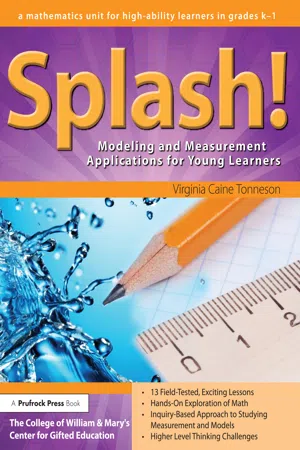
Splash! is a mathematics unit for high-ability learners in kindergarten and first grade focusing on concepts related to linear measurement, the creativity elements of fluency and flexibility, and the overarching, interdisciplinary concept of models. The unit consists of 13 lessons centered on the idea of designing a community pool. Students examine the question of why we measure, the importance of accuracy in measurement, and the various units and tools of measurement. The unit presents a hands-on, constructivist approach, allowing children to build their knowledge base and their skills as they explore mathematical ideas through play and planned investigations. Students are involved in creative and critical thinking, problem solving, process skill development, and communication.
Grades K-1
eBook - ePub
Splash!
Modeling and Measurement Applications for Young Learners in Grades K-1
- 100 pages
- English
- ePUB (mobile friendly)
- Available on iOS & Android
eBook - ePub
Splash!
Modeling and Measurement Applications for Young Learners in Grades K-1
About this book
Information
Part One: Introduction
Introduction to the Unit
DOI: 10.4324/9781003238171-2
Unit Overview: Splash! Modeling and Measurement Applications for Young Learners is a unit for students in kindergarten and first grade that focuses on the mathematical concepts related to linear measurement, the creativity elements of fluency and flexibility, and the overarching, interdisciplinary concept of models. The unit consists of 13 lessons centered on the idea of designing a community pool. Students examine the question of why we measure, the importance of accuracy in measurement, and the various units and tools of measurement. The unit presents a hands-on, constructivist approach, allowing children to build their knowledge base and their skills as they explore mathematical ideas through play and planned investigations. Students are involved in creative and critical thinking, problem solving, process skill development, and communication opportunities.
Essential Understandings in Mathematics:
- Objects with different attributes are measured in different ways (appropriate measurement).
- An item remains the same length even when placed in a different position (conservation).
- Knowing the relationship between one item and a second item, and between the second item and a third item, one may deduce the relationship between the first item and third item (transitivity).
- The length of an object can be divided into equal-sized units (partitioning).
- Accurate measurements require identical units, precise starting and ending points, no gaps or overlaps in coverage, and partitioning of leftover (non-whole) units (measurement accuracy).
- The length of a larger unit may be made up of repeating smaller units (unit iteration).
- Certain units convey what is being measured better than others (appropriate units).
- Certain tools work better than others to measure the same attributes (appropriate tools).
- The larger the unit of measure, the smaller the number of units needed to measure a particular object; the smaller the unit of measure, the larger the number of units needed to measure that same object (inverse relationship between size of units and number of units).
Unit Concept Map: This concept map (see Figure 1) illustrates various measurement ideas presented in this unit and their relationships to each other. Some concepts, such as area and volume, are not directly taught in this unit, but can easily be discussed as extensions.

Overarching Concept: The overarching, interdisciplinary concept for this unit is models. Students come to understand that models are simplifications of objects, ideas, or processes. Models can be physical, conceptual, or mathematical. In this unit, students learn more about the usefulness of physical models.
The second lesson in this unit introduces the concept of models. Students generate a list of examples of models and then categorize their examples, identify nonexamples, and make generalizations about models. The following generalizations are supported by and incorporated into the unit lessons.
- Real things can be represented by pictures, drawings, diagrams, objects, or actions.
- Models are simpler and often smaller versions of something.
- People use models to help solve problems.
- Models can be used to test ideas, solutions, and plans.
- Mathematicians use mathematical models to provide ways to solve problems using numbers.
Main Ideas in Mathematics: This unit builds on nine main ideas.
- Objects with different attributes are measured in different ways (appropriate measurement). Therefore, one might talk about the depth of a swimming pool, but not the depth of a sign painted on a wall. Similarly, one measures the length, width, and height of a three-dimensional object, but only the length and width of a two-dimensional object.
- An item remains the same length even when placed in a different position (conservation). Therefore, a 2-foot-long stick will remain that length whether it is lying flat, standing on its end, or leaning at an angle. Similarly, two items of equal length will remain equal even when they are moved to different positions in relation to each other.
- Knowing the relationship between one item and a second item, and between the second item and a third item, one may deduce the relationship between the first item and third item (transitivity). Therefore, if a child and a stick are the same height, and the stick and a bookcase are the same height, then the child and the bookcase will be the same height. An understanding of transitivity is necessary for students to make indirect comparisons.
- The length of an object can be divided into equal-sized units (partitioning). Therefore, a piece of string can be folded into four equal lengths.
- Accurate measurements require identical units, precise starting and ending points, no gaps or overlaps in coverage, and partitioning of leftover (non-whole) units (measurement accuracy). Therefore, if one wants to measure the height of the middle shelf of a bookshelf, the starting point is no longer at the bottom of the bookshelf, nor is the ending point at the top of the bookshelf. One would measure the bookshelf using like units, such as inches, and would express the non-whole remaining units as some portion of an inch.
- The length of a larger unit may be made up of repeating smaller units (unit iteration). Therefore, a table may be measured by repeatedly placing a craft stick along its length and counting how many craft sticks long the table is. A child who has not yet developed the logic of unit iteration may tell you that the craft stick is too short to measure the table.
- Certain units convey what is being measured better than others (appropriate units). Therefore, one might use inches to measure the length of a piece of string, but not to measure the length of a swimming pool.
- Certain tools work better than others to measure the same attributes (appropriate tools). Therefore, one might use a ruler to measure a short piece of string, but a tape measure to measure the length of a room.
- The larger the unit of measure, the smaller the number of units needed to measure a particular object; the smaller the unit of measure, the larger the number of units needed to measure that same object (inverse relationship between size of units and number of units). Therefore, an object that measures 10 craft sticks long may measure 36 paper clips long.
Supporting Ideas in Mathematics: There are several other important supporting mathematical concepts that this unit touches upon:
- Items may be grouped by comparing and contrasting their attributes (classification). Therefore, while two objects may each have a length and a width, if one also has a height, it becomes part of a different group (three-dimensional objects).
- Sometimes a close approximation of a number is accurate enough (rounding). Therefore, saying the length of a table is “about 20 craft sticks long” may be a less precise but more manageable measurement.
- Sets of items may look different, but represent the same amount (equivalence). Therefore, 29 paper clips laid end-to-end, 8 craft sticks laid end-to-end, and a yardstick could represent the same length.
- Using what you know about two objects may be helpful in estimating an attribute of one of the objects. Therefore, one might reason that because the smaller table is 20 craft sticks long, the larger table is approximately 30 craft sticks long.
Critical Thinking Skills:
- Students should be taught to think about their mathematical reasoning (meta-cognition) and should be encouraged to explain the strategies they used to get their answers. How do they know their answer is correct?
- Students need to understand the connections between mathematics and the world around them. They should develop an understanding of how mathematics is an integral part o...
Table of contents
- Cover
- Half Title
- Title Page
- Copyright Page
- Contents
- Part One: Introduction
- Part Two: Lesson Plans
- Part Three: Unit Extension and References
- Common Core State Standards Alignment
Trusted by 375,005 students
Access to over 1.5 million titles for a fair monthly price.
Study more efficiently using our study tools.
Frequently asked questions
Yes, you can cancel anytime from the Subscription tab in your account settings on the Perlego website. Your subscription will stay active until the end of your current billing period. Learn how to cancel your subscription
No, books cannot be downloaded as external files, such as PDFs, for use outside of Perlego. However, you can download books within the Perlego app for offline reading on mobile or tablet. Learn how to download books offline
Perlego offers two plans: Essential and Complete
- Essential is ideal for learners and professionals who enjoy exploring a wide range of subjects. Access the Essential Library with 800,000+ trusted titles and best-sellers across business, personal growth, and the humanities. Includes unlimited reading time and Standard Read Aloud voice.
- Complete: Perfect for advanced learners and researchers needing full, unrestricted access. Unlock 1.5M+ books across hundreds of subjects, including academic and specialized titles. The Complete Plan also includes advanced features like Premium Read Aloud and Research Assistant.
We are an online textbook subscription service, where you can get access to an entire online library for less than the price of a single book per month. With over 1.5 million books across 990+ topics, we’ve got you covered! Learn about our mission
Look out for the read-aloud symbol on your next book to see if you can listen to it. The read-aloud tool reads text aloud for you, highlighting the text as it is being read. You can pause it, speed it up and slow it down. Learn more about Read Aloud
Yes! You can use the Perlego app on both iOS and Android devices to read anytime, anywhere — even offline. Perfect for commutes or when you’re on the go.
Please note we cannot support devices running on iOS 13 and Android 7 or earlier. Learn more about using the app
Please note we cannot support devices running on iOS 13 and Android 7 or earlier. Learn more about using the app
Yes, you can access Splash! by Virginia Caine Tonneson,Clg Of William And Mary/Ctr Gift Ed in PDF and/or ePUB format, as well as other popular books in Education & Teaching Mathematics. We have over 1.5 million books available in our catalogue for you to explore.