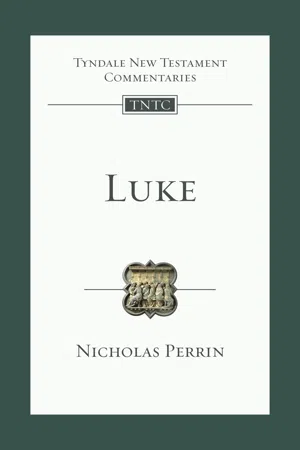
In this insightful and accessible biblical commentary, Nicholas Perrin explores the many unique pictures of Jesus found in the Gospel of Luke - from being a child in his Father's house to associating with the poor and disreputable, in communion with the Holy Spirit, and, above all, setting out resolutely for Jerusalem to fulfil God's plan for the world.
With particular attention to the redemptive-historical storyline and its scriptural roots, Perrin examines how Luke's Gospel is embedded in human history. He also show how it follows a cyclical narrative structure, with each recapitulation expanding the horizons of what has gone before.
Part of the Tyndale New Testament commentary series, Luke: An Introduction and Commentary examines the text section-by-section - exploring the context in which it was written, providing astute commentary on Luke's Gospel, and then unpacking the theology. It will leave you with a thorough understanding of the content and structure Gospel of Luke, as well as what it means and its continued relevance for Christians today.
The Tyndale New Testament Commentaries are ideal Bible commentaries for students and teachers of theology, as well as being usable for preachers and individual Christians looking to delve deeper into the riches of Scripture and discover its meaning for today.
Perceptive, cogent and thorough, Nicholas Perrin's commentary on Luke will give you a renewed appreciation for Luke's Gospel and a greater understanding of why it is such a vital part of Scripture.
- English
- ePUB (mobile friendly)
- Available on iOS & Android
eBook - ePub
About this book
Information
Topic
Theology & ReligionSubtopic
Biblical CommentaryCOMMENTARY
1. Prologue (1:1–4)
Context
In approaching any literary work, we will always find that genre matters. This should be obvious enough on considering the differing strategies readers adopt when they take in a newspaper article as opposed to, say, a science-fiction story. Consciously or unconsciously, we rely on certain textual signals as we discern a text’s genre. This was as true in antiquity as it is today. As Luke beckons his readers into his story through the doorway of this prologue, he immediately offers us the calling card of a historian. Everything about Luke 1:1–4 seems to say in so many words, ‘This is serious history.’
Modern Western readers tend to associate ‘serious history’ with a dispassionate and objective recounting of events. Good historians, we tell ourselves, at least try not to let on that they have a particular agenda. Nothing could be further from the case when it comes to ancient historiography. For the ancient historians, it was exactly their commitment to the facts and interpretation that qualified them to speak authoritatively. That is why Luke never claims to be objective, either here or at any other point in his two-volume set. He is unapologetically committed to the facts, true enough, but he is also – equally unapologetically – motivated by his theological interests. Like those before him who also had ‘undertaken to set down an orderly account’ (namely, Matthew and Mark), Luke wants to impress upon his readers the wonders of the earthly and Risen Lord Jesus Christ, as well as the necessity of placing faith in him.
Comment
1. Luke states that many have undertaken to set down an orderly account (diēgēsis), similar to the story he is about to tell. The word diēgēsis was a semi-technical term, referring to a ‘well-ordered, polished product of the historian’s work’.1 This would certainly support the Evangelist’s attempt to position his material as credible history. But in Luke’s writing, the verbal cognate of the same noun is regularly used in connection with God’s mighty acts.2 This implies that the author seeks to provide not just a biography of Jesus but also a narrative of God’s works through Jesus. These mighty works include certain salvific events which have been fulfilled among us. For Luke, then, the story which he is about to tell must be set in the broader context of God’s purposes – past, present and future.
2. Eager to vouch for the accuracy of his own account, Luke next informs his readers that the materials he received were handed on (paredosan) by eyewitnesses and servants of the word. The verb here often refers to the transmission of official traditions (1 Cor. 11:23; 15:1–3; 1 Thess. 4:1–2), suggesting that the process of passing on ‘Jesus stories’ was a carefully executed, even solemn task. Meanwhile, governed by a single article, the nouns eyewitnesses and servants actually refer to two aspects of the same role. The mediators of this tradition are eyewitness-servants, who are likely the apostles themselves (cf. Acts 26:16).3 The apostles serve God’s people by collectively standing by their traditions as authoritative eyewitnesses of the events they relate. As such they are also the self-identified guarantors of the gospel truth which now stands to be perpetuated through established ecclesial structures.
3. Luke himself claims to have investigated everything (1) from the very first, (2) carefully and (3) in an orderly fashion. The phrase from the very first (anōthen) speaks of Luke’s decision to begin with the birth narrative, as well as to the overall comprehensiveness of his biographical account.4 Working within the framework of transmitted traditions yet building upon them, Luke claims to have done fresh investigative work according to the best historiographical practices of his day. He does so for the sake of one Theophilus, a figure who was either a fictitious construct representing every friend (philos) of God (theos) or, as maintained above, an actual person.
4. The point of all this is to assure the truth (asphaleia) or certainty of the proclaimed gospel – in regard to not only the isolated historical facts but also their apostolic interpretation. For Luke, salvific event and interpretation are inseparable; together both must stand up to scrutiny. History and faith together stand as the bedrock for the gospel story he is about to tell.
Theology
Luke calls his story an ‘orderly account’ or a ‘narrative’ (ESV) of events. Now, as Aristotle pointed out, the very concept of narrative – complete with a beginning, a middle and an end – assumes a logical sequence of events. The concept of sequence is important. Far too often, modern readers of the Gospels have treated the authorized stories of Jesus as a hodgepodge of random incidents and teachings with little discernible relationship to one another. The same readers may wonder whether there is any rhyme or reason to the ordering of the stories, aside from a rough chronological interest. But by identifying his story as a diēgēsis and therefore an orderly account, Luke is claiming that his plot has a linear progression. This means that the Evangelist’s readers need to be sensitive to the narrative as a whole, even when examining the shortest of sayings or stories. Nothing is arbitrary: every word, sentence, paragraph, must be appreciated in relation to that which precedes and that which follows. Because Luke offers an organic narrative, the responsible interpreter must constantly look to the Gospel writer as his own best interpreter.
Moreover, because the Evangelist sees the events surrounding Jesus’ life, death, resurrection and ascension as having been ‘fulfilled among us’, he also sees his own narrative as an authorized extension of the Old Testament narrative, the writings of the likes of ‘Moses, the prophets, and the psalms’ (24:44). If the second-century heretic Marcion reduced the four Gospels to a pared-down version of Luke’s story simply because the third Gospel seemed to have the least to do with the God of Israel, it is only because he badly misunderstood that story in the first place. According to our Evangelist, the revelation of Jesus Christ is a progressive revelation, which fits snugly within the larger, overarching framework of the story of Israel.
1. Van Unnik, ‘Prologue’, pp. 12–13.
2. Green, p. 38.
3. Though see Kuhn (‘Beginning the Witness’), who wants to extend the term to select individuals from Luke 1 – 2.
4. Some commentators (e.g. Fitzymer, p. 298), however, understand from the very first as from the start of Jesus’ ministry in Luke 3:23.
2. INFANCY NARRATIVE (1:5 – 2:52)
A. Two birth announcements (1:5–38)
Context
The narrative action begins by focusing on Jesus’ forerunner John, as well John’s parents, Zechariah and Elizabeth. In all four Gospels, John the Baptizer plays an inestimably important role. Yet it is Luke, more than any other Gospel writer, who highlights John’s significance. In 1:5–38, Luke puts the prenatal histories of John and Jesus side by side. He does so to anticipate their mutual association and to establish a contrast. As great as John was, Jesus was greater.
To put Gabriel’s dual birth announcements in the same category as the many angelic appearances in Luke–Acts would be to miss the point. Gabriel stood at the top of the angelic hierarchy (cf. 1 En. 40:9). His appearance at the beginning of Luke’s story strikes an auspicious note. Further, Luke’s more well-versed readers would have been aware that when Gabriel first appears in Scripture, in the book of Daniel, he comes to reveal a flickering light of hope at the far end of the dark tunnel of exile (Dan. 8:16; 9:21). Now that flickering light, Luke begins to hint, is about to come into view.
The birth announcements of John and Jesus parallel each other in step-by-step fashion. Both conceptions announced by Gabriel are miraculous; both involve the Holy Spirit; finally, both are singled out as having redemptive significance.1 Of course, there are contrasts as well. Two are salient. First, whereas the announcement of John’s birth takes place in the temple in Jerusalem, news of the coming Messiah’s birth is first broadcast in an insignificant and out-of-the-way location. Second, while the priest Zechariah disbelieves the angel’s message and is rendered mute, the obedient response of a barely pubescent girl finally culminates in a declaration of God’s praises (1:46–55). The movement from unbelieving priestly man to believing common girl, from officially sanctioned sacred space to newly established sacred spaces, augurs the over...
Table of contents
- Cover
- Title
- Dedication
- Copyright
- Contents
- General Preface
- Author’s Preface
- Abbreviations
- Select Bibliography
- Introduction
- Analysis
- Commentary
- 2. Infancy Narrative (1:5 – 2:52)
- 3. Jesus’ Preparation for Ministry (3:1 – 4:13)
- 4. Ministry in Galilee (4:14 – 9:50)
- 5. Journey to Jerusalem (9:51 – 19:27)
- 6. Ministry in Jerusalem (19:28 – 21:38)
- 7. Passion Narrative (22:1 – 23:56)
- 8. Resurrection Narrative (24:1–53)
Trusted by 375,005 students
Access to over 1.5 million titles for a fair monthly price.
Study more efficiently using our study tools.
Frequently asked questions
Yes, you can cancel anytime from the Subscription tab in your account settings on the Perlego website. Your subscription will stay active until the end of your current billing period. Learn how to cancel your subscription
No, books cannot be downloaded as external files, such as PDFs, for use outside of Perlego. However, you can download books within the Perlego app for offline reading on mobile or tablet. Learn how to download books offline
Perlego offers two plans: Essential and Complete
- Essential is ideal for learners and professionals who enjoy exploring a wide range of subjects. Access the Essential Library with 800,000+ trusted titles and best-sellers across business, personal growth, and the humanities. Includes unlimited reading time and Standard Read Aloud voice.
- Complete: Perfect for advanced learners and researchers needing full, unrestricted access. Unlock 1.5M+ books across hundreds of subjects, including academic and specialized titles. The Complete Plan also includes advanced features like Premium Read Aloud and Research Assistant.
We are an online textbook subscription service, where you can get access to an entire online library for less than the price of a single book per month. With over 1.5 million books across 990+ topics, we’ve got you covered! Learn about our mission
Look out for the read-aloud symbol on your next book to see if you can listen to it. The read-aloud tool reads text aloud for you, highlighting the text as it is being read. You can pause it, speed it up and slow it down. Learn more about Read Aloud
Yes! You can use the Perlego app on both iOS and Android devices to read anytime, anywhere — even offline. Perfect for commutes or when you’re on the go.
Please note we cannot support devices running on iOS 13 and Android 7 or earlier. Learn more about using the app
Please note we cannot support devices running on iOS 13 and Android 7 or earlier. Learn more about using the app
Yes, you can access Luke by Nicholas Perrin in PDF and/or ePUB format, as well as other popular books in Theology & Religion & Biblical Commentary. We have over 1.5 million books available in our catalogue for you to explore.