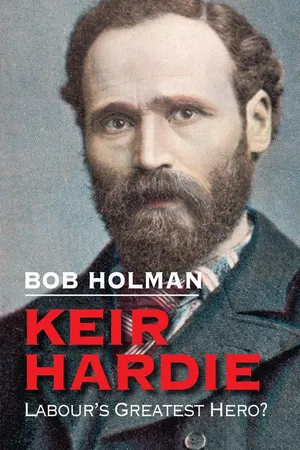
Hardie’s Scotland, the Scotland of the nineteenth century, experienced a huge growth in industry, commerce, trade, and financial institutions, with resultant large incomes for many citizens. Yet, as Professor T. C. Smout states in his seminal study, there were losers as well as winners. He wrote, “The age of great industrial triumphs was an age of appalling social deprivation. I am astounded by the tolerance… of unspeakable urban squalor, compounded by drink abuse, bad housing, low wages, long hours and sham education.”1 This too was Hardie’s Scotland.
Over the century, partly as a result of improvements in machinery, the numbers of jobs in farming and textiles declined by half. Some would have obtained employment in the growing coal-mining industry but found themselves subject to fluctuating demand and no job security. Smout continues that miners, in particular, “generally had no option but to live in company houses which were among the most inadequate and disgusting of all Scotland’s miserable housing stock”.2
For instance in 1892 in Auchenraith there were 492 people who lived in 42 single-room and 41 two-room houses, who had no wash houses and shared twelve doorless privies, an open sewer, and two drinking fountains. It was no wonder that miners and their families were exposed to dreadful diseases above the ground while the men suffered coal-related illnesses and severe accidents below. Hardie was a miner.
The hard labour and long hours were not compensated by adequate incomes. In 1867, unskilled workers (30 per cent of the total) received on average £20 10s. a year while one earner in three hundred (and not always earners but those whom Hardie called the “idle rich” whose money was derived from rents, shares, and dividends) received an average of £3,952 a year. Nor was there any state unemployment pay or pension. Those who suffered unemployment, sickness, or old age had no recourse but grudging charity or the workhouse.
At least Hardie was born in a Britain which had passed the Reform Acts of 1832. In fact, for all their fame, their outcomes in terms of extending the vote were small. In Scotland, the number of men with votes rose to a mere 65,000. The Scottish Reform Act of 1868 made a larger impact, with the vote granted to ratepaying male householders and £10-a-year lodgers in towns and to small owners and tenants paying a middling rent in the countryside. The larger electorate also led to greater local party activity in selecting candidates, winning support, and getting voters to polling stations. The victory of the Tories in the general election of 1874 was partly attributed to their improved local organization.
Welcome as it was, the extended franchise made little difference to the kinds of people who became MPs or the nature of political parties. MPs – who were unpaid and required money for electoral expenses – continued to be drawn from the aristocracy, very wealthy businessmen, and members of the professions, particularly lawyers. The number of working-class MPs was minimal and the few who were elected were paid by and so were dependent upon a political party. The two main parties (apart from Irish MPs), the Liberals and the Tories, continued to dominate politics and to rule in their own interests. Scotland had long been in the hands of the Liberals, who were seen as more sympathetic toward working people. In his early life, Hardie favoured them.
A HARD CHILDHOOD
Hardie was born on 15 August 1856, in a one-room house in Legbrannock, near Holytown in Lanarkshire, some ten miles from Glasgow. His mother, Mary Paterson, was a farm servant who lived with her mother Agnes. At the age of twenty-six, she had become pregnant by a miner, William Aitken, against whom she successfully pursued a paternity suit. She called the baby James Keir.
Aitken took no interest and probably did not, as the sheriff court had ordered, pay Mary £1 10s. for lying-in expenses and £6 a year. Mary continued to work in the fields. Grandmother Agnes looked after the child. She was a story teller and singer and Keir Hardie (as he became known) later spoke fondly of her. He could play in the fields and he always had a streak which looked back upon rural Britain with affection.
In 1859 Mary married a ship’s carpenter from Falkirk, David Hardie, in the Church of Scotland in Holytown on 21 August 1859. In time she was to have a further six sons and two daughters by him. David was a resolute and sensible man who always sought work and accepted Keir as his own son – except when he got drunk and called him “bastard”. They moved to Glasgow to seek work found in a Govan shipyard. Nonetheless, the growing family made life a financial struggle.
Mary was always keen that Keir should be educated. She probably taught him the basics, for she could certainly read. It may be that he attended a school for a very short period. There are references to a clergyman who gave him lessons. The boy responded with enthusiasm and would pick up discarded newspapers as his lesson books.
The Education Act (1872) which established compulsory education for five- to thirteen-year-olds came just too late for Keir Hardie. He started work aged eight, which is probably what he meant when he later said, “I am of the unfortunate class who never knew what it was to be a child.” Hamilton Fyfe cites Hardie as saying: “Under no circumstances, given freedom of choice, would I live that part of my life over again.”3 He was referring to his working childhood. From being a message boy in Glasgow he moved on to a printer’s and then a brass-fitting shop. The latter did not last, as his parents discovered that he would go unpaid for a year as part of his apprenticeship. Next he was in Thompsons Shipyards, heating up rivets for men to hammer in. The work was carried out at a height and, when the boy next to him fell to his death, Mary immediately withdrew Keir from the place.
Matters got worse. David Hardie suffered an accident which meant he could not work. By the time he recovered, a recession and shipyard strike had started in 1866. The family were forced to sell their meagre possessions and moved to one room in Partick. Keir was the breadwinner, with 3s. 6d. a week from a high-class baker’s with his job delivering bread and rolls. There followed an incident which engraved itself into Hardie’s being. It is best to use his words written many years later.
The incident planted in Hardie a venomous scorn of hypocritical wealthy Christians. As an adult he became a Christian and his life was characterized by his love for Christianity and his dislike of many so-called Christians.
THE MINER
Later that year, David Hardie went back to sea, which was the only place he could obtain work, as a ship’s carpenter. The family moved to the small mining village of Newarthill. On the very day his father left, ten-year-old Keir started work in the pits owned by the Monkland Iron Company for a shilling a day. He worked from 6 a.m. to 5.30 p.m. six days a week plus four hours on Sunday. This did not count his three-mile walk to and from the pit. In winter, he hardly ever saw the sun. William Stewart, in a biography written for the Independent Labour Party six years after Hardie’s death, adds that at this time, although it may well have been later, “he began to attend Fraser’s night school at Holytown… There was no light provided in the school and pupils had to bring their own candles.”4 Here he learned the rudiments of grammar and syntax.
His job was that of “a trapper”, that is he operated the trap door that let air into the mine-shaft. Aged twelve, he was promoted to draw the pit ponies underground. Mining was dangerous enough. As many pit-owners cut costs by ignoring legal safety standards, which were rarely applied, it became increasingly threatening. Before long, Keir Hardie was involved in a pit accident. Again, it is best to write what he recorded after the event.
The twelve-year-old had heard about pit accidents and now he had experienced one. Later he was to campaign strongly for effective legislation to be implemented to reduce their numbers. Trade unionism was not strong in this mine but he had witnessed the readiness of other miners to endanger themselves for the sake of colleagues. Not least, Keir Hardie never failed to identify people such as Rab Mair whose character and ability stood out.
The census of 1871 reveals that the family lived at 88 Durngaber Rows, Quarter Iron Works. It consisted of David Hardie (46), his wife Mary (38), James, that is Keir (14), Agnes (9), Alex (7), William (4) and David (2 months). Mary could not have envisaged in her wildest dreams that two of these boys (plus George, yet to be born) would become MPs.
When Keir was about seventeen, David Hardie, having returned home, found a job as a carpenter at the Quarter Iron Works. The family moved again and were housed in a colliers’ row with no sanitation and no running water. The Franco-Prussian War lessened competition from coalfields abroad and wages rose. The Hardie youngsters had boots and a second set of clothes. Then the enterprising Mary opened a shop in her house which undercut prices in the Ironmaster’s own store. David Hardie was ordered to shut it. Writers have sometimes overlooked that he too was a resolute and principled man: he refused and was sacked.
David and Mary had abandoned religion under the influence of the freethinker Charles Bradlaugh, whose writings they seemed to know, at least by report. But they had no objections to lessons being given to Keir by an evangelical clergyman, Dan Craig from Hamilton. Moreover, Mary encouraged him to attend an evening class at which he mastered shorthand. Keir’s daughter, Nan, later recorded that “he learnt to write shorthand, scratching the characters with the aid of his pit lamp on a slate blacked with smoke”.5
CHRISTIAN AND TRADE UNIONIST
David Hardie could be a hard drinker and Mary was determined that her children would not adopt the same vice. Much of Glasgow and beyond was gripped by a culture of heavy drinking. In response, the temperance movement came to the fore. Mary rejoiced when her eldest son joined the local branch, the Good Templars, and when he took the pledge at the age of seventeen. It was dominated by evangelical Christians...