- 192 pages
- English
- ePUB (mobile friendly)
- Available on iOS & Android
eBook - ePub
About this book
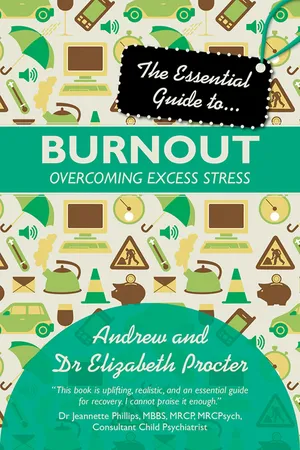
Increasing numbers of people are enduring huge levels of stress, economic pressures, family concerns, worries about jobs and health all contribute. And for many, the stress gets worse, increasing until they cannot even get out of bed to start the day. Their personality changes, their relationships become strained and before long they realize that they have hit burnout; their mind, body and spirit simply cannot take any more. It is preventable. This book enables the reader, wherever they are on the slope toward burnout, to overcome. If they are in the middle of it, it is the first step towards a full recovery and will provide the tools necessary to ensure that they never go back.
Information
Topic
Personal DevelopmentSubtopic
Mental Health & WellbeingPART ONE
This first part of the book is designed to help you understand how burnout works and assess whether you might be heading for it. We give guidance on the major symptoms of burnout, how stress works and can become overstress, and factors in life which tend towards burning us out.
1
What is Burnout and Have I Got It?
Here is the full version of Ed’s story, of which we have seen a little already.
Interview: Ed
I was a company director in the manufacturing industry. Manufacturing is a dynamic industry with lots of excitement and constant decision-making. There is extreme pressure to deliver – it is not uncommon to have to work late and go in at weekends. It is a very male and macho world with lots of bravado, but also covering up.
I was a fast track career person. Work was pretty much me; I didn’t have anything I could talk about outside of work. At the age of thirty-five I was with a new company and being given more responsibilities. I had a long commute each day, and at home all the domestic talk was about moving nearer to my work and finding more quality time to spend with my young family. That year we took a holiday in Italy. It was not the relaxing time I had hoped for and as a consequence I became frustrated, tired and angry. Toward[s] the end of the holiday I smacked my head on a low door lintel. I started to sob and sob. I curled up on the floor. I thought, “I can’t go on any more” but I realized I had to go back to work almost more tired than when I started the vacation.
Once back in the UK, I continued to lose confidence in myself and went into a period of low mood and self-questioning. I suppressed it by working harder and managing to disguise the symptoms. No one at work was aware [of] how I was feeling. At home it was a different matter; I was impatient with my young children and getting more distant from my wife.
Following a restructuring of the business, I was overlooked for promotion and did not get on with my new boss. Overall the new job was unchallenging. I reconsidered my career and took voluntary redundancy. This led to a period of depression.
Through the support of my wife and close friends, I started to look at the alternative career options available and set about planning a new start that would combine work and home life in a more balanced way.
I attribute getting better to keeping a reflective diary, reading and understanding what was happening to me. I realized I was treating my wife and family as trappings of the success of my career. A friend suggested I try writing down what I thought was my purpose in life. I was surprised when it didn’t mention work! I thought hard about what I wanted to be remembered for, beyond my job title and prestige. I tried to develop clear boundaries between home and work. I learned how to say no, to turn off my BlackBerry and give quality time to my wife and children.
I think individuals have to recognize themselves what is happening, and that all too often you don’t recognize it until it is too late. Ask yourself if you have a supportive network around you, and whether you have empowered them to give you honest feedback. If you have, are you receptive to it? And try to get feedback from as many sources as are relevant.
Overall, I have gained from having taken the time and effort to really understand who I am and what I am like when at my best. I have made my life less chaotic and cluttered by saying no to some things; I try to engage fully in all aspects of my life. I am less ambitious and see life as not simply being work-focused.
Ed’s case is a classic one of burnout through overwork. But what is burnout? This first chapter looks at what burnout is, and offers ways we can assess if we are suffering from it.
WHAT IS BURNOUT?
Burnout can be very difficult to define, even though it is so prevalent and we all think we know what we mean by it. Burnout doesn’t happen to us overnight but is the end result of a long and often slow process described as:
being driven by an ideal, working harder and harder, putting one’s own needs last, feeling miserable, isolated and denying what is happening, the death of one’s values leading to cynicism, frustration and disengagement, feelings of inner emptiness and finally both physical and mental collapse.1
The International Classification of Diseases (ICD-10) lists the following symptoms of burnout:
- physical and mental exhaustion and fatigue after minimal effort
- muscle aches and pains
- dizziness
- tension headaches
- sleep disturbance
- an inability to relax
- irritability
- inability to recover after rest, relaxation or entertainment.
All these symptoms need to last at least three months, and they should not be able to be explained by a different illness (such as depression). Is this true of you? Then maybe you are burnt out.
BURNOUT AND STRESS
Burnout comes when we overdo it for too long, and when our energy is used up faster than it is restored. “Burnout is not an event but the end point in burning down.”2 However we define burnout, we know that it is fundamentally about our levels of stress.
Stress is a normal part of our make-up. We use the word “stressed” when someone is not coping well, but doctors and psychologists talk about a “stress response” to mean a whole range of physiological changes that our brain triggers in order to prime our body to be alert and ready for action. “Stress” has become a catch-all term to describe the body’s reaction to pressure (more on this in Chapter 3). But for now, what we need to know is that the body produces an array of hormones in response to a range of things, including danger, but also to normal life events, even meeting a friend. This response is designed to be a short-term reaction; the hormones are produced for specific events, and then their levels in the bloodstream die away. However, problems begin to occur if we are under prolonged pressure (chronic stress) and the stress hormone levels remain very high for a long period. This will mean they do not return to their normal resting state, but continue to be pumped round in the bloodstream. If they become a permanent feature of everyday life, we will eventually get burnt out.
Another writer on burnout, the psychiatrist Glenn Roberts, whose model we use later in this chapter, says, “Burnout is not the result of stress but of mismanaged stress.”3 You might like to think over the concept of chronic stress for yourself. Do you think you have pushed yourself beyond your natural limits for too long?
WHERE DOES BURNOUT COME FROM?
One way to see where the excess stress is coming from is to think about internal and external pressures.
External pressures
Burnout is often connected with professional work, and that is where most of the research has been done. Life at work can become so stressful that it takes over and eclipses all else. Studies show that when people feel torn between home and work, work usually wins. But stress within family circumstances, particularly among long-term carers, can prove to be too much. Burnout, however, need not be limited to one scenario. Overstress can result from different parts of our lives all going wrong together and, as we say, “It all begins to get too much.” As more people, especially women, balance both a working life and a caring family role, this can lead to excess stress.
Jane had demands on her from work, her frail elderly mother, and her son and daughter, and at times she didn’t know who to put first. It was only a matter of time before she began to feel unwell, and she described herself as “stressed”. Her resources were overstretched and she pushed herself to the limit. She had no time or opportunity to relax, nor for her stress hormones to return to normal. They were constantly being pumped out to keep her going, and their normal ebb and flow had been lost. If Jane continued like this, she would inevitably suffer burnout.
Burnout can affect young people too. Margaret had her first episode of burnout when she was sixteen and pushing herself very hard for her GCSEs. She says, “I began to feel exhausted and had flu-like symptoms and was tearful. It took me nine months to recover.”
Sometimes, something unforeseen triggers or compounds burnout. This can be something trivial, such as Ed banging his head in the villa in Italy. This small thing acted like the last straw breaking the camel’s back. But sometimes a more serious traumatic incident can be a compounding factor. Dr Dina Glouberman mentions a person in her book, The Joy of Burnout, who was already under much work-related stress but whose burnout was compounded by a house fire.4 The unforeseen event need not necessarily kick in immediately. I (Andrew) was involved in a car accident soon after agreeing to write this book. I then took on another major piece of work. But it was not till six months later that I began to have post-traumatic symptoms of nightmares, weeping fits, temper fits, feeling detached from everything. With the excess stress, I very nearly burnt out.
So burnout can be work-related, family-related, triggered by something out of the blue, or a mixture of these different elements.
Exercise
Consider your circumstances, and using a scale of 1 to 10, where 1 is “I don’t feel under any stress at all in this area” and 10 is “I am under so much stress in this area I don’t know if I can carry on”, write down what your current scores are in the following areas:
- work
- family
- trigger event (something unexpected and difficult to deal with).
Having done this, go on to a composite measure, and consider all the areas of your life together on a scale of 0 to 10, where 0 is “Everything is fine. I could go on like this forever” and 10 is “I do not know if I can carry on like this much longer”.
Having added up your scores, consider the answers. A score of 5 or over is worth noting, especially in the final, composite score. Such a score would mean taking a good look at stress levels and the pressures on you. It might also help to compare your scores with how you think you would have fared six mo...
Table of contents
- Cover
- Dedication
- Title Page
- Copyright
- Contents
- Acknowledgments
- INTRODUCTION
- PART ONE
- PART TWO
- PART THREE
- RESOURCES
- END NOTES
Trusted by 375,005 students
Access to over 1.5 million titles for a fair monthly price.
Study more efficiently using our study tools.
Frequently asked questions
Yes, you can cancel anytime from the Subscription tab in your account settings on the Perlego website. Your subscription will stay active until the end of your current billing period. Learn how to cancel your subscription
No, books cannot be downloaded as external files, such as PDFs, for use outside of Perlego. However, you can download books within the Perlego app for offline reading on mobile or tablet. Learn how to download books offline
Perlego offers two plans: Essential and Complete
- Essential is ideal for learners and professionals who enjoy exploring a wide range of subjects. Access the Essential Library with 800,000+ trusted titles and best-sellers across business, personal growth, and the humanities. Includes unlimited reading time and Standard Read Aloud voice.
- Complete: Perfect for advanced learners and researchers needing full, unrestricted access. Unlock 1.5M+ books across hundreds of subjects, including academic and specialized titles. The Complete Plan also includes advanced features like Premium Read Aloud and Research Assistant.
We are an online textbook subscription service, where you can get access to an entire online library for less than the price of a single book per month. With over 1.5 million books across 990+ topics, we’ve got you covered! Learn about our mission
Look out for the read-aloud symbol on your next book to see if you can listen to it. The read-aloud tool reads text aloud for you, highlighting the text as it is being read. You can pause it, speed it up and slow it down. Learn more about Read Aloud
Yes! You can use the Perlego app on both iOS and Android devices to read anytime, anywhere — even offline. Perfect for commutes or when you’re on the go.
Please note we cannot support devices running on iOS 13 and Android 7 or earlier. Learn more about using the app
Please note we cannot support devices running on iOS 13 and Android 7 or earlier. Learn more about using the app
Yes, you can access The Essential Guide to Burnout by Andrew Procter,Elizabeth Procter in PDF and/or ePUB format, as well as other popular books in Personal Development & Mental Health & Wellbeing. We have over 1.5 million books available in our catalogue for you to explore.