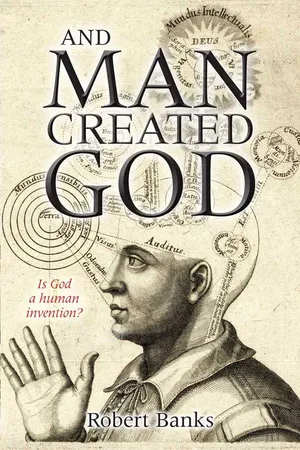
A new development is taking place in the wider culture. Those who query or reject religion are becoming more vocal in their stance against it. Weary of Christians publicly advertising their faith, a group of atheists in London in 2008 created bus posters declaring, “There’s probably no God. Now stop worrying and enjoy your life.” When a similar group in Chicago started up a public transport campaign, they went further and for their slogan chose: “In the beginning, man created God.” According to the group’s spokesman, the slogan “espouses the idea that man created God as well as all religions”, and “encourages public and critical examination of the merits of religious belief”.
Most recently, just before Christmas 2010, the American Atheists society commissioned a billboard to be placed on a major road leading into New York City. Above a picture of the three wise men following a star across the desert were the words “You know it’s a myth”.
This viewpoint is additionally being expressed in other popular ways. One internet expression of this is the appearance of advertisements for a variety of T-shirts bearing the logo “Man created God”. On websites such as Facebook and YouTube, the same message appears in the form of music videos and graphic designs. There are also blogs and forums devoted to a discussion of the topic.
Interest in the subject has resulted in the production of self-published books dealing directly with the issue. An example of this is D. G. McLeod’s Then Man Created God: The Truth about Believing a Lie (2009), which is an aggressive attack on all forms of religious belief and practice. From a different field altogether, there is the novel by Steve Toltz, A Fraction of the Whole, which was shortlisted for the Man Booker prize. Much of this is cast in the form of down-to-earth monologues or conversations around a wide range of topics. These focus on basic human concerns, including whether or not there is a God and how ideas of God came into being. As the chief protagonist at one point in the novel remarks: “To me, it was obvious man created God in his own image. Man hasn’t the imagination to come up with a God totally unlike him.”1
Why do we do this? We find it hard to believe that the being that most inspires imagination, creativity, and empathy, could be one of us. Recent films reflecting on everyday events and their consequences, such as Winged Creatures, also raise questions about what motivates belief in God. Within this, the story explores how vulnerable we are to fashioning or influencing our conceptions of God according to our own needs and desires.
So, then, in various ways the possibility that God is partly or wholly a man-made affair has come back on the public agenda. In other respects, however, preliminary forms of the question have always been at hand. A prime example occurs when some parents and religious instructors seek to encourage a religious attitude in their children. When told that God made the universe, most children simply accept what they hear. But after a time, generally between the ages of six and nine, some unexpectedly ask: “If God made everything, then who made God?” This is a good place to begin our investigation.
Who made God?
This question shows that a child is beginning to wonder about one of the big questions of life. In asking it they are not really querying whether God exists. They are simply trying to work out how similar or different God is to everything else in their world – particularly those who are older than them. Since these are the only categories they have for understanding God, it’s a perfectly natural question. The answer a child usually gets runs something like this: “God is not the same as us. He wasn’t made by anyone else. He has just always been there.”
For most children such an answer is enough – for the time being. It satisfies their curiosity about God. But occasionally they will want to take the question a stage further. Phillip Adams, a popular Australian journalist and broadcaster, is one example. His father was a minister and his mother was also a devout Christian. One day he asked them: “If everything began from something else, then who began God?” On hearing the conventional answer to his question, he decided that such a being was highly unlikely. This was the start of his journey into atheism.
As the children of believing parents grow up, they learn that the answer given to their question echoed the opening words in the Bible. After God created heaven and earth, states Genesis, he “created Man in his own image”. As a child’s understanding of God develops, especially if it is more than a second-hand belief, many come to the conclusion that their original question was inadequate. Others, for various reasons, might begin to doubt whether they can ever know for certain if God exists, or simply give up belief in God altogether, dismissing it as a childish fantasy.
In some cases the question “Who made God?” then comes back on the scene in a new form. An example of this thought process is evident in the physicist Stephen Hawking’s best-selling book on time. In it, he reflects on what it was that started the universe. “Does it need a creator”, he asks, “and if so … who created him?”2 So complex are the issues involved, Hawking concludes, that the question has no credible answer. In this matter we have no alternative but to live on the far edge of uncertainty, indeed improbability.
Other scientists add to this discussion by raising the question of whether humanity, specifically its brain, created God, arguing that the way people are neurologically wired may determine whether they believe in such a being or not.3
Several of the so-called “New Atheists” are more definite. According to the biologist Richard Dawkins, the beauty and intricacy of the universe make it quite understandable that people should wonder if it comes from the work of a “Grand Designer”. But since such a creator would have to be at least as complex as the universe itself, the problem is only pushed further back. It automatically raises the question “Who, or What, created God?”4 The cultural critic Sam Harris regards God as fiction and agrees that attempts to prove his existence cannot answer why the causal chain has to stop with God. Why shouldn’t it just go on for ever?5 For the scientist Daniel Dennett, God is a childish myth that has become an adult delusion, rather like Santa Claus.6 This makes the query “Who made God?” less an exploratory question about God’s nature and more a basic premise of his impossibility.
I will assess these claims later. Instead we first turn to those who take this approach a step further. What for the most part is only mentioned in passing by the thinkers mentioned above is explored in a more overt way by other figures.
Who made God up?
Many who become agnostics or atheists are content to simply raise objections to traditional views of God and to provide arguments for a more humanist approach to life. For the most part, the writers mentioned above all regard human understanding and experience alone as the source of values and goals to live by. If occasionally these writers ask how belief in God arises in the first place, they do not explore this in any significant way. For example, though Richard Dawkins identifies “wish fulfilment” – what we would like rather than what is actually the case – as a basic feature of all religious systems, he does not explore this any further. Why should the wish that God be there take the particular forms that it does? How could so many people down through the centuries come to believe in someone who does not exist? While many have accepted the existence of imaginary beings like fairies, ghosts, and vampires, the majority generally quietly and gradually outgrow such beliefs.
One of the New Atheists who raises this issue briefly is André Comte Sponville. He asks what it is that people wish for more than anything else. Leaving aside our baser desires, he says what we wish for most is:
… first, not to die, not completely, not irreversibly; second, to be united with the loved ones we have lost; third, for justice and peace to triumph; finally, and most important, to be loved. Now, what does religion tell us – and the Christian religion in particular? That we shall not die, or not really; that we shall rise from the dead and thus be reunited with the loved ones we have lost; that justice and peace will prevail in the end; and, finally, that we are already the object of infinite love. Who could ask for more? No one, of course! This is what makes religion so very suspicious, it is too good to be true!…7
But it is precisely the thought that Christianity’s ideas are too good to be true, he says, that makes it improbable and gives us every reason to suspect it springs from our own wishes.
Taking the next step, Christopher Hitchens suggests in passing that “God did not create man in his own image. Evidently it was the other way round…”.8 But in his treatment he only gives this brief attention. More substantially Michael Onfray links this with earlier philosophical critiques of religion, arguing that God is a fictional product of our projections:
Man creates God in their own inverted image. Mortal, finite, limited, suffering from all these constraints, haunted by the desire for completeness, human beings invent a power endowed with precisely the opposite characteristics … at whose feet they kneel and finally prostrate themselves. I am mortal, but God is immortal. I am finite, but God is infinite. I am limited, but God knows no limits. I do not know everything, but God is omniscient. I cannot do everything, but God is omnipotent. I am not blessed with the gift of ubiquity, but God is omnipresent. I was created, but God is uncreated. I am weak, but God is the Almighty. I am on earth, but God is in heaven. I am imperfect, but God is perfect. I am nothing, but God is everything, and so on. Religion thus … proposes the creation of an imaginary world falsely invested with truth.9
The first writer I came across who advocated this view was one who helped put it on the public agenda in a previous generation. As a young man, Bertrand Russell (1872–1970) was quite interested in discussions about the origin of the universe. Initially he accepted the idea that there had to be an original cause of everything that exists, behind which it was impossible to go. Then:
… one day, at the age of eighteen, I read John Stuart Mill’s Autobiography, and I there found this sentence: “My father taught me that the question, Who made me? cannot be answered, since it immediately suggests the further question, Who made God?” That very simple sentence showed me, as I still think, the fallacy in the argument of the First Cause … It is exactly of the same nature as the Indian’s view, that the world rested upon an elephant and the elephant rested upon a tortoise; and when they said, “How about the tortoise?” the Indian said, “Suppose we change the subject” … The idea that things must have a beginning is really due to the poverty of our imagination.10
How then did belief in God come into existence? According to Russell, religion is mainly based upon fear. Negatively it arose from our terror of the unknown and positively from our desire to have a cosmic elder brother to help us in our troubles. The earliest gods created by our primitive ancestors were primarily characterized by power. Later, as their moral awareness grew, our ancestors preferred gods who reflected higher ideals. Instead of it being the case that “God created man in his own image”, on the contrary “Man created God in his own image”! We are not personal because he is personal and has imprinted us with something of his nature. Rather we conceive him as personal because we imagine him to be something like us and have imprinted on him something of our own higher nature.
According to Russell this took place slowly over a long period of time. The gods pictured by the Greeks and Romans were a halfway house in this development. While they embodied some higher ideals, they also demonstrated some typical human flaws. In some ways they were similar to humans but operated on a larger scale. For Russell, the genius of the Jewish and Christian view was that it replaced the idea of a pantheon of deities with belief in one superior, universal God, characterized by love as well as power. This view influenced other religions such as Islam and continues to resound today in the universal claims of various ideologies.11
The downside of this all-embracing, perfect, and powerful “make-believe” divinity, argues Russell, is that it becomes an even more seductive crutch on which we can lean. We displace our yearnings, hopes, and goals onto him and look to him to overcome our uncertainties, challenges, and limitations. God becomes a kind of cosmic “Superman” through whom we hope to aspire to our potential and deal with our failures. This is illusory, for ultimately he prevents us making real progress in both areas. Only when we draw upon the strength that comes from within us and each other, and are willing to grow up and take responsibility for our individual and corporate lives, can this take place.12
We find a similar view reappearing today, with some new features, in the cultural anthropologist Stewart Elliott Guthrie’s picturesquely entitled work Faces in the Clouds. He builds his approach to religion on humanity’s need for a certain kind of understanding rather than for a certain kind of experience or meaning. With this he notes that a common feature of all religions is “communication with humanlike, yet nonhuman, beings through some form of symbolic action … Humanlike models persist because they identify and account for the crucial component of the world: humans and their activities and effects.”13
This means that anthropomorphic ways of describing and talking about the gods – describing their character and activities in terms drawn from human experience – is quite plausible and reasonable, even if on reflection it is mistaken.
Who made God over?
Even though a majority of people today grow up with little exposure to religion, most still develop some idea of God. This happens whether their attitude towards God is negative, positive, or just indifferent. As a result, when such people use the word “God” they often understand it in different, sometimes contradictory, ways. This is not only between adherents of different religions but even within the same one. Think of disagreements between Catholics and Protestants, not only in their doctrines and practices but also in some respects their views of God. While both believe that God is loving and holy, merciful and righte...