- 96 pages
- English
- ePUB (mobile friendly)
- Available on iOS & Android
eBook - ePub
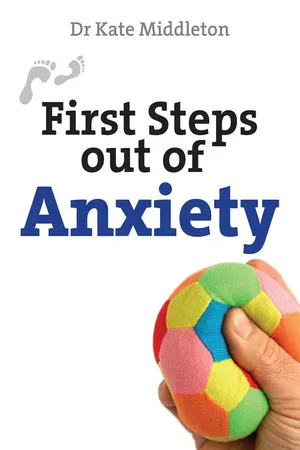
First Steps Out of Anxiety
About this book
First Steps is a new series of short, affordable self-help on a range of key topics. In First Steps out of Anxiety, Kate Middleton draws on years of experience as a psychologist to explain what anxiety is, how it works, and what you can do about it. Full of real-life stories and tips, it is a useful guide for sufferers and carers alike. Other titles in the First Steps series include: Bereavement, Depression, Eating Disorders, Gambling and Problem Drinking.
Information
Topic
Personal DevelopmentSubtopic
Self Improvement1
Anxiety – friend or foe?
As we prepare to fight back against anxiety, there is one important question we need to answer straight away. In order to understand how anxiety is designed to work, we need to look at what it’s there for in the first place. It’s easy to think that emotions are just a nuisance, but in fact they are essential to the normal functioning of our brain. Anxiety is no different – so let’s think about what it does.
Over to you!
Everyone’s experience of anxiety is different, and throughout this book you’ll see sections like this which ask you to think about exactly how some things feel for you. This will help you to apply the theory that you’ve read to your own situation. So wherever you see an “Over to you!” box, grab a notebook and take some time to jot down answers to the questions.
Let’s start by thinking about a recent time when you felt anxious. Can you remember where you were, what it felt like, and what you did? Now ask yourself this question: What was it about how you were feeling in that moment that makes you so sure you were feeling anxious?
To help you think this through, note down some of the things you remember thinking, feeling, or doing. So…
- Where were you/what were you doing?
- What did you feel? (Include emotions and any physical sensations you remember.)
- Do you remember any of the thoughts that were running through your head?
The three main functions of anxiety
Everyone’s experience of anxiety is different, but if we asked a group of people to do the same task, some common themes would emerge – experiences that we all have in common in those moments when we feel what we call “anxiety”. Research investigating emotions has found three main functions of anxiety – certain jobs it seems to do within the brain. These are closely related to the way we experience it. Let’s think about what those functions are – and how they relate to the way anxiety feels.
1 First and most important, anxiety is your brain’s way of grabbing your attention.
This is one reason why usually people find it pretty easy to think of times when they were anxious. The way you feel grabs your attention and makes you aware that it is happening. Anxiety triggers physical changes in your body which you very quickly notice. All those classic “symptoms” of anxiety – butterflies in the stomach, sweating, feeling breathless – are signs that your brain is using your body to try to get your attention!
Common signs and symptoms of anxiety
- Heart beating faster
- Feeling more aware of your heartbeat or experiencing palpitations
- Trembling or shaking
- Fast/shallow breathing
- Feeling sick/butterflies in stomach
- Needing to go to the loo more than usual
- Indigestion/stomach cramps
- Sweating/hot flushes
- Headaches
- Difficulty concentrating or sitting still
- Trouble sleeping
- Feeling lightheaded/faint
- Heightened awareness of sounds/things going on around you
- Irritability
- Obsessive (round and round) thinking
- Inability to think clearly or logically
Anxiety’s main job is to grab your attention when a part of your brain notices something that might be significant. In particular, anxiety is usually triggered if it looks as if something important to you is threatened. There is a part of your brain constantly keeping track of what is going on in your life and the world around you. It lines up this information with the goals and rules that you also have stored in your brain.
Some of these goals are basic and shared by all of us – like “staying alive”. Others are more complex and related to aspects of your own life or lessons you have learned in the past. So goals might be something like “I need to write a report that really impresses my boss” or important pieces of information such as “Last time I skied I fell over and hurt my knee really badly”. The next time your brain flags up that something about your circumstances is related to a goal, rule, or previous experience you have stored, it needs some way to alert you – and what it uses is the combination of sensations we call anxiety.
Anxiety is triggered when something going on around us threatens in some way a goal or rule, or reminds us of a previous experience which had a significant outcome.
So, let’s say you have planned to go out after work tonight. Then, just as you are about to leave, you remember that a report you haven’t finished has to be done by 9 o’clock tomorrow morning. You could run something off quickly before you go, but suddenly you feel a pang of anxiety. Why? Your brain is triggering anxiety to alert you that you have a goal to write a really impressive report, and your circumstances right now are threatening the successful achievement of that goal.
Let’s think about another example. Have you ever put the wrong fuel in your car? For most people, putting fuel in their car is one of those “automatic pilot” things they do without really thinking. But a friend of mine recently did this with a hire car… and suddenly realized to her horror she was putting unleaded petrol in a diesel tank! But what was it that, halfway through filling the tank, made her realize her mistake? She described how she suddenly felt a pang of quite strong anxiety – her brain, working in her subconscious mind, had realized there was a clash between what she was doing and a subconscious goal (something like “I do not want to mess up this hire car and lose my deposit”!) and it triggered anxiety. This grabbed her attention, and the minute she focused on what she was doing she realized her mistake and was able to rectify it before it was too late.
Think about this situation. It is 3 a.m. and you are fast asleep. Then the phone rings! What do you feel? Most people admit they would feel a stab of anxiety. But why? You don’t usually feel anxious when the phone rings. But because 3 a.m. is an unusual time to phone, most people make the link in their brains that something bad might have happened. This is a perfect example of how a worst case scenario suddenly starting to seem possible can trigger anxiety.
So anxiety is triggered when something going on around us threatens in some way a goal or rule, or reminds us of a previous experience which had a significant outcome. One other thing is always present with anxiety. It is what I call a Worst Case Scenario (WCS). This is the thing that you don’t want to happen – the thing you are dreading and want to avoid. It could be failing an exam, being yelled at by your boss, having to do something you don’t want to do, being attacked by a scary insect, animal, or reptile – each anxiety-provoking scenario has its own WCS. When your brain detects that the chances of this WCS being possible have just risen, it triggers anxiety to alert you.
Over to you!
What are your WCSs?
Think about the example you wrote about above, when you experienced anxiety. Can you identify what it was you were anxious about? What, in that example, was the worst case scenario? You might find it helps to think about the worst thing that could possibly have happened – and then write it down.
2 The second main role of anxiety is that it makes you ready to (re)act.
When you feel anxious, your brain activates a complex network of nerves, hormones, and other chemicals called the sympathetic nervous system. This system controls how ready you are to react to something – when it is turned up, you are primed for action. It controls the well-known fight or flight response. When the sympathetic nervous system is activated, a chain of events occurs in your body preparing it for physical activity – fighting or, in the case of anxiety, running away! These events include the following:
- The release of hormones (including adrenaline) increases your heart rate and dilates (widens) the blood vessels which supply your heart and main muscles.
- Your heart beats faster, delivering more blood around the body.
- The blood vessels supplying everyday functions (such as digestion) narrow, so your blood is immediately diverted to the muscles, where it might be needed if you have to jump into action.
- Glucose is released into your blood and your breathing rate increases so that your blood becomes rich with the energy-giving sugar and oxygen you need to be able to move fast.
Anxiety also triggers changes within your brain. These too make you ready to react to the slightest hint of danger or risk. You might notice yourself feeling more alert and more likely to react to small things – noises or movements, for example.
Over to you!
How can you tell when you are “primed to react”?
Think about your example of an anxious episode. Do you remember feeling more alert then? Were there sounds or movements you responded to that you wouldn’t usually respond to? Did you feel more jumpy than usual or find it hard to sit still? What were the signs that you were “primed to react”?
3 Finally, anxiety affects the way you are thinking.
Your brain doesn’t just trigger changes to your physical and emotional state. At the same time the alert it sends pushes into overdrive the part of your brain that does the analysing. The purpose of this is to give you the chance to work out if you need to react, and, if so, what that reaction should be.
Often it feels as if this is actually the first thing you do when you are anxious, not the last! People often say that it is because they are thinking certain things – “Oh no, I hope I get this done in time” or “I really hope she didn’t hear me say that” – that the anxiety is triggered in the first place. In fact, the reality is that your change in thinking is actually something that happens later on in your anxiety response. In moments of real life-threatening danger, your brain can by-pass this stage and trigger a physical reaction before you have even had time to think. Before you even realize what you are doing you have jumped out of the way of the car that was about to hit you, or run away from the wasp buzzing near you, and only after you have rea...
Table of contents
- Cover
- Dedication
- Title Page
- Copyright
- Contents
- Introduction
- 1 Anxiety – friend or foe?
- 2 When anxiety goes bad
- 3 When what we do makes things worse: Part 1: Ignoring or trying to avoid anxiety
- 4 When what we do makes things worse: Part 2: How phobias develop
- 5 The anxiety line
- 6 A quick lesson in relaxation
- 7 Clearing out the kindling
- 8 Starting to win back ground: Part 1: List your fears
- 9 Starting to win back ground: Part 2: Your road to recovery
- 10 Looking forward
- For the family
- Useful resources
- Also currently available in the “First Steps” series:
Trusted by 375,005 students
Access to over 1.5 million titles for a fair monthly price.
Study more efficiently using our study tools.
Frequently asked questions
Yes, you can cancel anytime from the Subscription tab in your account settings on the Perlego website. Your subscription will stay active until the end of your current billing period. Learn how to cancel your subscription
No, books cannot be downloaded as external files, such as PDFs, for use outside of Perlego. However, you can download books within the Perlego app for offline reading on mobile or tablet. Learn how to download books offline
Perlego offers two plans: Essential and Complete
- Essential is ideal for learners and professionals who enjoy exploring a wide range of subjects. Access the Essential Library with 800,000+ trusted titles and best-sellers across business, personal growth, and the humanities. Includes unlimited reading time and Standard Read Aloud voice.
- Complete: Perfect for advanced learners and researchers needing full, unrestricted access. Unlock 1.5M+ books across hundreds of subjects, including academic and specialized titles. The Complete Plan also includes advanced features like Premium Read Aloud and Research Assistant.
We are an online textbook subscription service, where you can get access to an entire online library for less than the price of a single book per month. With over 1.5 million books across 990+ topics, we’ve got you covered! Learn about our mission
Look out for the read-aloud symbol on your next book to see if you can listen to it. The read-aloud tool reads text aloud for you, highlighting the text as it is being read. You can pause it, speed it up and slow it down. Learn more about Read Aloud
Yes! You can use the Perlego app on both iOS and Android devices to read anytime, anywhere — even offline. Perfect for commutes or when you’re on the go.
Please note we cannot support devices running on iOS 13 and Android 7 or earlier. Learn more about using the app
Please note we cannot support devices running on iOS 13 and Android 7 or earlier. Learn more about using the app
Yes, you can access First Steps Out of Anxiety by Kate Middleton in PDF and/or ePUB format, as well as other popular books in Personal Development & Self Improvement. We have over 1.5 million books available in our catalogue for you to explore.