- 96 pages
- English
- ePUB (mobile friendly)
- Available on iOS & Android
eBook - ePub
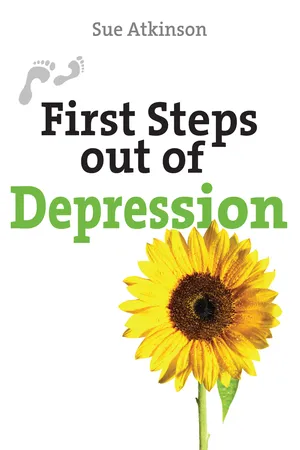
First Steps out of Depression
About this book
First Steps is a new series of short, affordable self-help on a range of key topics. Depression is wide-spread in today's world, with statistics suggesting that 1 in 5 of us will experience it at some stage in life. In First Steps out of Depression, successful author Sue Atkinson draws on her experiences as someone who has suffered - and recovered - from depression, to guide sufferers through the first stages of recovery themselves. Other titles in the First Steps series include: Anxiety, Bereavement, Eating Disorders, Gambling and Problem Drinking.
Information
Topic
Desarrollo personalSubtopic
Salud mental y bienestar1
Staying in bed vs. Grabbing the moment
One aspect of depression that most people experience is that they wish to stay in bed (or hide from the pressures of life in some way) and have no incentive to do anything.
- “What’s the point of getting up anyway? It’ll be an awful day, just like yesterday.”
- “I just can’t face the world.”
- “I’m hopeless at everything so people are better off without me there.”
We need to be clear that there are times when a depressed person needs to stay in bed. There can be a genuine need to rest – sometimes for days. But once that time is over, it can become counterproductive to go on hiding away.
How do we tell when we need to stop the resting and get up? The answer is: with great difficulty!
What people say…
“I just watch the television all day. That’s all I do.”
Arthur, aged 69, retired engineer
I wonder if I could get up?
One of the most crucial skills to learn on our journey away from depression is to do something the instant that a positive thought enters our mind.
So if you are lying in bed and think, “Hmm, I think I might switch the radio on,” then do it immediately. If you don’t grab that moment, it will be gone and you’ll lie there for another hour – or the rest of the day. It’s just like an alarm clock strategy when you need to catch a train. If you turn the ring off and say, “I’ll just rest for another few minutes,” you risk dozing off and being late.
I did it
An outcome of getting up and doing at least one thing – perhaps letting the cat out – is that it can add to our sense of getting going. The trick at this point is to congratulate ourselves. OK, that might sound stupid, but as the saying goes, “Nothing succeeds like success.”
I make the point, now, of telling myself how well I’ve done when I’ve got myself going on mornings when I just want to lie and do nothing. Telling myself I just did something well really does make me feel better.
I have to keep going
Those of us at home with children have no choice but to care for them. There is no option. Be aware that there are at least two important effects of this:
- It is utterly draining of energy – and this has long-term consequences.
- It shows all of us that we can defeat our feelings just by keeping going. We can grab the moment.
If this applies to you, rest when you can and try to get some practical help, perhaps teaming up with another parent and looking after each other’s children sometimes.
Lethargy strikes
But the dreaded lethargy can trap us in that slough of despond for weeks, even months. Arthur, who watches television all day, asked me, “How do I teach myself to switch off the television?”
The only way out of the lethargy of depression is to do it. Switch the television off. Make yourself do it!
Understanding our lethargy
There seems to be two main reasons for our total lack of incentive to do anything:
- Because our body chemistry has changed, there just aren’t as many of the good messages going through our brain and this makes us weary. It’s not clear whether these changes happen first, then we get depressed, or we get depressed first and that makes the body chemistry change. But the outcome is the same – we are exhausted just thinking about starting the day and we are likely to lie on the sofa and eat badly, making a bad situation even worse.
- Surprisingly, what we think can be making us feel lethargic. Honestly! This is true. Thinking negative thoughts makes us feel negative.
What people say…
“Don’t be a loner, because isolation has been shown to heighten feelings of failure and lowers ability to cope with stress. It also increases vulnerability to viral and bacterial infections by lowering immune system function.”
An NHS doctor
Negative thinking
When we’re depressed it’s all too easy to keep giving ourselves so much “negative feedback” that in effect we’re just keeping ourselves in the sinking bog and preventing ourselves getting on with the journey.
We say things like:
- “My life is awful and will never be any different.”
- “Everything I do is a disaster.”
- “I hate everything about myself.”
It’s hardly surprising that if we’re thinking these things, we’ll feel low and anxious. (See Chapter 6 for more detail about negative thinking.)
Not caring I’m a slob
Inevitably being depressed, even mildly, brings with it a sense that everything is just too much to cope with. We start looking for easier options such as eating fast food instead of making a meal with healthy ingredients. Even looking after our body and brushing our hair can become a trial.
Eating badly and making no effort to get exercise can mean that as well as feeling sad, we can start to feel that sense of malaise that comes from eating those vein-clogging trans fats, artificial colourings, and sweeteners that are so bad for our body.
What people say…
“I stand in the kitchen and eat anything I can find. I get pizzas delivered and I’ve put on five stone… I don’t care that I’m obese and I don’t care that my doctor said I’m heading for a heart attack. I’m too depressed to do anything about it.”
Gary
What’s the point?
We ask ourselves, “What’s the point in being healthy? I don’t care.” And that is a normal reaction in depression.
But, given that the journey to get better from depression is complex, it is a good idea to identify the easier first steps.
Easier steps
There isn’t much about getting better from depression that is easy, but deciding to make healthy choices is one of the easier first steps.
We don’t need to make drastic changes. Little things can all add up to helping our body to feel better.
- Cut down on those unhealthy fats that are in take-away meals by making simple easy meals at home, such as baked beans or poached eggs.
- Eating fruit and veg is one very easy way to improve your diet, as is buying good quality bread and eating tinned fish instead of fat-laden battered fish with chips.
- Cutting down on salt and animal fats in meat and cheese will help to reduce the risk of high blood pressure. (Being depressed is very stressful and that raises our blood pressure. This can lead to strokes.)
Gentle exercise
Just walking downstairs might be the only exercise we get on the days when we feel stuck in the mire, but as we start to heal, a little bit more moving around helps us feel we really are on our journey out of depression.
Don’t start running or doing some kind of high-impact sport without seeing your doctor first, especially if you are overweight.
Brisk walking is just great. It burns fat, is easy, free, and gets those “happy hormones” (called endorphins) rushing around your body. Build up from ten minutes until you can do thirty minutes. If you can do that three days a week, you will see real progress in how you feel.
What people say…
“I can’t believe how just going out for a brisk walk each day has changed me. I thought I was far too tired to walk even slowly! But oddly, after walking I feel less tired and full of energy. And my mood is so much better. Thank God.”
Ben
Things we need to know about depression
Eating more healthily can lift our mood, and, apparently, rewarding ourselves by doing something we enjoy can boost our immune system and get those happy hormones giving us a lift.
Let’s get out of here
- “Grabbing the moment” is one of the crucial aspects of taking our first steps away from depression. Grab that positive thought and do it! The more you practise it, the better you get at it.
- Don’t beat yourself up by thinking you’re not doing it well enough. If you push yourself too much, you might end up sinking back into bed and deciding that being a slob is better.
- Easier than exercise, but just as good at getting the happy hormones dashing around our body, helping our mood to lift, is to laugh. My favourite ways to get myself laughing when I feel really low are: Bill Bryson books, those clips of films on the web of cats doing the most extraordinary things, those silly television programmes with home videos of birthday parties ending up in mayhem. I really do feel great after laughing.
- Psychologists say that even smiling can help to reduce stress hormones, so smile at everyone you meet today.
- If it’s pouring with rain and a walk doesn’t seem a ...
Table of contents
- Cover
- Dedication
- Title Page
- Copyright
- Contents
- Acknowledgments
- Introduction
- 1 Staying in bed vs. Grabbing the moment
- 2 Hiding behind “I’m fine” vs. Acknowledging the truth
- 3 Drowning in worries vs. Developing strategies to reduce stress
- 4 Doing what others want vs. Making our own decisions
- 5 Wandering without a map vs. Creating boundaries
- 6 Drowning in negative thinking vs. Choosing to think more positively
- 7 Blaming others vs. Taking responsibility for ourselves
- 8 Hanging on to resentment vs. Deciding to let go
- 9 Believing “I’m stuck” vs. Being a creative learner
- 10 Choosing despair vs. Choosing hope
- For the family
- Useful resources
- Also currently available in the “First Steps” series
Trusted by 375,005 students
Access to over 1.5 million titles for a fair monthly price.
Study more efficiently using our study tools.
Frequently asked questions
Yes, you can cancel anytime from the Subscription tab in your account settings on the Perlego website. Your subscription will stay active until the end of your current billing period. Learn how to cancel your subscription
No, books cannot be downloaded as external files, such as PDFs, for use outside of Perlego. However, you can download books within the Perlego app for offline reading on mobile or tablet. Learn how to download books offline
Perlego offers two plans: Essential and Complete
- Essential is ideal for learners and professionals who enjoy exploring a wide range of subjects. Access the Essential Library with 800,000+ trusted titles and best-sellers across business, personal growth, and the humanities. Includes unlimited reading time and Standard Read Aloud voice.
- Complete: Perfect for advanced learners and researchers needing full, unrestricted access. Unlock 1.5M+ books across hundreds of subjects, including academic and specialized titles. The Complete Plan also includes advanced features like Premium Read Aloud and Research Assistant.
We are an online textbook subscription service, where you can get access to an entire online library for less than the price of a single book per month. With over 1.5 million books across 990+ topics, we’ve got you covered! Learn about our mission
Look out for the read-aloud symbol on your next book to see if you can listen to it. The read-aloud tool reads text aloud for you, highlighting the text as it is being read. You can pause it, speed it up and slow it down. Learn more about Read Aloud
Yes! You can use the Perlego app on both iOS and Android devices to read anytime, anywhere — even offline. Perfect for commutes or when you’re on the go.
Please note we cannot support devices running on iOS 13 and Android 7 or earlier. Learn more about using the app
Please note we cannot support devices running on iOS 13 and Android 7 or earlier. Learn more about using the app
Yes, you can access First Steps out of Depression by Sue Atkinson in PDF and/or ePUB format, as well as other popular books in Desarrollo personal & Salud mental y bienestar. We have over 1.5 million books available in our catalogue for you to explore.