eBook - ePub
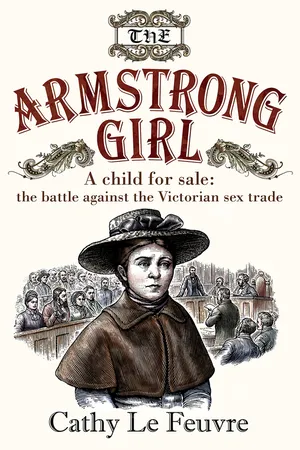
The Armstrong Girl
A child for sale: the battle against the Victorial sex trade
- 288 pages
- English
- ePUB (mobile friendly)
- Available on iOS & Android
eBook - ePub
About this book
In 1885 Victorian England was scandalized by a court case that lifted the veil on prostitution and the sex trade. In the Old Bailey dock stood W.T. Stead, the editor of the Pall Mall Gazette, which had recently published a series of articles on the sex trade; Rebecca Jarrett, a reformed brothel keeper; and the second-in-command of The Salvation Army, Bramwell Booth. They were accused of abducting a thirteen-year-old girl, Eliza Armstrong, apparently buying her for the purpose of prostitution. In fact they had done this as a sensational exposé of the trade in young girls. The scandal triggered a massive petition and ultimately resulted in the raising of the British age of consent from thirteen to sixteen. Today human trafficking is once again making world headlines - as are recent calls to lower the age of consent. Eliza's story is a thrilling account of what can be achieved by those brave enough to believe that change is not only possible but has to come.
Information
Topic
Theology & ReligionSubtopic
History of ChristianityCHAPTER 1
ELIZA IN THE WITNESS BOX

I was 13 years old last April. Up to the beginning of June last I was living with my father, Charles, and mother, Elizabeth Armstrong, at 32, Charles Street, Lisson Grove. My eldest sister Elizabeth is 17; she was out at service. I have three little brothers, aged 11, 7, and 4. My father is a chimney-sweep. We had all been living at the same address for many years. I used to nurse and look after the youngest child, a baby. I attended at the Board School, and can read and write. I know Mrs. Broughton, who lived with her husband at No. 37 in the same street.1
When Eliza Armstrong stepped tentatively into the witness box on an October morning in 1885 at England’s most prominent court, it marked the beginning of a thirteen-day trial which would be followed closely by people at all levels of society, from royalty and government ministers and advisers at Westminster, to churches the length and breadth of England. The Old Bailey proceedings captured the imagination of those sitting comfortably in their aristocratic clubs and the parlours of the rising middle classes, right down to those on the poorest streets of the British capital where the majority of the population scraped a living however they could.
The high-profile trial was the culmination of a series of events which had obsessed Great Britain across the summer of 1885 and which had begun with a startling headline on a warm day early in July in one of the prominent daily London newspapers:
Notice to our Readers: A Frank Warning
The Pall Mall Gazette, 4 July 1885
The articles published over the following week had exposed details of life in Victorian England which had outraged society and touched the conscience of the nation. The “Maiden Tribute of Modern Babylon” reports were salacious and scandalous for a society in which sex – the theme of the articles – was rarely spoken of. And the editorial gave fair warning of what lay ahead for its readers.
Therefore we say quite frankly to-day that all those who are squeamish, and all those who are prudish, and all those who prefer to live in a fool’s paradise of imaginary innocence and purity, selfishly oblivious to the horrible realities which torment those whose lives are passed in the London Inferno, will do well not to read the Pall Mall Gazette of Monday and the three following days. The story of an actual pilgrimage into a real hell is not pleasant reading, and is not meant to be. It is, however, an authentic record of unimpeachable facts, “abominable, unutterable, and worse than fables yet have feigned or fear conceived”. But it is true, and its publication is necessary.2
The “pilgrimage into hell” which the readers of the Pall Mall Gazette were invited to join would include the tale of a child – called “Lily” – who the newspaper claimed had been purchased for the sex trade, a story that had eventually brought little Eliza to the Old Bailey where she faced a crowded courtroom.
The “Maiden Tribute Trial”, as the case would later become commonly known, involved individuals from across the social spectrum starting with Eliza, a working class London girl who lived in what was then a rather run-down part of Central London – Marylebone.
The man presiding over proceedings at the Old Bailey was one of the leading judges of the day, the esteemed Mr Justice Henry Charles Lopes, and the prosecuting lawyer was none other than the Attorney General for England, Sir Richard Everard Webster, whose responsibilities included giving legal advice to Queen Victoria. Sir Richard led the case against an unlikely group of co-defendants.
There was the influential and self-assured editor of the Pall Mall Gazette, the often flamboyantly dressed William Thomas Stead (often known as W. T.), notorious for his outrageous campaigning journalism and the man behind the Maiden Tribute articles. Standing in the dock with him was Rebecca Jarrett, a haggard-looking reformed prostitute and brothel-keeper. In sharp contrast was the other female defendant – Mrs Elizabeth Combe, a refined Swiss national described as a “rich widow”.3
Next in line was Sampson Jacques, a sometime private investigator, a tall and burly Greek man in his sixties. This mysterious individual, whose real name was “Mussabini”, was variously described a “war correspondent”4 and as a “freelance writer”.5 And finally, there was a gentleman in military-style uniform, William Bramwell Booth.
Bramwell, as he was known, was second-in-command of a new and growing Christian movement and the son of the founders of that organization, The Salvation Army. Standing upright in the dock, he held the large trumpet of a hearing aid to his ear. He had been hard of hearing since childhood, and without this he would have struggled to make sense of Eliza’s evidence.
All eyes were turned on the child who was barely able to peer over the witness box into the room below as she began to tell her story.
Friday, 23 October, Central Criminal Court: Eliza Armstrong (Witness for the Prosecution)
On the 2nd June a little girl told me someone wanted a servant and I went to Mrs. Broughton’s house. Mrs. Broughton and the prisoner Jarrett, whom I had not seen before, were there. Mrs. Broughton asked me whether my mother would let me go out to service. I said I would go and ask my mother. I did so; my mother came up and went with me to Mrs. Broughton’s.
Jarrett was still there, she asked my mother if she would let me go to service, mother asked her whereabouts she lived. I understood her to say Wimbledon. Mother asked why she could not get another girl where she lived? Jarrett said she could do so, but she thought a poor girl would like to go to a home where she lived…
Mother asked her what to do? She said to scrub and to clean oilcloth, because she could not kneel, and she would do the dusting and the other part of the work. I afterwards saw she was lame.
… The next day was the Derby Day. I saw my mother with Mrs. Broughton about 11 on the morning of Wednesday 3rd June. My mother told me something when she came back, which Mrs. Broughton had said to her, and I went with her to Mrs. Broughton’s. Mrs. Jarrett was there, she asked mother if I had any nice clothes to go in, mother said I had not. Jarrett said she would buy me some, because her husband was a particular man. Jarrett told me to go home, wash myself, and get myself all ready, and I was to go along with her to buy some clothes.
… Afterwards I came back to Mrs. Broughton’s. Mrs. Jarrett was there, and put on her things, and went with me to the boot-shop at the corner of Charles Street. Up to that time I had not heard what Jarrett’s name was. While going to the boot-shop she said I should like going into her service very much. She then took me into several shops, and bought various articles of clothing for me. She paid for them and brought them with her. We went back to Mrs. Broughton’s, where I put on my new clothes. Nothing further was said by Jarrett, nothing was said about what my wages were to be. I went home for about an hour, and had dinner there. I had left Mrs. Jarrett trimming my new hat at Mrs. Broughton’s, the other clothes I had got on.
When I went home to dinner I saw my mother. I don’t remember whether I saw my father. Afterwards I went back to Mrs. Broughton’s, at about 2 o’clock in the afternoon. My mother did not go with me. I saw Jarrett in the room, and she said she was going to start at 3 o’clock. I stayed there till 3, I had seen my mother at the door, and kissed her before I came away.
My mother said she would see me off. At 3 o’clock she was to meet me in Mrs. Broughton’s room. I waited at Mrs. Broughton’s about an hour, till 3 o’clock, when Mrs. Jarrett said it was time to go. I was then all dressed ready to start, with the hat on which Jarrett had trimmed. Jarrett, Mrs. Broughton, and I went out together. Nothing was said about mother not having come back.
When we started Mrs. Broughton and Jarrett went into a public-house. I waited outside. Jarrett and I got into an omnibus at the corner of Chapel Street… I said goodbye to Mrs. Broughton, we got out of the omnibus past the Marble Arch, and went to a house I know now as 16, Albany Street.6
Although the prospect of standing in the imposing Old Bailey courtroom must have been daunting for the child, Eliza Armstrong gave her evidence simply, coaxed gently by the Attorney General to explain what had happened to her on Derby Day, 1885.
The details she outlined may have seemed inconsequentially mundane but they were the fundamental building blocks of the case. Eliza’s removal from her home in Charles Street, Lisson Grove, in the Marylebone area of London, on 3 June was at the heart of the circumstances which led to the trial.
How had her departure from Charles Street come about? Did Eliza’s parents know where the woman walking with a limp and a stick was taking their daughter? Apart from the fact that she appeared to be friendly with their neighbour, Mrs Nancy Broughton, what else did they know, or suspect, about the woman who suddenly appeared in their street seeking a young girl who might work for her?
The five defendants listening carefully to the evidence of the child on that first day of their trial all faced the same charge: “Unlawfully taking Eliza Armstrong, aged 13, out of the possession and against the will of her father” and other counts charging them for the taking of Eliza from the possession of the mother.7
In plain English, Stead, Booth, Jarrett, Jacques, and Combe were all charged with abducting Eliza Armstrong. For Eliza was, of course, “Lily” – the girl bought for the sex trade, whose story in the Pall Mall Gazette’s Maiden Tribute of Modern Babylon articles had so outraged the nation.
CHAPTER 2
SEX AND VICTORIAN SOCIETY
“From three o’clock in the afternoon it is impossible for any respectable woman to walk from the top of the Haymarket to Wellington Street, Strand.” With these shocking words, just a handful of years before Eliza stepped up into the Old Bailey witness box, Howard Vincent, director of the Criminal Investigation Department at police headquarters at Scotland Yard had reported to a Committee of the House of Lords on the state of prostitution in London.1
The 1881 inquiry was the latest investigation into the sex trade in a society which was becoming increasingly obsessed with what some saw as the moral decline of the nation. Although there had always been prostitutes willing to sell sexual favours to those lining up to buy, by the mid to late nineteenth century in England there was a growing number of social campaigners who believed the sex trade had reached unacceptable levels and was undermining the very bedrock of their culture.
Formal reports to Parliament, official studies, and newspaper reports had down the...
Table of contents
- Cover
- Title Page
- Copyright
- Praise
- Other books by this author
- Dedication
- Contents
- Chapter 1: Eliza in the Witness Box
- Chapter 2: Sex and Victorian Society
- Chapter 3: Rebecca Jarrett’s Story
- Chapter 4: Rebecca Meets The Salvation Army
- Chapter 5: The Age of the Innocents
- Chapter 6: Introducing William Thomas Stead
- Chapter 7: Mr Stead, the Editor
- Chapter 8: Getting the Girl
- Chapter 9: The Maiden Tribute of Modern Babylon
- Chapter 10: “A Child of 13 Bought for £5”
- Chapter 11: An International Sensation
- Chapter 12: “Filth and Obscenity”
- Chapter 13: Getting Personal
- Chapter 14: A Two-and-a-Half-Mile-Long Petition
- Chapter 15: A Case of Abduction
- Chapter 16: The Road to the Old Bailey
- Chapter 17: On Trial
- Chapter 18: Mother and Father in Court
- Chapter 19: The Case for the Prosecution
- Chapter 20: The Defence Begins
- Chapter 21: Stead on the Stand
- Chapter 22: The Defence Wraps Up
- Chapter 23: Verdict
- Chapter 24: Prison
- Epilogue
- A Note from the Author
- Endnotes
- Bibliography
Trusted by 375,005 students
Access to over 1.5 million titles for a fair monthly price.
Study more efficiently using our study tools.
Frequently asked questions
Yes, you can cancel anytime from the Subscription tab in your account settings on the Perlego website. Your subscription will stay active until the end of your current billing period. Learn how to cancel your subscription
No, books cannot be downloaded as external files, such as PDFs, for use outside of Perlego. However, you can download books within the Perlego app for offline reading on mobile or tablet. Learn how to download books offline
Perlego offers two plans: Essential and Complete
- Essential is ideal for learners and professionals who enjoy exploring a wide range of subjects. Access the Essential Library with 800,000+ trusted titles and best-sellers across business, personal growth, and the humanities. Includes unlimited reading time and Standard Read Aloud voice.
- Complete: Perfect for advanced learners and researchers needing full, unrestricted access. Unlock 1.5M+ books across hundreds of subjects, including academic and specialized titles. The Complete Plan also includes advanced features like Premium Read Aloud and Research Assistant.
We are an online textbook subscription service, where you can get access to an entire online library for less than the price of a single book per month. With over 1.5 million books across 990+ topics, we’ve got you covered! Learn about our mission
Look out for the read-aloud symbol on your next book to see if you can listen to it. The read-aloud tool reads text aloud for you, highlighting the text as it is being read. You can pause it, speed it up and slow it down. Learn more about Read Aloud
Yes! You can use the Perlego app on both iOS and Android devices to read anytime, anywhere — even offline. Perfect for commutes or when you’re on the go.
Please note we cannot support devices running on iOS 13 and Android 7 or earlier. Learn more about using the app
Please note we cannot support devices running on iOS 13 and Android 7 or earlier. Learn more about using the app
Yes, you can access The Armstrong Girl by Cathy Le Feuvre in PDF and/or ePUB format, as well as other popular books in Theology & Religion & History of Christianity. We have over 1.5 million books available in our catalogue for you to explore.