- 176 pages
- English
- ePUB (mobile friendly)
- Available on iOS & Android
eBook - ePub
About this book
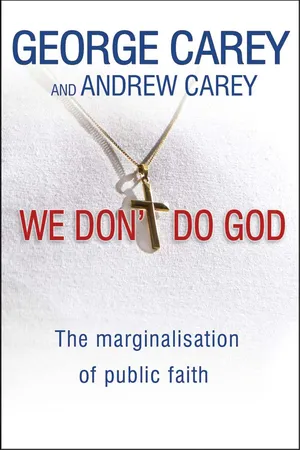
Secular assumptions are being introduced piecemeal into our way of life. From the Millennium Dome (what exactly was it celebrating?) to the restrictions on the wearing of crosses and abolition of nativity plays, Christianity is being marginalised. Christian social initiatives at local levels are now so severely restricted that several Christian bodies issue guidelines on handling local council prejudice. There is a widespread if ill-defined sense that a valuable heritage is slipping away. Yet the Bible and Prayer Book are seminal for our language and literature; Christian social action predated the modern welfare state; our laws are based on Christian ethical systems. Christians should push back, re-engaging with politicians and opinion formers. Christians must be salt and light. Introverted Christianity must give way to engagement with the world, not defensively but with confidence and hope. It is time for a proper debate about the place of faith in modern Britain.
Information
Topic
Teologia e religioneSubtopic
ReligioneCHAPTER ONE
LIVING IN CRITICAL TIMES
My decision to write this book was made on a precise date. It was 29 April 2010, when Lord Justice Laws’ ruling in the case of Gary McFarlane (who had been dismissed from relationship counselling agency Relate because he refused to counsel a same-sex couple) declared: “We do not live in a society where all the people share uniform religious beliefs. The precepts of any one religion – any belief system – cannot by force of their religious origins, sound any louder in the general law than the precepts of any other. If they did, those out in the cold would be less than citizens, and our constitution would be on the way to a theocracy, which is of necessity autocratic.”
As I read those words I realized how different my world view is from that of this learned judge and, at the same time, how ill-informed he was about the Christian tradition – and even less informed about the way that the Christian faith is woven into the history, culture, ethics, laws, and political life of the United Kingdom.
The curious thing is that in my witness statement (which Lord Justice Laws rejected) there was nothing that contradicted his words.
This witness statement arose out of my own sense of frustration on the part of some good Christian people, who had been dealt with harshly. I too am not arguing for a theocracy. Indeed, I am entirely at one with Lord Justice Laws in people having the same rights and being subject to the same laws. My objection to his ruling that led to the dismissal of a good man who had been a very good Relate counsellor for some years, is that it was now evident that if a person were a Christian and sought to live her or his life by Christian principles in the workplace, they would not get fair treatment. The interesting, yet very disturbing thing about Lord Justice Laws’ presuppositions was that he assumed that the Christian faith had nothing to say about justice today and could be dismissed with remarks that bordered on the contemptuous.
As I read Justice Laws’ summary I thought back to the Queen’s Coronation in 1953 where the Queen was presented with a Bible: “To keep your Majesty ever mindful of the Law and the Gospel as the rule for the whole of life and government of Christian princes.” Those powerful and precise words were not designed as a commitment binding on the young Queen alone; they were intended to signal that what our country stood for was a commitment to Christian values and teaching that stemmed from our foundational document. From 2 June 1953 to 30 April 2010, rather than the UK growing in greatness, we have witnessed a slow decline in moral values and a loss of memory regarding our indebtedness to Christian truth.
But it is all so puzzling. How is it possible that, in a country which has an established Church and a Queen who by tradition “defends the faith”, that Christianity is being squeezed out or marginalized? Yet that very question dominates the pages of tabloid newspapers annually as they reveal yet more stories of nativity plays banned in schools; “Seasons Greetings” replacing “Happy Christmas” on the cards of political leaders; and the switching on of “Winter lights” rather than “Christmas lights” by twitchy local authorities. These may seem trivial examples, yet the same question was to dominate a BBC documentary by the well-known broadcaster, Nicky Campbell, in April 2010 under the title Are Christians Being Persecuted? While he concluded that persecution was too large a word for what was happening, he nevertheless pointed to a series of running skirmishes between Church and State, and the worrying signs of entrenched cultural warfare between the State’s official religion, and the State itself.
We should avoid the word “persecution” because what Christians face in Britain does not have that aspect of suffering for one’s faith that many experience abroad – sadly, many in Muslim countries. Discrimination is a more accurate word, but for those who have lost their jobs because they have stood up for their Christian convictions it is entirely natural for them to feel that their experience is one of “persecution”. The legal battles over the wearing of symbols of faith such as the cross by individual Christians, the sacking of staff because of their refusal to act against their Christian conscience, the cry of “foul” from some quarters when political leaders wear their faith on their sleeves can all be noted as examples of a society newly ill at ease with faith.
While these are well-known cases of secular ambivalence towards Christianity, behind them lies a new level of anxiety and alienation among believers. Church of England General Synod members have never been noted as unduly alarmist, yet a survey of them by the Sunday Telegraph in February 2009 found that up to two-thirds believe that Christians are discriminated against at work.2 A further national opinion poll survey by the same newspaper in May 2009 revealed that this feeling was shared by Christians throughout Britain. One in five of respondents said they faced opposition at work because of their faith. More than half revealed they had suffered some form of “persecution” for being a Christian. Three quarters of those polled said they felt that there is less religious freedom than twenty years ago. And a staggering 84 per cent of Christians thought that religious freedom of speech and action are now at risk in the UK.3
The truth on the ground is that Christians feel hemmed in as never before by often well-meaning legislation which they believe has had the unintended consequence of restricting religious liberties that have been taken for granted for centuries. In the light of recent cases in which public servants have been suspended for offering to say a prayer for members of the public, Christians question whether they can even mention their faith during their working life. The heavy-handed actions of some police in arresting street preachers makes them doubt whether they have the freedom to evangelize or share their faith. They ask whether they still have any freedom of speech, given the welter of hate crimes legislation during the past few years.
Can they any longer state traditional Christian views on the uniqueness of Christ without risking the charge of being prejudiced against those of other faiths? Is it possible to defend Christian marriage without being abused as “homophobic” and worse, arrested for inciting hatred?
The worrying aspect of these developments is that people who would in previous decades have been recognized as pillars of the community, now feel alienated and discriminated against. The rate of change has been bewildering and worrying for many ordinary Christians.
However, I do recognize that some Christians themselves scoff at the notion of “discrimination”, or even a marginalization of Christianity. Some argue that it is high time that Christianity was divorced entirely from any supposed submissive role to the State, and its “privileged” status in the British constitution.
Christians who hold this view want a post-Christendom church, believing that Christianity sold itself out under Emperor Constantine in a Faustian pact with temporal power, which resulted in some 1,500 years of a spiritual dead-end. The uncoupling of Christianity from the machinery of State, the reduction of the Christian message to just another competing voice in a world of ideas of roughly equal validity, is simply a necessary evolution for the Church. It must be freed from the curse of privilege, prestige, and recognition to follow its true mission as Jesus Christ’s community for outcasts, the poor, and dispossessed.
I understand the force of this argument and it may be that the time will come when the Church of England will, for the sake of its own dignity and independence, have to separate from an Establishment that is indifferent to the religious identity that once shaped it. But that time has not yet come because there are still very many people both within and without the Church who believe passionately that the Church in England (and in that I include all mainstream traditions) is still the backbone and sinew of what it is to be British. Indeed, this view is often echoed by those of other faiths who are just as disturbed as Christians by the erosion of faith in our land: secularism challenges all creeds.
This is an argument we will revisit later. However, it does not address the actual reality of the situation in which despite its established status, the Church has the freedom to pursue its mission. The novel situation that this book attempts to highlight is that under this new dispensation of a “neutral secularism”, the first signs are that the mission of the Church is restricted. The brave new world into which secularists believe the Church may emerge with its integrity intact, may in contrast be a wholly bad thing. The signs point to restrictions in religious freedoms and an outcome that actually suppresses rather than releases the true voice of Christianity.
Can anyone still pretend that a secular State delivers neutrality? In fact, from the point at which it casts down state religion it makes a powerful statement of repudiation of the religious voice – all religious voices – in the public square. However, there appears to be no appetite for wholesale disestablishment on the part either of the public or of Parliament. As a consequence, the secularist strategy is simply to pretend that the current state of constitutional affairs does not exist. This has proved successful in spite of its dishonesty. Simply by pretending we live in a secular state, the secularist can make it so with a series of much smaller campaigning steps in that direction, such as seeking the abolition of the Lords Spiritual (the bishops in the House of Lords), or of faith schools. More audacious tactics include a national campaign to sue a West Country district council over the practice of saying prayers at the beginning of council meetings, completely sidestepping or ignoring the fact that prayers are said daily in the House of Commons, led by the Speaker’s Chaplain.
The disappointing thing, of course, is that politicians have colluded in this dishonesty by neglecting the Church–State relationship progressively over recent Parliaments. From Prime Minister Gordon Brown’s voluntary relinquishment of his part in appointing bishops, to the incomplete reform of the House of Lords, constitutional questions have been left hanging in the air to damaging effect on public confidence in our country’s institutions. The former Bishop of Durham, N. T. Wright, currently Research Professor of New Testament at the University of St Andrews, has been one of the few voices raised in the House of Lords decrying constitutional reform “on the hoof” and calling for a Royal Commission to apply “joined-up” thinking to this state of affairs. His voice has been largely ignored.
The “new secularism” which will be observed during the course of this book has as its champion the atheist scientist Richard Dawkins whose challenges to faith have often been bad-tempered and ill-informed. His critique of faith reached its nadir with his claim that to bring up children in a faith is tantamount to child abuse. His is hardly an unrepresentative voice among the atheist community, though it has to be said that many atheists find his more outrageous statements embarrassing. Looking at the websites of national newspapers, whenever the question of faith is raised, one can see an astonishingly illiberal and intolerant attitude from atheists and secularists. There is an apparent fanaticism in this section of society, a fanaticism unrivalled in mainstream forms of British Christianity for decades, if not hundreds of years.
The task of this book then is to explore the roots of this distemper with the Christian faith and to present the argument that, far from enriching our nation when the Christian faith is stripped from our cultural and public life, our society will be infinitely poorer and far less united.
We live in critical times for Christian people. However oddly it might seem, I think the struggles that we face present an exciting opportunity to draw on the reserves of our faith, to present it once again to our nation as something that “makes all things new”. Christianity began its life facing discrimination, which went on to become full-blown persecution. It has overcome many, many problems in the last two milliennia. It can triumph still.
CHAPTER TWO
WHAT HAS CHRISTIANITY DONE FOR US?
In our perennial debates on “Britishness” or “Englishness” that have flowed from Britain’s identity complex as a nation, it has been intriguing to hear the powerful contributions coming from two immigrant bishops of the Church of England. Both bishops fled from real persecution in their homelands and have a profound sense of gratitude for the welcome they have been given in Britain. Yet both of them have given far more back. They are the Archbishop of York, John Sentamu, who as a High Court Judge in Uganda in the 1970s under the dictator Idi Amin was forced to flee to Britain, and the former Bishop of Rochester, Michael Nazir-Ali, who came to Britain from Pakistan in the 1980s when his family was threatened by Islamists.
In spite of their very different views on important matters, both men are playing a major role in reminding native-born British people of the remarkable legacy that is theirs. The Archbishop of York’s call for the celebration of Englishness, and his reminder that our values are those of the Christian faith, has struck a chord with the British public. Similarly, Bishop Michael Nazir-Ali’s prophetic blasts against multiculturalism – the doctrine that all cultures being equal, all must be treated the same – have gathered him a following outside regular churchgoers.
Both men have powerfully reminded us that a nation that forgets its past is likely to repeat tragic mistakes. In his resignation statement as Bishop of Rochester in 2009, Bishop Michael Nazir-Ali referred to a historical amnesia in British society, or at least a “selective sort of amnesia”. He pointed to a forgetfulness about the Magna Carta, and widespread ignorance of Britain’s role in the abolition of the slave trade, the age of universal suffrage, and the introduction of universal education – all of which were influenced directly and strongly by the Christian faith. However, he argued, our present focus on our corporate guilt over Britain’s involvement in the slave trade, over its past complicity in forms of religious persecution, and over its involvement along with other European countries in exploitative colonialism has robbed Britain of pride in our achievements. Britons certainly need to repent, he agrees, “But repentance for past wrongs without the celebration of what has been good has deprived people of a common vision by which to live and a strong basis for the future.”4
So at some point we have to ask ourselves: What has Christianity done for us? And like those revolutionary zealots in Monty Python’s Life of Brian who posed the same question about the Roman invasion of the Holy Land, the answer is not immediately obvious. Yet once they started mentioning “sanitation, aqueducts and the roads”, the answers in the Life of Brian kept spilling out. Surely, the same should be true of the contribution of Christianity to Britain?
An astonishing forgetfulness has gripped our public life. I became acutely aware of this during the 1990s when, during the preparations for the Millennium celebrations, there was a risible lack of clarity about the nature of the celebration itself. Both the Conservative and Labour Parties in the run-up to the year 2000 shared the same approach: “Yes, we want to celebrate the Millennium – but what is it actually about?” I remember recalling at the time that a massive cathedral building programme had coincided with the first Millennium of Christianity, bequeathing us buildings of grandeur and longevity throughout Europe. In the 1990s, government ministers and civil servants were planning a “Dome”. This “Dome” had no coherent long-term purpose, no long-term future, and its contents were an after-thought. Virginia Bottomley, the Secretary of State for National Heritage in John Major’s government, told me in the buildup to the Millennium that even some of the best minds in the civil service were ignorant of the Christian nature of the Millennium. For them and for others involved in the planning the event was simply the rolling of “9s” into “0s”. The fact that the calendar itself began with “Anno Domini” (“The Year of Our Lord”) apparently had little or no significance. No wonder that the Dome was so utterly forgettable that it is only making an impact on the public now that it has been turned into a venue for live events. It was not surprising then that negotiations with the government to establish a “Faith Zone” in the Dome were quite difficult, even though, under pressure, the Government agreed to the setting up of a Government/Faith committee on which I was represented through my chaplain, Colin Fletcher, whose effective contribution was rewarded with an OBE. And it was in this under-funded area – a poor relation to many of the other “Zones” – that the story of Britain’s Christian heritage was told, particularly powerfully, through the lens of the Church’s impact on our landscape. Photographs of church spires or towers in the distance on the landscape revealed how these graceful spires or rugged towers dominated rural Britain in a way that their forerunners, the scattered stones of prehistory, never did. A distant spire is a sign to the weary, hungry, thirsty traveller that a settlement is nearby with quite possibly a hostelry for food, drink, and board. The bells that ring out calling the faithful to prayer, or merely mark the passing of the hours of the day, have for centuries punctuated the lives of Britons. And this is only looking at the outward symbols and the buildings inspired by faith in Britain!
The untold story is the contribution – both good and sometimes bad – which the Church has made to the lives of people. An aspect of this is as a force for social cohesion. The church building has very often been the only venue in a town or village for gathering the community together. The contribution of churches to ordinary life has also come in the form of the occasional rites (baptisms, confirmations, weddings, funerals) by which the course of a human life has been marked out – from welcome to celebration to final farewells. Church festivals such as Christmas and Easter are still remembered through our Bank Holidays. Even now some of these festivals still have a profound influence on contemporary Britons, but in the past they were the occasions for communities coming together: family celebrations providing a break in hard-times and a blessing in the good.
Additionally, for centuries the Church has often been the sole provider of education to rich and poor alike. Hospitals, the roots of nursing, and more latterly the hospice movement have been inspired by the Christian faith. Many of our most significant charities had Christian foundations even if they have now downplayed the connection.
This is all to say nothing of the grand narrative of history: our patron saints; the stories of the kings and queens and their connection with the Church; the Magna Carta – that manifesto of Christian freedom; and then the early modern revolution and reformation which saw the rise of parliamentary democracy founded clearly on Christian ideals of equality, and freedom. Even the beginnings of secularism are to be found in the Church’s own political theology, with an easily recognizable separation of Church and State based on the saying...
Table of contents
- COVER
- TITLE PAGE
- COPYRIGHT PAGE
- DEDICATION
- CONTENTS
- INTRODUCTION
- CHAPTER ONE LIVING IN CRITICAL TIMES
- CHAPTER TWO WHAT HAS CHRISTIANITY DONE FOR US?
- CHAPTER THREE THE CHANGING STATE OF BRITAIN
- CHAPTER FOUR THE ATTACK ON CHRISTIANITY
- CHAPTER FIVE FAITH IN THE PUBLIC SQUARE
- CHAPTER SIX CLASHING WITH THE LAW
- CHAPTER SEVEN THE ROOTS OF CONFLICT
- CHAPTER EIGHT ESTABLISHMENT: A BULWARK AGAINST INTOLERANCE
- CHAPTER NINE CHALLENGING THE CULTURE
Trusted by 375,005 students
Access to over 1.5 million titles for a fair monthly price.
Study more efficiently using our study tools.
Frequently asked questions
Yes, you can cancel anytime from the Subscription tab in your account settings on the Perlego website. Your subscription will stay active until the end of your current billing period. Learn how to cancel your subscription
No, books cannot be downloaded as external files, such as PDFs, for use outside of Perlego. However, you can download books within the Perlego app for offline reading on mobile or tablet. Learn how to download books offline
Perlego offers two plans: Essential and Complete
- Essential is ideal for learners and professionals who enjoy exploring a wide range of subjects. Access the Essential Library with 800,000+ trusted titles and best-sellers across business, personal growth, and the humanities. Includes unlimited reading time and Standard Read Aloud voice.
- Complete: Perfect for advanced learners and researchers needing full, unrestricted access. Unlock 1.5M+ books across hundreds of subjects, including academic and specialized titles. The Complete Plan also includes advanced features like Premium Read Aloud and Research Assistant.
We are an online textbook subscription service, where you can get access to an entire online library for less than the price of a single book per month. With over 1.5 million books across 990+ topics, we’ve got you covered! Learn about our mission
Look out for the read-aloud symbol on your next book to see if you can listen to it. The read-aloud tool reads text aloud for you, highlighting the text as it is being read. You can pause it, speed it up and slow it down. Learn more about Read Aloud
Yes! You can use the Perlego app on both iOS and Android devices to read anytime, anywhere — even offline. Perfect for commutes or when you’re on the go.
Please note we cannot support devices running on iOS 13 and Android 7 or earlier. Learn more about using the app
Please note we cannot support devices running on iOS 13 and Android 7 or earlier. Learn more about using the app
Yes, you can access We Don't Do God by George Carey,Andrew Carey in PDF and/or ePUB format, as well as other popular books in Teologia e religione & Religione. We have over 1.5 million books available in our catalogue for you to explore.