eBook - ePub
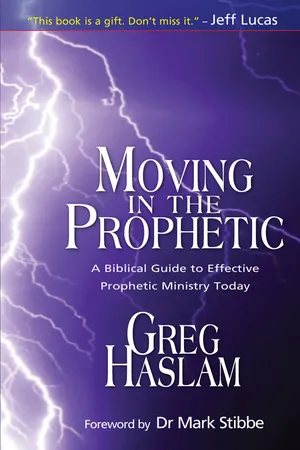
Moving in the Prophetic
A Biblical Guide to Effective Prophetic Ministry Today
- 384 pages
- English
- ePUB (mobile friendly)
- Available on iOS & Android
eBook - ePub
About this book
The gift of prophecy has always invited some degree of opposition and controversy. It is one of the most vivid displays of God's presence and power among his people. Many people struggle with the very concept of the validity of prophecy today. They are troubled by the possibility that God may have direct access to our minds. Greg Haslam argues that such concerns are misplaced. Following St Paul's injunction that we should be 'eager to prophesy' he considers how God speaks, and how we should hear him; how we can test and deliver a prophetic word; and how we can grow in confidence as we learn to discern what the Spirit is saying to the church.
Information
Topic
Theology & ReligionSubtopic
Biblical StudiesChapter One
Does God Speak Today?
Prophecy is God’s gift to the world and to the church, given to challenge and refine contemporary culture and build up the household of faith.
Yet, whether it is exercised in the church or the world, the gift of prophecy always invites some degree of opposition and controversy. It is one of the most vivid displays of God’s presence and power among his people, and since the presence of God can prove to be disturbing and even frightening, many have concluded that prophecy is best forgotten, consigned to the dustbin of history.
Yet we can’t avoid the gift of prophecy if we continue to read the Bible. Especially in the New Testament, we read so much about this activity of God in our midst: its importance, how it works, and the honour due to it. Typical of this positive emphasis would be a passage like this:
…eagerly desire spiritual gifts, especially the gift of prophecy…everyone who prophesies speaks to men for their strengthening, encouragement and comfort… he who prophesies edifies the church. I would like every one of you to speak in tongues, but I would rather have you prophesy. He who prophesies is greater than one who speaks in tongues, unless he interprets, so that the church may be edified.
1 Corinthians 14:1–5
In this epistle Paul has already been focusing on the internal life of the church at Corinth, responding to questions his readers had asked about matters of misconduct and malpractice in their corporate life together and about the way the gifts of the Spirit operated. We need to read straight through 1 Corinthians 12–14 to gain a proper understanding of Paul’s teaching on this issue. Taking selected verses, or looking only at chapter 13, is not enough. That great chapter on love is the “meat in the sandwich” of all that Paul says here and it indicates that Paul saw charismatic manifestations not in terms of “either love or gifts” but rather “gifts with love” or “gifts without love”.
We may be surprised and challenged by the suggestion that it is possible to operate the gifts of the Holy Spirit without the seal of the Spirit’s presence – love – upon what we do. Paul warns us that such use of the charismatic gifts is vain and empty.
Yet this does not mean we do better when we aim for love alone, suppressing the activity of the Spirit in the operation of the gifts; for Paul exhorts us to “eagerly desire” the gifts, especially prophecy. We must take Paul seriously as he goes on to discuss how the gift of prophecy is to be used.
A.W. Tozer has been frequently referred to as “that great twentieth-century prophet” and is widely regarded as having been a true prophet to the church, yet during his lifetime he was not esteemed in that way by many. The human tendency is to honour prophets when they are dead and safely in their graves, no longer posing a threat to the way we customarily want things done. Like the teachers of the law and the Pharisees who opposed the ministry of Jesus (Matthew 23:29–32), we build tombs to pay honour to dead prophets even if we were prepared to stone them while they were alive. Tozer is one such prophet, almost universally respected for his words and profound insights now that he has gone.
Tozer once asserted that, “We need to have the gifts of the Holy Spirit restored again to the church, and it is my belief that the one gift we need most now is the gift of Prophecy.” Many would agree, seeing prophecy as a desirable gift and one that we most need as a church living in troubled times when, if we are completely honest, our reputation as the church of Jesus Christ has more often been pathetic than prophetic. Yet the Spirit of God is faithful and longs to work with us to build a truly effective Christian community in every part of the world. This is why we stand in such need of the authentic gift of prophecy, for it has a crucial role to play in building up the people of God.
Danger – Saints at Work!
Even in churches where prophetic gifts are encouraged and fostered, they are robbed of power if the church leadership lacks confidence and experience to pastor, weigh and discern them appropriately. Much slips by in our churches without accurate weighing, correction, affirmation or admonition; and this is a sign that we are not living the mindful, reflective and discerning lives of true disciples. Sometimes even the plainly ridiculous or dangerous is accepted without question. There is often a high “cringe factor” in many churches, and it is one of the major stumbling blocks that frequently keep both sensible believers and unbelievers away from our meetings. The bizarre things we do and say inevitably turn them off. When this happens, people cease to take us seriously or listen to what we say – and so we dishonour our call to be God’s prophetic people in the world. Carelessness makes our words appear ridiculous. From time to time I have come across announcements in church bulletins or notice boards that have made me laugh out loud at their unintentional oddity.
A Baptist church built on a street corner used the windowless wall at the side of the chapel to display “wayside pulpit” posters, but did not take the trouble to reread them. As a result, passersby were treated to such gems as, “Don’t let worry kill you – let the church help!”. Another read, “Sermon for Sunday: What is hell like?”, then, just below that, the apparent answer: “Come in and hear our choir sing”!
An Anglican church, wishing to chivvy the congregation in the direction of more responsible giving, headed a paragraph on stewardship in their newsletter with a phrase from 2 Corinthians 9:7. Careless proofreading sent it to press saying: “God Loves A Cheerful Fiver!” Everyone laughed at the heading, and nobody read the rest!
A notice posted outside an Assemblies of God Pentecostal church in a small town in the south of England boldly advertised their weekly Sunday morning meeting. It read: “Healing service here every Sunday at 10.30 am”, then added the alarming words, “You won’t get better!” It’s a wonder anyone turned up!
Occasionally our errors take us nearer the bone than we intended – as when a Methodist church advertised their forthcoming choir event as a “Sarkey and Moody Evening”. Crowds stayed away in their thousands! And one of my favourites was the priceless announcement: “On Wednesday night the Ladies’ Liturgy Society will meet, when Mrs Jones will sing ‘Put Me in My Little Bed’ accompanied by the pastor”! It amused me, but somebody should have spotted that and informed them.
We laugh at these silly mistakes because they are harmless and unimportant, but they are symptomatic of a carelessness that disastrously blunts our prophetic edge. Our message can be effective only when it is supported by a faithful, discerning, honest critique; an ongoing, clear-sighted appraisal. God knows this, and that is why he raises up prophetic voices in his church even to this day, showing us how we can realign ourselves with his revealed will in the Holy Scriptures.
We are all aware that many people, especially prominent Christian leaders, struggle with the very concept of the validity of prophecy today. They have difficulties because God has spoken in his Word, the written Scriptures, and therefore they are troubled by the possibility that God may have direct access to the minds of his children in more immediate and personal ways than reading the Bible alone, through such means as hunches and divine intuitions, intimations or directions, pictures or even words that come directly from the Spirit of God. Such “words” are designed to build up and positively strengthen his church and not to harm it.
Our Speaking God
I myself had serious doubts about the validity of prophetic ministry at one time. What changed my thinking was the reflection that the devil often operates as a speaking agent in the supernatural realm, all too often gaining access to our minds in this way.
Satan is quite capable of putting alien ideas into our heads – unwanted thoughts, unwelcome imagery, dangerous suggestions, accusations, ideas and directions. Some of us see pictures in our imagination; others have had dreams that seem to be demonic in origin. We have sometimes woken up in a cold sweat, trembling with fear because of what has been screened in our imagination and seen by our mind’s eye. At other times we hear voices, sometimes even audible voices, suggesting the most horrendous things: “You would be better off dead”, “Your life is going nowhere”, “You’re useless”, “Your ministry is over, your influence is finished. You may as well end it all.”
It is important to recognize that the devil is a supernatural, speaking agent with access to our minds. But is it really credible to believe that the devil has a total monopoly of airtime on the radio waves of our souls, while God himself – who created all things by his Word, who expressed himself in Jesus as the living Word, who gave us the Bible as his Word of power – is silent when it comes to dealing directly with his people?
Does God have no access to the minds or spirits of his children? Has he no way of conveying pictures or images, words or suggestions, clear directions or specific intimations to them? Is all of this activity the devil’s province alone, because God is now decidedly “hands off ” when it comes to such activities, having given us a completed canon of Scripture in the Holy Bible? Has God retired from the fray in which the devil is still actively engaged? The logic of this reasoning is totally flawed.
I believe in the full inspiration of the Bible from Genesis to Revelation, and its final authority and total sufficiency for faith and practice, according to the claim of the Scriptures themselves. But I do not believe that when God inspired the last chapter of the book of Revelation, that acted as a kind of suicide note or at least the announcement of his retirement, after which we would never hear from God directly again. This is unthinkable. God has not signed off. He is Immanuel, “God with us”, still speaking to us, conveying thoughts, images, promptings and directions to men and women who will listen to him and act as his messengers; and that can include you and me!
In this study, I hope to impart the necessary confidence to every reader to reach out to God for more of the Spirit’s encouragement than ever before, coming to terms with our capacity to hear from him concerning people and situations where our words and insights are desperately needed and can become an untold blessing to many. God took Balaam, that mercenary and probably self-appointed prophet, and turned him around. Balaam was a man highly motivated by social status, personal prestige and hefty cash offers – he was actually paid to curse the children of Israel. God supernaturally redirected Balaam, using him to pronounce blessings over God’s people rather than curses. If God can use Balaam, surely he can use you and me! Balaam was a man whose character was flawed and whose motives were questionable; but God picked him up and turned his curses into blessings even as they emerged from his lips (see Numbers 22–24).
God also seized hold of the insecure and wayward first monarch of Israel, King Saul. Though a man of decidedly mixed motives and flawed character, Saul was also counted amongst the prophets, at least for a time during the earliest phase of his career, as the Spirit of God came upon him in power (1 Samuel 10:6–7).
It is also worth noting that the pragmatic, politically conniving and power-hungry high priest, Caiaphas, was supernaturally led by God to say on one occasion, “It is better …that one man die for the people than that the whole nation perish” (as justification for the Sanhedrin’s planned murder of Jesus). John the apostle comments: “He did not say this on his own, but as high priest that year he prophesied that Jesus would die for the… nation…” (John 11:50–51).
From these examples you can see that God is able to distribute authentic gifts of a prophetic nature to whomever he wishes, and whenever he likes. And if God frequently did this with such imperfect individuals as the men we have mentioned, how can we fail to have confidence that he is still prepared to bestow the gift of prophecy upon his children in our own day, children who love him, believe him, and want to serve both him and his church with integrity?
The Connection Between the Holy Spirit and Prophecy
The life of the church has seen long periods when prophetic ministry has been hidden and neglected in the mainstream expressions of Christianity. This has usually coincided with times when there has been a drought of the Holy Spirit’s presence among the people of God. Prophecy lay unrecognized even in those moments when it has stirred and in those lives who seemed to speak with special power.
It is impossible to institutionalize the charismata of God – the Spirit blows where he wills – and perhaps we should not be surprised that wherever worship is highly ritualized and the faith community becomes the establishment, talk of prophecy fades away.
Yet as we look more closely at the paths in which the faithful have walked, if we look for the byways and field-tracks instead of the high roads of the Christian map books, we discover that God has always spoken among his people. If the synods and the councils and the elders’ meetings would not hear him, still his voice was known in out-of-the-way chapels and in prayer meetings held before the main service began, or among ordinary people gathered around the kitchen tables of their homes.
Wherever the Holy Spirit has been welcomed and powerfully operative there has always been a resurgence of the gifts of the Holy Spirit, and particularly the gift of prophecy. In recent times, the wave of Holy Spirit renewal and blessing that has come to the body of Christ all around the world from the mid-1990s onwards was marked by a resurgence and flood of remarkable prophetic activity. This was also true of the birth of the Pentecostal movement in 1904–05, and the charismatic movement that began in the mid-1960s as well.
As these waves of Holy Spirit blessing and activity swept through thousands of churches all around the world, the quality and quantity of prophetic words increased. This is congruent with the prediction of the prophet Joel (Joel 2:28– 3:3), affirmed by the apostle Peter on the day of Pentecost, the first day the Spirit was outpoured in fullness upon Christ’s new covenant people. Peter cites this ancient prophecy in his address to the potentially hostile Jewish audience before him: “…this is what was spoken by the prophet Joel: ‘In the last days, God says, I will pour out my Spirit on all people. Your sons and daughters will prophesy, your young men will see visions, your old men will dream dreams. Even on my servants, both men and women, I will pour out my Spirit in those days, and they will prophesy’” (Acts 2:16–18).
The time-note struck here is important. This is the promise of an outpouring of the Holy Spirit in the “Last Days”. Most reputable Bible scholars, though not all, believe that this phrase, the “Last Days”, connotes the era between Christ’s ascension and his second coming from heaven, his parousia. The “Last Days” were not fully played out in the first few decades of the first century AD as the preterist (“past-ist”) school of eschatology maintains, declaring that they came to an end with the destruction of Jerusalem and the temple at the hands of the Romans in AD 70.
That event did not complete history, for we are all still here – and not yet fully redeemed residents in the new heaven and earth. Though the Roman invasion and destruction of the temple was important in sealing God’s “planned obsolescence” of the priesthood and sacrificial temple worship, it also revealed patterns of God’s reaction to the religious autonomy and spiritual deception of wicked men that repeatedly unfold throughout all subsequent history, just as our Lord predicted (Matthew 24–25; Mark 13).
Nor is this phrase the “Last Days” a reference to a short period of time immediately before the end of the world, as futurists would see it, and therefore to be postponed in its fulfilment and significance until the final decades of world history, as though the intervening 2,000 years of church history experienced thus far have been but a parenthesis between two short but significant periods when the “real action” supposedly occurs. A further problem with the futurist understanding of the “Last Days” is that they can only be confidently identified by hindsight – since “no-one knows about that day or hour” when the Son of Man will return (Matthew 24:36). Certainly the predictions, descriptions and criteria for the “end times” in Mark 13 and Matthew 24–25 apply to the times in which we are now living, as they have for the most part to past generations. They seem to describe the whole inter-adventual period from beginning to end.
The “Last Days” have already arrived, according to the New Testament, and we are presently still living within them. Hebrews 1:1–2, for example, tells us that God has spoken to us “…in these last days… by his Son”, referring to an era that commenced with the public appearance of Jesus Christ and that has shown no signs of coming to an end even yet. There seems to be a unanimous testimony among the apostles writing in the New Testament that the “Last Days” suddenly erupted in the middle of history, and not at the end of it, as contemporary first-century Jewish eschatology had expected. We now live in the overlap of the “old evil age” dominated by sin and Satan, and the “age to come” that commenced with the first coming of Christ and particularly the great epoch-making, saving events of his cross and resurrection/ascension. In his sermon on the day of Pentecost, Peter proclaimed God’s promise (through the prophet Joel) to be fulfilled, so indicating that the Last Days had thus begun. As we are still living in the “Last Days”, waiting for the return of the Lord, the promise has surely continued in force for all of the running centuries since then. We have no reason to believe that the promise has in any way been rescinded – “I will pour out my Spirit on all people… and they will prophesy.”
Notice also the close connection, in Peter’s understanding, between an outpouring of the Holy Spirit and the manifestation of prophetic gifts among God’s people. The Spirit inaugurates a new age of revelation, lavish and indiscriminate in its effects upon the people of God. The Holy Spirit is declared to have been poured out on every nation and ethnic group (“all people”), all ages (“young“ and “old”), both sexes (“men and women”) and regardless of economic status or class (on “servants”). The Holy Spirit is not ageist, sexist, racist or class conscious. Instead, he is an “equal opportunity” empowerer of his people. He breaks down all of the artificial barriers that we might erect in order to limit or monopolize his generosity. There is no elitism in the kingdom of God for, at the moment of Christ’s death when the temple veil was torn in two, a way was made open for all people into the Holy of Holies, the very presence of God. At that moment, the prophetic calling to come into God’s presence, and receive his Word for this generation, passed from being the spasmodic ministry of a select few to being the regular privilege of all: an every-believer ministry. It follows from this that we should expect to see manifestations of the Spirit’s coming in this new way among the whole community of believers everywhere, including the gift of prophecy displayed in diverse forms – such as God-directed speech, dreams, visions, signs and actions, as well as prophetic lifestyles that model God’s justice...
Table of contents
- Cover
- Title Page
- Copyright
- Praise for Moving in the Prophetic
- Dedication
- Table of Contents
- Foreword
- Preface
- Chapter One: Does God Speak Today?
- Chapter Two: Be Eager to Prophesy
- Chapter Three: Prophetic Watchmen in the Church
- Chapter Four: Pursuing the "Real Deal"
- Chapter Five: Hearing the Voice of God
- Chapter Six: Learning to Prophesy
- Chapter Seven: Delivering a Prophetic Word
- Chapter Eight: Testing a Prophetic Word
- Chapter Nine: Finding Prophetic Vision and Direction for Your Life (Part 1)
- Chapter Ten: Finding Prophetic Vision and Direction for Your Life (Part 2)
- Chapter Eleven: Paul on the Prophetic - Healthy Relationships
- Chapter Twelve: Paul on the Prophetic - Men and Women Together
- Chapter Thirteen: Paul on the Prophetic - Love Changes Everything
- Chapter Fourteen: Growing in the Prophetic (Part 1)
- Chapter Fifteen: Growing in the Prophetic (Part 2)
- Recommended Reading
- Notes
Trusted by 375,005 students
Access to over 1.5 million titles for a fair monthly price.
Study more efficiently using our study tools.
Frequently asked questions
Yes, you can cancel anytime from the Subscription tab in your account settings on the Perlego website. Your subscription will stay active until the end of your current billing period. Learn how to cancel your subscription
No, books cannot be downloaded as external files, such as PDFs, for use outside of Perlego. However, you can download books within the Perlego app for offline reading on mobile or tablet. Learn how to download books offline
Perlego offers two plans: Essential and Complete
- Essential is ideal for learners and professionals who enjoy exploring a wide range of subjects. Access the Essential Library with 800,000+ trusted titles and best-sellers across business, personal growth, and the humanities. Includes unlimited reading time and Standard Read Aloud voice.
- Complete: Perfect for advanced learners and researchers needing full, unrestricted access. Unlock 1.5M+ books across hundreds of subjects, including academic and specialized titles. The Complete Plan also includes advanced features like Premium Read Aloud and Research Assistant.
We are an online textbook subscription service, where you can get access to an entire online library for less than the price of a single book per month. With over 1.5 million books across 990+ topics, we’ve got you covered! Learn about our mission
Look out for the read-aloud symbol on your next book to see if you can listen to it. The read-aloud tool reads text aloud for you, highlighting the text as it is being read. You can pause it, speed it up and slow it down. Learn more about Read Aloud
Yes! You can use the Perlego app on both iOS and Android devices to read anytime, anywhere — even offline. Perfect for commutes or when you’re on the go.
Please note we cannot support devices running on iOS 13 and Android 7 or earlier. Learn more about using the app
Please note we cannot support devices running on iOS 13 and Android 7 or earlier. Learn more about using the app
Yes, you can access Moving in the Prophetic by Gregory Haslam in PDF and/or ePUB format, as well as other popular books in Theology & Religion & Biblical Studies. We have over 1.5 million books available in our catalogue for you to explore.