- 256 pages
- English
- ePUB (mobile friendly)
- Available on iOS & Android
eBook - ePub
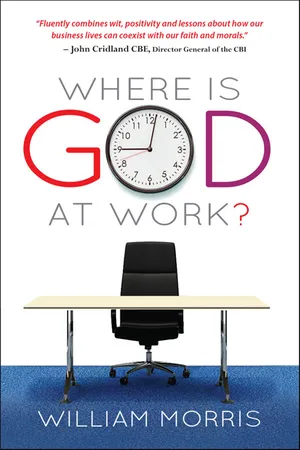
Where is God at Work?
About this book
Difficult boss; annoying colleagues; boring work? Asked to work harder and harder; told by your manager to lie; tempted to do something bad? This book helps you think through the calling to be a Christian at work by showing how God can be unexpectedly present even in the most difficult people and dilemmas. Work can become a place where you can exercise your talents, positively influence your business, and be a witness to Christ just by being who you are.
Information
Topic
Theologie & ReligionSubtopic
ReligionPART I
Where is God at Work?
1
The Workplace
Genesis 28:11–17 (NRSV)

He came to a certain place and stayed there for the night, because the sun had set. Taking one of the stones of the place, he put it under his head and lay down in that place. And he dreamed that there was a ladder set up on the earth, the top of it reaching to heaven; and the angels of God were ascending and descending on it. And the Lord stood beside him and said, “I am the Lord, the God of Abraham your father and the God of Isaac; the land on which you lie I will give to you and to your offspring; and your offspring shall be like the dust of the earth, and you shall spread abroad to the west and to the east and to the north and to the south; and all the families of the earth shall be blessed in you and in your offspring. Know that I am with you and will keep you wherever you go, and will bring you back to this land; for I will not leave you until I have done what I have promised you.” Then Jacob woke from his sleep and said, “Surely the Lord is in this place – and I did not know it!” And he was afraid, and said, “How awesome is this place! This is none other than the house of God, and this is the gate of heaven.”
If you were asked to spot the odd one out in the following pairs – salt and pepper, bread and butter, knife and fork, God and workplace – the answer is obviously “God and workplace”. The two are so far from being a complementary pair that the dissonance is hardly even worth noting. It’s so unremarkable that we accept it without thinking and move on. But perhaps we should pause a moment, consider it more, and dig down a little. Why are they so obviously incompatible? Why are “God” and “workplace” such clear opposites in our minds?
Of course, we can complain that it’s the fault of secularism in the modern workplace that squeezes out all references to, and thoughts of, God. About businesses so fearful of favouring anyone – including in relation to religion – that they end up disadvantaging everyone. God has been banished from the public square, we can tell ourselves. But, in fact, I think that most of the problem lies not with secularism, but with us as Christians. Beliefs, issues, come at us from two directions, combining to form an impenetrable barrier – in our minds – between God and our workplace.
One set of issues arise from that significant part of the institutional church that, whatever it says, really only believes that God exists in church, on a Sunday morning, preferably with liturgy and hymns. On this view we can only meet God in a building with an altar, a cross, and pews, and at a certain time. For all the talk of café churches and weekday house groups, our Christian culture, our upbringing (and some of our church leaders) all make us consciously or unconsciously feel, believe, that God is only – or, at the very least, is especially – present in church, on the sabbath.
The other set of issues come from an equally deeply held belief by many Christians that God and religious activity are “good” and “pure”, while office work or anything done for a salary (and especially for profit) is, at the very least, inferior, probably slightly grubby, or possibly even just plain dirty. And if that’s the case, then how on earth can God be there in that?
Both of these ideas are deeply rooted in Western culture. And yet countless millions of people in the UK and elsewhere spend eight or more hours in workplaces every day. What is the church saying to them? God doesn’t love you? God doesn’t care? You’re wasting your time and skills doing this? That may not be what the church thinks it’s saying, but that’s sometimes very much what it sounds like. And then the church wonders why these people (now the significant majority) think Christians are weird; wonders why they don’t want to come to church, and why they don’t think that religion has anything to say to them or wants anything to do with them.
I spent the first year of my training to be a priest wondering what on earth I was doing. I was really there only because no one in the process of selection and training had said “no”. There was a vague, nagging feeling that God was somehow driving (dragging?) me forward, but there had been no clear light shining on the road, no fixed plan. Then, one evening, someone came to teach a class on “faith and the workplace”. Suddenly I realized what it was that I was doing, and why I was doing it.
I had always known that I was going to carry on with my secular (“day”) job after ordination – but perhaps switch from the slightly grubbier, commercial world over time into something “better”, more “worthwhile”, perhaps something more “pleasing” to God. During the class that night my view changed suddenly and almost completely. I realized that I was getting ordained and staying in the secular workplace in order to make links between those two worlds. I was doing both in order to try to make clearer how the Worker, Creator God of Genesis 1 is also present in our workplace today, and how much He cares about those workplaces and cares about us in them.
Now you may accept logically what I’m saying, but do you really feel it? Many workplaces don’t feel that great, don’t feel like places of opportunity. There can be enormous tension. Tyrannical bosses. Horrible colleagues. Stupid, pointless, meaningless rules. Long hours. Little sympathy or empathy. The threat of redundancy. A total lack of privacy. Or it can be even worse than that. There can be real discrimination. You might feel you are being asked to do unethical things, to cut corners. Or you may feel that the social utility of what you are doing is zero – or even negative. All of these things can make the workplace seem a bit of a nightmare. So, how on earth can God be there? Well, the simple answer is this: in the same way that He’s present in the rest of our broken world. Life outside the workplace can be pretty awful sometimes, too – even in churches. Does every family get on at Christmas? Do families never viciously argue? Does every church welcome outsiders with open arms? What about clerical sexual abuse scandals? Nevertheless, despite this, do we feel that means that God cannot, therefore, be present in the midst of family, or in the midst of the church?
The point is not what’s wrong; it’s what could be right. And that may be unexpected – totally, completely, utterly unexpected. That is the story of Jacob’s ladder. Here’s Jacob. He’s already tricked his stupid elder brother Esau out of his birthright, and now he impersonates him to his old, blind father Isaac, with the total support of his conniving mother Rebekah, in order to get Isaac’s blessing. Esau, who’s a big guy, not unreasonably is outraged when he finds out about this and, slightly less reasonably, decides to kill Jacob. Rebekah finds out and tells Jacob, and she and Isaac bundle him off out of the way to see relatives.
So, sent away, and in trouble both with his brother and also, one might hope, with his conscience, Jacob travels until it’s dark and then just lies down in the countryside to go to sleep. Then the totally unexpected happens. To this dodgy character, on the run, and in the middle of nowhere – miles from the nearest shrine, and a long way from 10 a.m. on Sunday morning – God appears. And doesn’t just appear, but heaven touches earth and earth touches heaven. All of a sudden everything is changed, transformed. What looked like an ordinary place is, in fact, the place where God is present, and where heaven and earth meet. In this nowhere place, God announces to Jacob that He will be with him and his successors and that they will be blessed forever.
God is not constrained by buildings, or by days of the week, or by circumstances, or by where we feel we are, or by what others think of us. God is not made in our image; it’s the other way around – and, therefore, we should expect to be surprised from time to time. Jacob exclaims, “Surely the Lord is in this place – and I did not know it!… How awesome is this place! This is none other than the house of God, and this is the gate of heaven.” That strikes me as a pretty good way of viewing even the worst workplace. People may think it’s dodgy; they may think it’s nowhere – the place that you have to go to in order to earn the money that you can then spend in order to be able to forget it – but, looked at in the right way, it may just be the gate of heaven. We must be prepared to be surprised because one thing can be almost guaranteed. If the heavens open and a ladder descends it will not – it will not – be in a church by the altar. It will almost certainly be nowhere in the building. It will surprise us – and it could very well be in your workplace.
So in these first ten chapters, we will explore where the ladder might be in your workplace, and perhaps how to find it. We’ll certainly look at the bad things that can happen in any workplace, but the essential point to remember is that what we humans make bad, God can (quite often through us) make good again. So what might the opportunities be once we recognize the ladder in the workplace? Well, there are some obvious ones. It can be a place where we exercise personal responsibility and behave ethically – not fiddle our expenses, and always cut square corners (as my former boss was fond of saying). Where we can deliver an honest day’s work for an honest day’s pay.
But it’s not just that. It can also be where we carry out the gospel imperative to care for those who are in need, for those who need help. Our fellow workers may not be literally hungry, or prisoners, or naked, as in the parable of the sheep and the goats, but there are plenty – far too many people – who in the workplace really do feel trapped. Who feel imprisoned by circumstances, imprisoned by the need to earn something, anything, to put bread on the table for their family. Imprisoned by an inability to imagine something better, or by blind ambition that drives them ever harder and, thus, also further away from friends and family. Those people are prisoners in a workplace rather than a jail.
There may be those who are starving for respect, or a little love or friendship, or just a little fulfilment – and those people are truly hungry. Or our fellow workers may feel incompetent and out of their depth, or ugly, or unbearably different. Under the spotlight in the workplace these people are in a very real sense naked. It is our job, our duty, our obligation, but also our opportunity, our privilege, to help those people in those situations wherever they may be – including in the workplace.
But it’s not just that. The workplace can also be the place where we exercise our talents, our God-given talents, to reach true fulfilment. A place where we exercise our skills to create things and services that other people want and need. Where we can be the stewards that God calls us to be from the very beginning of creation. A place where, if we get it right, we can create employment that gives our fellow humans jobs that give them dignity – that allows them to look after their families. And a place where we can work imaginatively in teams giving living expression to Paul’s analogy in 1 Corinthians 12 of the different parts of the body bringing their own functions and gifts to make up something which is more than the sum of its parts. That doesn’t just work for the church – it can work for a secular workplace, too.
But it’s not just that. It’s a place where we can be co-workers in the act of healing God’s creation. Where we can work for justice and for ethics. Where we can try to ensure that what our business, or government department, or school – or whatever it is – does, contributes in some way to the common good. Where, be it ever so slowly, we can try to make sure that the next decision that is taken is slightly better in some way than the previous one. A place where we can fight for what we believe – gently, respectfully, but persistently – and make a real, tangible difference to those around us, and to those whom we seek to serve.
But it’s not just that. It can be a place of mission. A place where we try to bring what we know about our God, about Jesus Christ who lived and died and rose for us, to those who don’t know. Now to be clear, I’m not for a moment suggesting handing out tracts or standing on a soapbox in the corridor with a megaphone. What I am suggesting, however, is that we can be who we are, that we witness to being Christians by being the people we are and by the way we act. We are much closer to many more people in the workplace than in any other area of our lives. In those close settings, day in day out, there are very few secrets. If we’re Christians, they’ll know it. If we act in certain ways, they’ll see that. If it seems to help us in bad times and good, they’ll note it. And sometimes they’ll want to talk – and then we can tell them about the gift that has been given to us.
But it’s not just that. There’s so much more – but perhaps that’s enough for now. Even when you read that partial list, however, don’t you feel like Jacob? You’ve been looking around and everything seems pretty grim and then, all of sudden, you see the potential – heaven opens up, so to speak – and you realize, surprised, shocked, that surely the Lord is in this place, and I did not know it! God is there at the most unexpected times and in the most unexpected places. Heaven can touch earth when we least expect it. That is the potential of Jacob’s ladder. That is the potential of the workplace. That is the potential of God at work.
2
Your Boss
Ephesians 6:1–9 (NRSV)
Children, obey your parents in the Lord, for this is right. “Honour your father and mother” – this is the first commandment with a promise: “so that it may be well with you and you may live long on the earth.” And, fathers, do not provoke your children to anger, but bring them up in the discipline and instruction of the Lord. Slaves, obey your earthly masters with fear and trembling, in singleness of heart, as you obey Christ; not only while being watched, and in order to please them, but as slaves of Christ, doing the will of God from the heart. Render service with enthusiasm, as to the Lord and not to men and women, knowing that whatever good we do, we will receive the same again from the Lord, whether we are slaves or free. And, masters, do the same to them. Stop threatening them, for you know that both of you have the same Master in heaven, and with him there is no partiality.
In the first chapter, we looked at how God might be present in the workplace in the most unexpected places and the most unexpected ways. However, of all the unexpected ways in which heaven might manifest itself in the workplace, few seem less likely than something closely connected with our boss.
I remember my first boss. I was nineteen and he must have been almost three times that. He did not socialize, spoke – literally – a different language from almost everyone else in that workplace, and was rarely seen except for the occasional explosive foray from his office to find out why someone had failed to do something. For me, as an impatient teenager, he appeared to sum up all that was tiresome, static, and unimaginative about people in their fifties drifting towards retirement. So here’s the question – and even discounting heavily for the exceptional arrogance of (my) youth: what might uninspiring bosses, and tyrannical bosses, and careless bosses, and ineffective bosses have to say about where God might be in the workplace? Again, looking through the prism of the story of Jacob, is there really any chance that the heavenly ladder might actually touch down in the boss’s office, and, if it did, what on earth would it mean?
To try to tease that answer out a bit, I have picked one of the most controversial passages in the Bible: “Slaves obey your earthly masters”. In Richard Dawkins-land this passage sits in the front row of the accused at the Bible-Crimes Trial; Christianity in the dock as the religion of the oppressor and the bigot. How can a passage used by pre-Civil War American slave-owners to defend their holding of fellow humans as goods and chattels to be exploited, abused, and bought and sold, have anything useful to say to us about anything? Our normal reaction to this passage is either to skip it, or, if we’re really forced to look at it, to come up with good reasons why it wasn’t written by the “nice” Paul who wrote Romans and Corinthians. It must instead have been written later by someone else who had appropriated Paul’s name in order to squeeze the church into a patriarchal, property-owning straightjacket very removed from what Jesus of Nazareth could ever have intended. But along the lines of being surprised, or never quite knowing where God will be, let’s just stick with the passage for a moment longer.
Now – and I hope obviously – while we occasionally talk about being “slaves to work”, or “wage slaves”, I am not in any way condoning or defending, far less advocating for, slavery. However, what do we get if we replace the word “master” with “boss”, and the word “slave” with “direct report” or “employee”? Well, it still rankles doesn’t it? That word “obey” doesn’t have a particularly twenty-first-century feel to it. What about “flat pyramids” and “cooperative workplaces” and all the other things they teach at business school? Go back to my nineteen-year-old self for a moment. Fresh out of boarding school, where “obey” had very much been the way of things, I wanted to be “free”. I was determined to live the more individualistic, adult culture that I had previously watched from my schoolroom window. Deference seemed very old-fashioned – constricting, suffocating – placed against the desire and the possibilities for self-expression. Perhaps I could learn from a boss who was dynamic and charismatic, her or himself a dramatically individualistic individual. But from some grey plodder? What was there to learn?
Well, let’s take a closer look at what Paul (or his evil twin) actually has to say. The key to understanding the slaves and masters passage may actually lie in the passage that immediately precedes it about parents and children. Even today we understand that kids do best when there are boundaries that they cannot cross, rules that keep them safe. Rules that allow them freedom within certain limits. Rules which perhaps allow them to protest – e.g. “I just want to be free” or “I need to express myself” – but, nevertheless, also allow them to protest in safety. Rules that allow the process of really growing up, of developing minds, of intellectual exploration, of social development, of trying things and failing – but failing in safety. That’s what these boundaries for children are for: not to restrict freedom, but to allow real development. If the boundaries are draw...
Table of contents
- Cover
- Praise
- Title Page
- Copyright
- Dedication
- Contents
- Acknowledgments
- Foreword
- Introduction
- Part I: Where is God at Work?
- Part II: Where is God at Work in Work’s Dilemmas?
- Part III: Where is God at Work in the Bible?
- Epilogue: A Personal Reflection on Witnessing at Work
- Suggested Questions for Study Groups
- Bibliography
Trusted by 375,005 students
Access to over 1.5 million titles for a fair monthly price.
Study more efficiently using our study tools.
Frequently asked questions
Yes, you can cancel anytime from the Subscription tab in your account settings on the Perlego website. Your subscription will stay active until the end of your current billing period. Learn how to cancel your subscription
No, books cannot be downloaded as external files, such as PDFs, for use outside of Perlego. However, you can download books within the Perlego app for offline reading on mobile or tablet. Learn how to download books offline
Perlego offers two plans: Essential and Complete
- Essential is ideal for learners and professionals who enjoy exploring a wide range of subjects. Access the Essential Library with 800,000+ trusted titles and best-sellers across business, personal growth, and the humanities. Includes unlimited reading time and Standard Read Aloud voice.
- Complete: Perfect for advanced learners and researchers needing full, unrestricted access. Unlock 1.5M+ books across hundreds of subjects, including academic and specialized titles. The Complete Plan also includes advanced features like Premium Read Aloud and Research Assistant.
We are an online textbook subscription service, where you can get access to an entire online library for less than the price of a single book per month. With over 1.5 million books across 990+ topics, we’ve got you covered! Learn about our mission
Look out for the read-aloud symbol on your next book to see if you can listen to it. The read-aloud tool reads text aloud for you, highlighting the text as it is being read. You can pause it, speed it up and slow it down. Learn more about Read Aloud
Yes! You can use the Perlego app on both iOS and Android devices to read anytime, anywhere — even offline. Perfect for commutes or when you’re on the go.
Please note we cannot support devices running on iOS 13 and Android 7 or earlier. Learn more about using the app
Please note we cannot support devices running on iOS 13 and Android 7 or earlier. Learn more about using the app
Yes, you can access Where is God at Work? by William Morris in PDF and/or ePUB format, as well as other popular books in Theologie & Religion & Religion. We have over 1.5 million books available in our catalogue for you to explore.