eBook - ePub
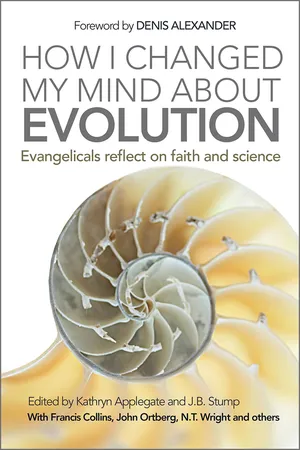
How I Changed My Mind About Evolution
Evangelicals Reflect on Faith and Science
- 208 pages
- English
- ePUB (mobile friendly)
- Available on iOS & Android
eBook - ePub
How I Changed My Mind About Evolution
Evangelicals Reflect on Faith and Science
About this book
Over two dozen Christian leaders describe how they changed their minds about evolution Perhaps no topic appears as potentially threatening to evangelicals as evolution. The very idea seems to exclude God from the creation the book of Genesis celebrates. Yet many evangelicals have come to accept the conclusions of science while still holding to a vigorous belief in God and the Bible. How did they make this journey? How did they come to embrace both evolution and faith? Here are stories from a community of people who love Jesus and honor the authority of the Bible, but who also agree with what science says about the cosmos, our planet and the life that so abundantly fills it. Among the contributors are Scientists such as: Francis Collins Deborah Haarsma Denis Lamoureux Theologians and philosophers such as: James K. A. Smith Amos Yong Oliver Crisp Biblical scholars such as: N. T. Wright Scot McKnight Tremper Longman III Pastors such as: John Ortberg Ken Fong Laura Truax
Information
Topic
Theology & ReligionSubtopic
Religion & Science- 1 -
From Culture Wars to Common Witness
A Pilgrimage on Faith and Science
James K. A. Smith is professor of philosophy at Calvin College and a senior fellow of The Colossian Forum. His most recent book is Who’s Afraid of Relativism? (Baker Academic, 2014). He and his wife, Deanna, have four children and are committed urban gardeners.

Strangely (and sadly) enough, it was Christians who taught me how to fight. Since I was not raised in a Christian home, I didn’t receive the standard evangelical formation in the faith (Christian schooling, youth group, summer camps concluding with heartfelt renditions of Michael W. Smith songs). So I also didn’t absorb the common evangelical sense of the “fault lines” that defined our culture.
However, when I became a Christian at the age of eighteen, I quickly made up for this. I drank up the Bible and consumed whatever mode of Bible teaching I could find (I’m old enough, I confess, that most of this was from huge catalogues of cassette tapes by noted Bible teachers). I abandoned my plans to become an architect, immediately sensed a call to ministry, and enrolled in Bible college. My first year at Bible college was a veritable boot camp in what I would only later learn to describe as “the culture wars.”
Perhaps surprisingly, it was at Bible college that I was first taught to care about science. That might strike some as odd, since we often perceive Bible colleges as anti-intellectual zones of hostility to science. But that picture needs to be corrected a bit. In my Bible college experience, I was energized by a new interest in science bequeathed to me by the energy and passion of my apologetics teacher. A former naval engineer with a PhD in chemical engineering, “Dr. Dave” had experienced a radical conversion and also sensed a call to ministry. After spending time at seminary, he devoted himself to a teaching ministry that eventually landed him at the Bible college where his responsibilities were apologetics and “Christian evidences.”
His passion and knowledge were infectious. I soaked up his fascination with archaeology (a historical science). I was awed by his presentation of geological evidences of the flood and cosmological evidence for creation. Here I was at Bible college, being invited to think about carbon dating and the Doppler effect and the geological science of sedimentation (the volcanic impact of Mount St. Helens was always a favorite case study). As someone who had skated through high school with little to no interest in science, I would never have imagined that going to Bible college would pique my interest in everything from molecules to galaxies.
Dr. Dave noted my curiosity and began to express personal interest, taking me under his wing as a kind of apprentice. Indeed, while the intellectual component fostered my curiosity about “creation science,” I think it’s crucial not to underestimate the personal and pastoral factors at work here as well. In significant ways, I cared about creation science because Dr. Dave had clearly demonstrated that he cared for me. I was open to being intellectually convinced precisely because I had already sensed that I was being pastorally cared for. My mind was open to creation science because Dr. Dave had expressed love and concern for my soul. I sensed a symbolic culmination of all of this when he gave me a personal copy of Ian Taylor’s (rather infamous) book, In the Minds of Men: Darwin and the New World Order. It still sits on my shelf, no longer because I value the arguments it contains, but because I’m grateful for the love with which it was given.
Not until later did I realize that, in my Bible college education, science was primarily of interest as ammunition in a culture war. I don’t mean to suggest there wasn’t genuine interest or curiosity in features of God’s creation and the intricacies of the physical world. I only mean that this curiosity was circumscribed and selective and instrumentalized. Science was of interest insofar as it contributed “evidences” that would help win an argument, defeat an opponent and shore up a “position” in the culture war. Science was not entertained as a vocation or calling for Christians. Instead, science was something we could use—and use as a weapon.
In addition, it gradually became clear to me that the “science” I was being offered was a very selective sampling of data and evidences that exhibited a kind of confirmation bias: unlike the sort of open curiosity—and openness to being wrong—that characterizes genuine scientific exploration of the physical world, my teachers were primarily interested in science that confirmed a certain reading of the Bible (specifically, a young-earth creationist reading of Genesis). I started to get an inkling that maybe I hadn’t gotten the whole story—that maybe there was a lot more to science than flood geology and critical questions about carbon dating.
Interestingly enough, the seeds of my critical distance from this sort of “science” were also sown at the same Bible college—through an encounter with Christian theologians associated with “Old Princeton.” (In Book VIII of Augustine’s spiritual autobiography, The Confessions, he recounts his conversion through his encounter with several important books. My “conversion” with respect to faith and science is also a history of encounter with important books. Who knew libraries could be evangelists?) In some of my courses in systematic theology, my professors regularly referred to the rich heritage of Reformed thinkers that included B. B. Warfield, Charles Hodge, A. A. Hodge and others. Being a Bible and theology geek, I scoured the college library for anything and everything by these august scholars and Bible commentators. I camped out in the basement library for hours on end surrounded by their works. Whenever I could scrabble together a few dollars, I added another Warfield or Hodge to my growing personal library. My “upstairs” education in the classrooms of the Bible college were supplemented by a “downstairs,” parallel education in “Old Princeton” Reformed theology. And in their work—already in the 1800s—I found quite a different posture toward science.
This all crystallized when I hit upon Mark Noll’s excellent anthology, The Princeton Theology 1812–1921: Scripture, Science, and Theological Method from Archibald Alexander to Benjamin Breckinridge Warfield. Here I first encountered the writings of orthodox, conservative, Reformed evangelicals who were open to—and affirmative of—developments in evolutionary science. Indeed, Warfield had been cited by my professors as one of the great defenders of biblical inerrancy; but they hadn’t told me about his very favorable stance towards evolution. And so some of my former sureties began to crumble. I began to sense that science was bigger than what I had been taught, and that evangelical Christians need not be characterized by fear or a posture of defense, but could be open and curious about new developments. Most importantly, I began to realize that science need not just be an apologetic weapon. Scientific exploration could be a good in and of itself, even if that exploration might take us into places that could be unsettling.
This season in my life was a turning point in many ways. In particular, it was at this juncture that my pilgrimage in faith took me toward the Reformed tradition. (I discuss this in more detail in my little book Letters to a Young Calvinist: An Invitation to the Reformed Tradition.1) This had repercussions for every sector of my thinking, including how I thought about science. But what I absorbed from the Reformed tradition was also a stance toward history and the historical riches of the Christian tradition. The Reformation was a renewal movement in the church catholic that was birthed by the Reformers’ recovery of ancient Christian sources, mining the wisdom of church fathers like Augustine and Chrysostom. That means the Reformed tradition is characterized by a sense of chronological deference, in a way—a sense that we have much to learn from what has gone before, even a certain healthy skepticism about theological novelty.
This sensibility dovetailed with my encounter with another important book in my pilgrimage: Ronald Numbers’s The Creationists: The Evolution of Scientific Creationism. In this meticulous history, Numbers demonstrates the utter novelty of young-earth creationism as a biblical hermeneutic (a direct parallel to the utter novelty of dispensationalism as a way of understanding the eschatology of Scripture). Because my pilgrimage in the Reformed tradition had instilled in me a sense of indebtedness to the riches and legacy of the historic Christian faith, the newness and novelty of “scientific creationism” gave me serious pause. And I began to realize that the way I had been taught to read the Bible alongside selective presentation of scientific data was, in fact, quite aberrant in the history of Christianity—a modern hermeneutical invention that was strikingly different from the way the Bible had been read from Augustine to John Calvin. So in a way, it was discovering the orthodox voices of Augustine and Calvin and Warfield that made me suspicious of the notion that I needed to be a young-earth creationist in order to be orthodox.
In my pilgrimage, the riches of the Reformed tradition and heritage have encouraged an expansive, positive affirmation of science. This is forcefully articulated in Abraham Kuyper’s 1898 Stone Lectures (delivered at Princeton Seminary), particularly his fourth lecture, “Calvinism and Science.” There Kuyper showed how the Reformation gave rise to scientific exploration. This was rooted, he said, in the Reformed affirmation that “every square inch” of creation belongs to God, which means that our cultural labor—whether as farmers or pharmacists, entrepreneurs or entomologists—can be legitimate expressions of Christian vocation, a way to serve the Lord of creation. Because the Reformed tradition encouraged scientific exploration, and because giants of the Reformed faith like Hodge and Warfield didn’t seem to balk at affirming evolutionary science, I could say that my pilgrimage to the Reformed tradition instilled in me an openness to evolution I couldn’t have imagined before. I reached a place where forbears in the faith led me to see that orthodox Christian confession did not require a narrow biblical hermeneutic on such matters. Or perhaps I could say that my pilgrimage to the Reformed tradition actually helped me distinguish matters of historic, essential orthodoxy from secondary matters on which Christians might disagree. The anchor and guide of the historic Christian faith prevented me from inflating a theological innovation like young-earth creationism to the status of orthodox litmus test.
However, there remained one more important phase of my own “evolution”—my own (ongoing) pilgrimage on the intersecting path of faith and science. The examples of historic figures like Augustine and Calvin and Warfield had helped me see that orthodox Christians could hold a range of positions on creation, evolution and human origins. And so the tent of the faithful was enlarged beyond the small circle of young-earth creationists. It was less a matter of having changed my position and more a matter of recognizing that a range of positions could be consistent with orthodox Christian confession.
However, I noticed that not all of my colleagues shared this “big tent” sensibility. Instead of being characterized by openness to a range of positions, some convinced proponents of evolutionary creation looked rather familiar to me. Indeed, I began to realize that while some of my friends and colleagues who were evolutionary creationists affirmed a very different sort of science from what I’d been taught at Bible college, they actually mirrored my Bible college professors insofar as they were using science in a similar way. While they had swapped positions (and many of them had been former young-earth creationists), they hadn’t given up the culture wars stance that comes with such positions. Science was still a weapon used in a war. The point was winning, not witness.
And it seemed to me that this stance was fostered by fear. If young-earth creationists feared the erosion of biblical faith and a compromise of the gospel—a fear that drove their “culture war” stance—then some of my evolutionary creationist colleagues seemed to fear being perceived as hicks and fundamentalists, losing the respect of their colleagues in the academy or opinion-shapers in culture. In each case, it seemed that these very different fears nonetheless occasioned similar responses: brandishing “science” as a weapon in order to win.
While it might have been (some) Christians who taught me to fight, the Spirit of Christ has taught me to “be not afraid.” This means I don’t need to fall into fight-or-flight mode, driven by fear to either crush all threats or hide from difficult questions. It also means that I don’t need to confuse a particular position with the only way to follow Jesus. While Christians need to wrestle with and work through difficult questions at the intersection of faith and science, that intellectual labor needs to be rooted in the core conviction that all things hold together in Christ (Colossians 1:17).
As my friend and colleague Michael Gulker of the Colossian Forum sometimes puts it: true discipleship is learning to “fight like Jesus.” That, of course, is an ironic, provocative way to remind us that if we look at the model and exemplar of Jesus, we’ll see that he wins by losing. As N. T. Wright provocatively puts it in The Challenge of Jesus, “The cross is the surest, truest and deepest window on the very heart and character of the living and loving God.”2 So in all of our cultural labor—including science, theology and the conversation between the two—“the methods, as well as the message, must be cross-shaped through and though.”3 By bearing witness to the coming kingdom, we—like Christ—will be witnesses by giving up our penchant for winning, for domination and control—either of the culture or of our brothers and sisters in Christ. To follow Jesus is to beat our swords into plowshares and our microscopes into vessels of worship and praise. It is also to prize our common witness above being right or respected. This means refusing to instrumentalize science for either party in the culture wars by eschewing such warring altogether, following instead the Prince of Peace, in whom all things hold together.
- 2 -
Who’s Afraid of Science?
Scot McKnight is the Julius R. Mantey Professor of New Testament at Northern Seminary. He completed his PhD at the University of Nottingham with a dissertation on the Gospel of Matthew. A native Illinoisan, Scot and his wife, Kris, live in the northern suburbs of Chicago, and they have two adult children and two grandchildren. They enjoy gardening, walking and travel. He is the author of more than fifty books.
A student of mine recently wrote a paper in which he talked about growing up in a church that taught young-earth creationism. This student had begun to feel quite uncomfortable, as he had learned some facts about the world a long, long time ago that were almost certainly undeniable. Here is how he reported it to me:
Specifically, I remember the single youth group lesson that finally pushed me to the point of crisis. We were being taught about creation from a perspective that I now know to be called young-earth creationism. I remember watching the video our youth leader and pastor had selected, and as they launched into the prefabricated curriculum, I remember raising my hand and asking a single, simple question: “What about the dinosaur bones?” The pastor and youth leader looked at each other, exchanging some unspoken communication, and then our pastor looked me in the eyes and said “Satan buried those bones.” After receiving comparably absurd responses to questions I asked about carbon dating and human archaeological evidence, I walked away feeling deeply shaken and concerned.
When we are driven to think that dinosaur bones were buried by Satan to fool the world into demonic ideas, and to think the whole world is duped, and that we alone are right in our interpretation of the Bible, I contend that we need more humility, not more confidence. We need enough humility to give the Bible yet one more read to see if we’ve got it right.
I grew up in the environment of young-earth creationism, though because my childhood pastor had been to a university and not to an encapsulating Christian college, we were less strident about our beliefs. Yes, we firmly believed God created the world, and yes, we believed that evolution was rooted in unbelief and often enough in atheism. But we did not develop the kind of explanation my student heard. My own Christian college experience, while never once given to such explanations, did mean a robust, evidence-based defense of creationism. As a college student I thought I had expanded my brain to the breaking point when I read Francis Schaeffer’s Genesis in Space and Time and began to think the cosmos just might be older than I had been taught.
Later, as a seminary student, I read L. Duane Thurman’s...
Table of contents
- Cover
- Title Page
- Copyright
- Dedication
- Contents
- Foreword by Denis Alexander
- Acknowledgments
- Introduction
- 1. From Culture Wars to Common Witness: A Pilgrimage on Faith and Science
- 2. Who’s Afraid of Science?
- 3. The Inevitable Conclusion
- 4. Learning to Praise God for His Work in Evolution
- 5. An Old Testament Professor Celebrates Creation
- 6. Embracing the Lord of Life
- 7. Peace
- 8. Learning the Language of God
- 9. Faith, Truth and Mystery
- 10. Inspired by an Amazing Universe
- 11. Boiling Kettles and Remodeled Apes
- 12. From Intelligent Design to Evolutionary Creation
- 13. A Scientist’s Journey to Reflective Christian Faith
- 14. A Fumbling Journey
- 15. A Biblically Fulfilled Evolutionary Creationist
- 16. A True Read on Reality
- 17. A British Reflection on the Evolution Controversy in America
- 18. Personal Evolution: Reconciling Evolutionary Science and Christianity
- 19. The Evolution of an Evolutionary Creationist
- 20. Learning from the Stars
- 21. So, Do You Believe in Evolution?
- 22. The Spirit of an Evolving Creation: Surmisings of a Pentecostal Theologian
- 23. Two Books + Two Eyes = Four Necessities for Christian Witness
- 24. Finding Rest in Christ, Not in Easy Answers
- 25. Safe Spaces
- Notes
Trusted by 375,005 students
Access to over 1.5 million titles for a fair monthly price.
Study more efficiently using our study tools.
Frequently asked questions
Yes, you can cancel anytime from the Subscription tab in your account settings on the Perlego website. Your subscription will stay active until the end of your current billing period. Learn how to cancel your subscription
No, books cannot be downloaded as external files, such as PDFs, for use outside of Perlego. However, you can download books within the Perlego app for offline reading on mobile or tablet. Learn how to download books offline
Perlego offers two plans: Essential and Complete
- Essential is ideal for learners and professionals who enjoy exploring a wide range of subjects. Access the Essential Library with 800,000+ trusted titles and best-sellers across business, personal growth, and the humanities. Includes unlimited reading time and Standard Read Aloud voice.
- Complete: Perfect for advanced learners and researchers needing full, unrestricted access. Unlock 1.5M+ books across hundreds of subjects, including academic and specialized titles. The Complete Plan also includes advanced features like Premium Read Aloud and Research Assistant.
We are an online textbook subscription service, where you can get access to an entire online library for less than the price of a single book per month. With over 1.5 million books across 990+ topics, we’ve got you covered! Learn about our mission
Look out for the read-aloud symbol on your next book to see if you can listen to it. The read-aloud tool reads text aloud for you, highlighting the text as it is being read. You can pause it, speed it up and slow it down. Learn more about Read Aloud
Yes! You can use the Perlego app on both iOS and Android devices to read anytime, anywhere — even offline. Perfect for commutes or when you’re on the go.
Please note we cannot support devices running on iOS 13 and Android 7 or earlier. Learn more about using the app
Please note we cannot support devices running on iOS 13 and Android 7 or earlier. Learn more about using the app
Yes, you can access How I Changed My Mind About Evolution by Kathryn Applegate,Jim Stump, Jim Stump in PDF and/or ePUB format, as well as other popular books in Theology & Religion & Religion & Science. We have over 1.5 million books available in our catalogue for you to explore.