Bridging the gap between the science of animal welfare, the animals and their owners, this book gives essential advice to practitioners worldwide on how to improve the welfare of all animals.
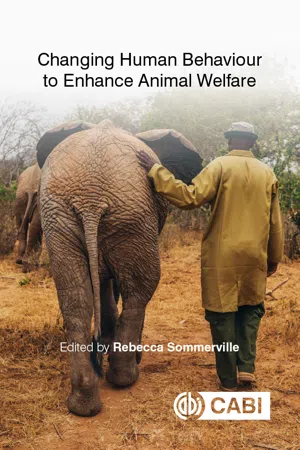
- 208 pages
- English
- ePUB (mobile friendly)
- Available on iOS & Android
eBook - ePub
Changing Human Behaviour to Enhance Animal Welfare
About this book
Information
Topic
MedicineSubtopic
Veterinary Medicine1
The Need for Recognition of Practical Animal Welfare as a Profession
Rebecca Sommerville
Behaviour by Becca, London, UK
1.1 Introduction
The welfare of animals is intricately linked with human wellbeing and the environment, a concept known as ‘One Welfare’ (García Pinillos, 2018). Today the biomass of humans and domestic livestock on the planet outweighs that of all vertebrate wildlife (except fishes), mainly comprising chickens, cows and pigs (Bar-On et al., 2018). With this vast number of animals managed by, or interacting with, humans we need to engage with people to improve the animals’ welfare – to prevent suffering and to ensure a good quality of life. Animal welfare science provides evidence about what animals need and want. There are several books about what animal welfare means (e.g. Grandin, 2015; Appleby et al., 2018) and why it matters (McMillan, 2020), but few describe how to translate this into everyday actions and who makes this change happen. This gap between science and existing practices can be a challenge to bridge.
There are well-established professions in veterinary health, animal welfare science, clinical behaviour and applied animal behaviour, yet there is no field of ‘practical animal welfare’. There isn’t a widely recognized role of an ‘animal welfare practitioner’ who translates animal welfare principles into practice. There is a need to recognize this distinct profession of individuals who work closely with the animals and their owners, carers, communities or users to improve animal welfare. Such professionals already exist and are based at non-governmental organizations (NGOs), charities, governments, industries and universities, with roles as animal welfare advisors, researchers, welfare assessors or veterinarians with additional animal welfare expertise.
This book sets out to give an insight into these professionals’ lives, with a chapter each to share their view and ways of working, while offering practical guidance to others who want to improve animal welfare. It highlights the need for recognition of the field of ‘practical animal welfare’. The importance of human behaviour change to animal welfare is increasingly recognized and therefore is a core theme of this book. Legislation can be passed to outlaw practices that lead to poor welfare, but the practice will continue if there is no enforcement, or if legislators have little knowledge of the field conditions (Grandin, 2015). Behaviour change of individuals isn’t enough alone, however, to create lasting animal welfare improvements. Therefore, how to make systemic changes to whole institutions and industries is another theme of this book.
The authors featured and their work have a truly international focus, because while the field of animal welfare science began in Europe, North America and Australasia, it is growing across Asia, Africa and Latin America, as research groups are established, international and grassroots NGOs undertake projects and governments implement guidelines, such as from the World Organisation for Animal Health (OIE). This book suggests resources to use, describes case studies, and discusses the barriers, solutions and future directions in the field of practical animal welfare. The book aims to help budding animal welfare practitioners to get involved and for existing practitioners to get the recognition they deserve for their often ‘behind the scenes’ work.
• Part I ‘Enhancing Animal Welfare – a Profession with Human Engagement at Its Centre’, describes the scientific theories and principles that underpin human behaviour and systemic change to enhance animal welfare. There are examples from companion animals (Chapters 2 and 5), farm animals (Chapters 3 and 5) and wildlife (Chapter 4).
• Part II ‘Enhancing Animal Welfare in Practice Worldwide’ describes the realities in practice, hearing the voices of animal welfare practitioners in different sectors describe how they work. There are examples from farm animals (Chapters 6–9), wildlife (Chapters 9 and 10) and working equids (Chapters 10 and 11).
1.2 What Is Animal Welfare?
Animal welfare comprises an animal’s physical functioning to survive (Fraser and Broom, 1990), their ability to express natural behaviour (Rollin, 1992) and their emotional state (Duncan, 1996) (see Chapter 3). When their survival needs are met and they can express rewarding behaviours, animals thrive and enjoy good welfare. Emotional states promote survival by prompting an animal to behave in a certain way. Negative emotional states from sensations inside the body include: hunger, thirst, pain, breathlessness, nausea, dizziness, debility, weakness and sickness. Those from perceiving the environment include: fear, anxiety, frustration, panic, vigilance, boredom, depression, loneliness and helplessness (Mellor and Beausoleil, 2020).
By reducing negative experiences, welfare can only be negative or neutral; it’s not possible to avoid all negative states because some are essential for survival. To enhance welfare, negative experiences should be minimized to a tolerable level that still allows life-sustaining behaviours, such as eating, drinking, resting, ceasing activity when unwell and seeking warmth or shade (Mellor and Beausoleil, 2020). In order to avoid suffering, negative states should not be permitted to become chronic, long-term experiences. Positive emotional states are caused by the body’s experience, or anticipation of rewards. Positive emotional states include: pleasure, comfort, interest and a sense of control.
Since their origin, the five freedoms of animal welfare (Brambell, 1965) have contributed to laws and policies worldwide, however there is increasing recognition that they don’t go far enough (Mellor and Beausoleil, 2020). The focus on ‘freedom from’ a negative state prevents efforts towards positive animal welfare, which are essential for an animal to thrive and feel good, beyond just surviving (Boissy et al., 2007). The five domains of welfare are a useful concept that build on the five freedoms and now take into account the potential positive and negative influences of human behaviour on animal welfare (Mellor et al., 2020). The domains have taken longer to be taken up into global practice. This is changing because they are a useful framework to assess all of the components of animal welfare. Undertaking welfare assessment is needed to understand the current state of the animals’ conditions, to provide objective evidence and a baseline to monitor progress against for the individual or group.
The provisions of animal welfare, from the Five Domains Model (Mellor, 2016; Mellor et al., 2020) are:
1. Good nutrition: provide ready access to fresh water and a diet to maintain full health and vigour.
2. Good environment: provide shade/shelter or suitable housing, good air quality and comfortable resting areas.
3. Good health: prevent or rapidly diagnose and treat disease and injury, and foster good muscle tone, posture and cardiorespiratory function.
4. Behavioural interaction: provide positive interactions with the environment, other animals and humans.
5. Positive mental experiences: provide safe, congenial and species-appropriate opportunities to have pleasurable experiences.
Figure 1.1 is an example of how the domains can be used in practice as an education tool with an animal owner, community, NGO, government or industry staff member who does not have an animal welfare science background. Combining welfare measures into a single score is not recommended, because weighing one score against another is subjective and higher scores in one area can mask poor welfare measures that are unacceptable in another area (Grandin, 2015). A more detailed tool and training of assessors is required for a full welfare assessment. Here are some example questions to consider with your stakeholder while using this summary:
• How many positive vs negative states do the animal/s have?
• Which of these apply to your animals’ species-specific behaviour?
• How long do their positive and negative experiences last for?
• What are the frequency, intensity and severity of their experiences?
• Are some experiences better or worse than others?

Fig. 1.1. A summary of the Five Domains Model. (Derived from Mellor and Beausoleil, 2020 and Mellor et al., 2020.)

Fig. 1.2. As an animal welfare practitioner, author Rebecca uses her training in animal welfare and clinical behaviour to rehabilitate ex-racing greyhounds. (© Freya Dowson.)
1.3 How Should Animal Welfare Practitioners Be Trained?
Formal training in animal welfare is required to become an animal welfare practitioner; it is not sufficient to have a degree in veterinary health or animal behaviour because the role requires an in-depth understanding of an animal’s mental wellbeing, not just physical health, the components of welfare and how to assess these. There are many different routes to become an animal welfare practitioner and to continue lifelong learning, including:
• undergraduate degrees;
• postgraduate MSc/PhD;
• short courses;
• association memberships;
• work shadowing, volunteering, internships;
• on-the-job training, e.g. in an NGO, government or industry role;
• practical experience ‘in the field’, e.g. as a welfare assessor; and
• conference or workshop attendance.
In this book, the authors share their different routes to becoming an animal welfare practitioner, as they work in a wide variety of roles with different animal species. They include individuals working for an NGO (Chapters 1, 2, 4, 6, 10 and 11), university (Chapter 3), industry (Chapter 7) and government (Chapters 8 and 9). Chapter 5 describes routes to obtaining the education and Chapter 10 the practical field experience required to become a practitioner.
1.4 How Do Practitioners Engage People in Animal Welfare?
The two overarching methods leading to animal welfare progress are individual human behaviour change and institutional systemic change. The principles of behaviour change are described in Chapters 2, 3 and 4. Examples of the variety of approaches used to change human behaviour or the system are given in Table 1.1. This table demonstrates that there is no single right way to create change, there are many approaches, and which approach is most suitable depends on the stakeholders, what they will be receptive to and the surrounding conditions. Monitoring and evaluating the effectiveness of the chosen approach during and after a project is essential.
Table 1.1. Approaches to enhancing animal welfare through individual human behaviour and institutional systemic change.


1.5 Looking to the Future of the Field
This book and chapter feature case studies from animal welfare practitioners working with farm, research, wildlife and companion animals, with a wide diversity of approaches. The importance of the field of applying animal welfare to real-life practice shouldn’t be undervalued and it is hoped that animal welfare institutions, NGOs, governments and veterinary departments will recognize and strengthen the profession of practical animal welfare. A promising sign is the increase in the study, groups and conferences focusing on human behaviour change. In turn these talented professionals will use their expertise and experience to improve the quality of life of animals worldwide, by working closely with their owners and users and influencing positive change in the systems and institutions overarching these.
Case Study ...
Table of contents
- Cover
- Half Title
- Title
- Copyright
- Contents
- Foreword
- Preface
- About the Contributors
- Part I. Enhancing Animal Welfare – a Profession with Human Engagement at Its Centre
- Part II: Enhancing Animal Welfare in Practice Worldwide
- Index
- Cabi
- Back
Trusted by 375,005 students
Access to over 1.5 million titles for a fair monthly price.
Study more efficiently using our study tools.
Frequently asked questions
Yes, you can cancel anytime from the Subscription tab in your account settings on the Perlego website. Your subscription will stay active until the end of your current billing period. Learn how to cancel your subscription
No, books cannot be downloaded as external files, such as PDFs, for use outside of Perlego. However, you can download books within the Perlego app for offline reading on mobile or tablet. Learn how to download books offline
Perlego offers two plans: Essential and Complete
- Essential is ideal for learners and professionals who enjoy exploring a wide range of subjects. Access the Essential Library with 800,000+ trusted titles and best-sellers across business, personal growth, and the humanities. Includes unlimited reading time and Standard Read Aloud voice.
- Complete: Perfect for advanced learners and researchers needing full, unrestricted access. Unlock 1.5M+ books across hundreds of subjects, including academic and specialized titles. The Complete Plan also includes advanced features like Premium Read Aloud and Research Assistant.
We are an online textbook subscription service, where you can get access to an entire online library for less than the price of a single book per month. With over 1.5 million books across 990+ topics, we’ve got you covered! Learn about our mission
Look out for the read-aloud symbol on your next book to see if you can listen to it. The read-aloud tool reads text aloud for you, highlighting the text as it is being read. You can pause it, speed it up and slow it down. Learn more about Read Aloud
Yes! You can use the Perlego app on both iOS and Android devices to read anytime, anywhere — even offline. Perfect for commutes or when you’re on the go.
Please note we cannot support devices running on iOS 13 and Android 7 or earlier. Learn more about using the app
Please note we cannot support devices running on iOS 13 and Android 7 or earlier. Learn more about using the app
Yes, you can access Changing Human Behaviour to Enhance Animal Welfare by Rebecca Sommerville in PDF and/or ePUB format, as well as other popular books in Medicine & Veterinary Medicine. We have over 1.5 million books available in our catalogue for you to explore.