eBook - ePub
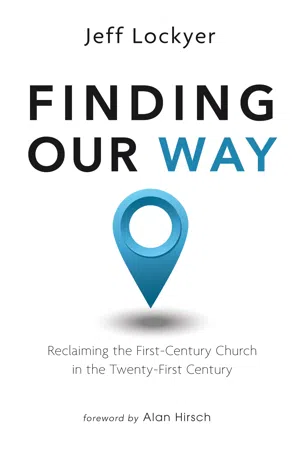
Finding Our Way
Reclaiming the First-Century Church in the Twenty-First Century
- 176 pages
- English
- ePUB (mobile friendly)
- Available on iOS & Android
eBook - ePub
About this book
What if the way the Church is "doing church" is the very reason the world is seeing less of Jesus in it every day?
Beginning with the biblical basics, Jeff Lockyer walks readers through the underlying theology and practical application of how Southridge Community Church has approached ministry for nearly a quarter century. While providing a fresh approach to ministry, the book stimulates how to think--not what to think. It's written by a local church practitioner for local church practitioners.
By providing clarity to the confused, it helps church leaders find their way. By providing practical examples delivered uniquely in multiple church contexts, it supports leaders in finding their own way. And, most of all, by re-framing the operation of the church around fostering full devotion instead of facilitating consumerism, it enables leaders of local churches to reclaim the lifestyle of Jesus among its people. It supports churches and leaders to find their Way--the Way of Jesus.
Information
Topic
Theology & ReligionSubtopic
Christian Ministry1
God’s Vision
A Restorative Force
When it comes to unleashing the power of the church, it all starts with vision . . . kind of.
Most church leaders believe that the sun rises and sets on vision; that vision is the core from which everything else in your community flows. Vision has been defined as a preferred picture of the future that produces passion in people. Because of this, many pastors see their primary role as visionary, keeping the vision fresh and in front of their people. Vision-casting has become an art among church leaders because of the chronic challenge in churches where it’s been said that “vision leaks.” Of all the dynamics of church life, what seems to get the most attention is the power of a church’s vision.
Often, the Proverbs are cited to make this case. The King James Version of Proverbs 29:18 reads, “Where there is no vision, the people perish.” This seems to be the slam-dunk biblical argument for the necessity of vision—without it, the people of God perish! Many conferences and workshops fill up on the promise of equipping church leaders to cast a compelling vision. Many leadership retreats have been invested in mining, refining, and wordsmithing statements of vision. After all, no one wants their people to perish.
What’s interesting to note, though, is what Scripture means by the term “vision” in Proverbs 29:18. In other English translations, terms like “Word from God” (NCV), “divine guidance” (NLT), and “prophecy” (RSV) are used instead. Most commonly, in fact, the actual word is more directly translated—as in the New International Version, for example: “Where there is no revelation . . .” Do you see the difference? People don’t perish if someone doesn’t come up with a great slogan. People perish—or at least miss out on God’s best for them—when God’s vision isn’t revealed as the vision for their church.
Here’s the thing: when the Bible talks about vision and its deal-breaking necessity among God’s people, it’s not referring to a made-up, sloganeered, framed-and-hung-at-head-office kind of vision. It’s talking about the vision of God as revealed through the Scriptures. Biblically speaking, vision more accurately refers to the revealed vision of God. For sure, vision matters. And for sure, it leaks. But the primary vision God cares about when it comes to his body and bride is the one God’s provided in the Scriptures.
So, the obvious question that emerges then is: what is God’s revealed vision for his church? Which chapter and verse do you prioritize to highlight and underline to organize your church around? If the vision for God’s people is to be received instead of invented, what’s the process for receiving God’s revealed vision for his church?
The Monomythic Cycle
In our context, we’ve understood the “revelation” of God to mean all of Scripture: the revelation of the activity of God throughout human history as recorded in the Bible. So, our quest to discern God’s vision for Christ’s Church—and ultimately for our local church—began with surveying the whole of Scripture from front to back. To do this, we applied what scholars refer to as “narrative theology,” meaning we viewed the arc of the whole Bible as a single story. Before doing that, though, we had to first understand how the arc of a single story works. For those who haven’t majored in literature (which includes me!), we need to understand something called the monomythic cycle. The term combines the root words “mono” (meaning one or single), “myth” (meaning story or narrative) and “cycle” (meaning pattern or structure). The monomythic cycle is the single pattern or structure of a story. We needed to appreciate that every story, especially an epic narrative, actually follows a very predictable pattern or structure:
First, it begins with the original ideal. This is the “Once upon a time” moment where everything is as it should be. Soon, though, conflict emerges. This tension is what gives stories their plot. From there, the plot thickens as things go from bad to worse. In spite of efforts to resolve the tension, the tension only intensifies. At some point, a surprising twist emerges, where an unexpected event reroutes the trajectory of the entire story. This sends the characters into an era of restoration, where the problems and challenges of the story begin to resolve. And ultimately, the story ends at a point of superior ideal, where the “happily ever after” dynamic is even better than the “once upon a time” era. If you reflect on your favorite story, especially an epic narrative, you’ll find that stories from Cinderella to Star Wars follow this same predictable pattern.
What you may never have considered before, though, is that the single most epic narrative of all is the activity of God throughout human history. And you may have never realized (unless you’ve embraced narrative theology) that the arc of Scripture follows this same overarching pattern. A good friend and mentor of mine, Tim Day, wrote brilliantly about this in a book called God Enters Stage Left, where he detailed the various dramatic acts of the Bible. For our purposes, I’ll just summarize them through the structure of the monomythic cycle.
God’s Epic Story
The original ideal is Creation in Genesis 1–2, where God’s design fully functions as God intended. There, repeatedly, when God saw what he had made he declared it, “good.” Unfortunately (like most narratives), that didn’t last long, because by the third chapter of the Bible, sin emerges, and because Adam and Eve abandoned God’s ideal, humanity finds themselves separated from God. The “bad to worse” era can be a little harder to narrowly identify, but essentially this initial tension increasingly intensifies throughout the entire Old Testament. After the fall, humanity seems paralyzed to address its own brokenness, and throughout the rest of the Old Testament—while God is certainly at work in Israel—the brokenness or incompleteness of humanity only becomes increasingly obvious.
Tim Day summarizes this era in four phases: the establishment of the people of Israel (which, at its worst, became, “if we can be good people who avoid all the bad people, we’ll live faithfully with God”), the emergence of the law (which sadly descended into, “if we can just get clear on the rules—and build more rules to protect us from breaking the rules—we’ll get right with God”), the institution of the kingship (which defied God’s best, believing “if we can get a strong leader like all the other nations, we’ll get right with God”), and finally the era of the prophets (which turned God’s redemptive message into, “if we could just receive some harsh accountability when we stray from God, we’ll get right with God”). These four phases of the Old Testament form the basis for the dynamics of toxic religion—a man-made process of attempting to get right with God and deal with the consequences of sin by our own effort and our own way. When this kind of religion becomes the order of the day, the result is predictable: the powerlessness and failure of humanity to fix the problem of sin we’ve created.
By the end of the Old Testament, things look bleak for God’s people. They’ve divided, been conquered, captured, and are exiled. God seems silent. There seems to be no hope, because not only are they in a dark place, but in and of themselves they don’t seem to have the capacity to rectify things and realize the beauty of who God intended them to be. Yet, like all epic narratives, when things are at their darkest the light of the surprising twist shines more brightly. And in our best Sunday School voice, we declare the twist of the story of God to be: Jesus! (Frankly, in Sunday school, even if it looked like a squirrel and walked like a squirrel, the correct answer was probably still Jesus). More specifically though, what is ultimately so surprising about the birth, life, death and resurrection of Jesus (from the context of the Old Testament) is that God intervened and, in his love, did for humanity what people fundamentally could not do for themselves. The surprising twist is the gospel of love and grace, fulfilled in Jesus Christ: that while we were sinners—hopeless to make ourselves right with God—God made a way for us to be forgiven and set free for a new life with him through the gift of Jesus Christ. The surprising twist is that humanity gets made right with God by God’s grace, through faith, in Jesus Christ alone—not through the futile acts of human religion.
This sets off a chain reaction—following Jesus’ resurrection—where forgiven believers receive his living Spirit and are united together into a new spiritual family. And this era—inaugurated in the New Testament, known as the church—aims to bring the life and love of Jesus Christ to the far corners of the earth. Where Jesus came as incarnate love in one person, God’s Spirit made it possible for incarnate love to multiply and expand through many people, as the bride and body of Christ.
This leaves one final phase (or “act,” in Day’s language): the superior ideal. I don’t want to stir up unnecessary theological debate among scholars who differ in their understanding of the end-times. Suffice to say, the Story of God reaches its ultimate culmination when the ascended Jesus returns one day to establish what John describes in the book of Revelation as, “The New Heaven and New Earth.” In this case, however, it will be even more magnificent than the initial garden of Eden, as renewed and resurrected followers of Jesus are united with him and each other forever. Since this era is still to come, Christians wait in confident hope and eager anticipation for the eventual return of Jesus Christ to fully complete his restorative work.
God’s Vision for His Church
Aside from upsetting scholarly people with such a crude summary of Scripture, what was the point of recounting the Bible through the framework of the monomythic cycle? When you remember that the “vision” that matters to God—which his people cannot live without—is actually his revealed vision, and you then outline and audit his revealed vision through the front-to-back framework of the epic narrative of his timeless activity throughout human history, you find something I believe is very significant: that the vision for the “church” already exists in the pages of Scripture; that the church is actually a core part of God’s revealed vision.
In God’s epic narrative, there already is a vision for the church. More specifically, there already exists a God-determined role for his church to play in his Story. God’s vision for his church is for it to fulfill its role in the era of restoration, effectively filling the space in history between the surprising twist of Jesus’ life on earth to the superior ideal of his imminent return and establishment of the New Creation. In between those eras, the church exists—Holy Spirit-empowered and unified—to function as God’s restorative force on Planet Earth, to be part of God’s kingdom coming on earth as it is in heaven. That’s God’s vision for his church: to be a Holy Spirit-empowered and unified restorative force in the world.
Since vision matters so much, it is probably worth it to take a moment and call a time-out. Notice a few things about this definition of God’s revealed vision for his church. First, nowhere in this definition does a place or event to attend appear. In our culture, people of faith are most commonly referred to as “church-goers,” because the church has become virtually synonymous with a building where an event occurs, typically on Sunday mornings. To be a church person essentially refers to attending this gathering. And while gathering as God’s people certainly matters (we’ll unpack why in future chapters), nowhere does attending an event directly appear in God’s revealed vision for his church. In fact, God’s revealed vision for his church isn’t a program at all; it’s a people—a Holy Sp...
Table of contents
- Title Page
- Foreword
- Acknowledgements
- Introduction
- Discovering God’s Way
- 1
- 2
- 3
- 4
- Designing Our Way
- 5
- 6
- 7
- 8
- Developing Our Way
- 9
- 10
- 11
- 12
- 13
- 14
- 15
- Discerning Our Way
- 16
- 17
- 18
- Invitation
- Invitation - The Leaders’ Village
Trusted by 375,005 students
Access to over 1.5 million titles for a fair monthly price.
Study more efficiently using our study tools.
Frequently asked questions
Yes, you can cancel anytime from the Subscription tab in your account settings on the Perlego website. Your subscription will stay active until the end of your current billing period. Learn how to cancel your subscription
No, books cannot be downloaded as external files, such as PDFs, for use outside of Perlego. However, you can download books within the Perlego app for offline reading on mobile or tablet. Learn how to download books offline
Perlego offers two plans: Essential and Complete
- Essential is ideal for learners and professionals who enjoy exploring a wide range of subjects. Access the Essential Library with 800,000+ trusted titles and best-sellers across business, personal growth, and the humanities. Includes unlimited reading time and Standard Read Aloud voice.
- Complete: Perfect for advanced learners and researchers needing full, unrestricted access. Unlock 1.5M+ books across hundreds of subjects, including academic and specialized titles. The Complete Plan also includes advanced features like Premium Read Aloud and Research Assistant.
We are an online textbook subscription service, where you can get access to an entire online library for less than the price of a single book per month. With over 1.5 million books across 990+ topics, we’ve got you covered! Learn about our mission
Look out for the read-aloud symbol on your next book to see if you can listen to it. The read-aloud tool reads text aloud for you, highlighting the text as it is being read. You can pause it, speed it up and slow it down. Learn more about Read Aloud
Yes! You can use the Perlego app on both iOS and Android devices to read anytime, anywhere — even offline. Perfect for commutes or when you’re on the go.
Please note we cannot support devices running on iOS 13 and Android 7 or earlier. Learn more about using the app
Please note we cannot support devices running on iOS 13 and Android 7 or earlier. Learn more about using the app
Yes, you can access Finding Our Way by Jeff Lockyer in PDF and/or ePUB format, as well as other popular books in Theology & Religion & Christian Ministry. We have over 1.5 million books available in our catalogue for you to explore.