- English
- ePUB (mobile friendly)
- Available on iOS & Android
eBook - ePub
Information
Topic
Scienze socialiSubtopic
Cultura popolareCHAPTER I
EASTER EGGS HIDDEN IN THE BATES MOTEL
Can I give you some advice?
You gotta cut that shit out. “Mother?” It’s just weird.
Dylan Massett, “What’s Wrong with Norman,” Bates Motel, 2013
The man that wandereth out of the way of understanding
shall remain in the congregation of the dead.
Proverbs 21:16
shall remain in the congregation of the dead.
Proverbs 21:16
We’re all in this sideshow together. And then we die.
Chick Hogan, “Bad Blood,” Bates Motel, 2017
Bates Motel, created by Anthony Cipriano, Carlton Cuse, and Kerry Ehrin, was one of this author’s favorite television series. Like Twin Peaks, the show takes place in the northwestern United States, set in the fictional town of White Pine Bay. An everyday American borough on the surface, yet beneath its saccharine vista, like Lynch’s fictional hamlet, lurks a criminal and seedy underworld. Bates Motel aired on the A&E Network for five seasons from 2013 to 2017. The show is a modern retelling of Hitchcock’s Psycho, hiding Easter eggs that pay homage to its precursor. Psycho, often considered the keystone of the horror-thrillers, the godfather of explicit media violence, is replete with undercurrents, both abstract and concrete, so it’s only logical Bates Motel followed in its footsteps.
For instance, Hitchcock uses artwork to establish Norman Bates’ (Anthony Perkins, 1932-1992) psychosis and repressed sexuality. The oil painting he uses to cover the peephole in the motel’s parlor is a replica of Susanna and the Elders (1731). It depicts a story from the Bible–Book of Daniel, Chapter XIII– in which three old men spy on an innocent woman as she gets ready to bathe, but when they find themselves overcome with passion, they accuse her of sexual blackmail. Watching Marion Crane (Janet Leigh, 1927-2004) voyeuristically, his lust brings jealous “Mother” to life; she, not Norman, seals Marion’s fate. Later, when he is caught by Sam Loomis (John Gavin, 1931-2018), Norman’s pose emulates Susanna’s: his clothes are torn while his head is thrown back, and his right arm lifted high in the air. Stripped of his Mother’s dress and a cheap wig, Norman is finally laid bare for all he is: mother and son, female and male, guilty and innocent.

(Left) Susanna and the Elders oil painting by either Frans van Mieris the Elder (1635-1681) or Willem van Mieris (1662-1747), Frans’ youngest son. The artwork, based on a story from the Bible, features three men, like Norman, spying on a bathing woman. In the Biblical tale, the men accuse her of erotic blackmail; in Room 1, Norman qua Mother brutally stabs the naked woman. (Right) Norman, a sexual doppelganger, imitates Susanna’s posture during the creepy climax when Loomis subdues him. From Psycho.
Hitchcock uses uneaten food or the refusal to share food–the interruption or denial of a natural act–as a conceptual device presenting his characters’ inability to communicate, either with their innermost desires or with each other. Eating is a communal activity, but by refusing to indulge, the characters increase their suspicion and isolation. In the hotel room, during Sam and Marion’s lunchtime tryst, we see her uneaten sandwich sitting on the night table; the lovers argue about whether or not to get married. Later, Mother will not let Norman invite Marion inside for dinner, so he brings food to her. He prepares nothing for himself while she only picks at hers. The meal produces only hostility: Norman and his Mother argue over Marion, and then in the parlor, Norman and Marion get into a disagreement over Mrs. Bates. When Detective Arbogast (Martin Balsam, 1919-1996) inquires about Marion, Norman offers him candy, but he refuses, indicating distrust. When questioned further by the detective, Norman becomes agitated, concealing the nature of Marion’s arrival at the motel, and her subsequent disappearance, to the private investigator.112
Marion has a change of heart and decides to return the money she’s stolen. She wants to go back to society after her brief stint as a fugitive, so she takes a shower. The water is a baptism, a transitional action signaling her purification, of her intention to return to normalcy. Her murder by Norman-as-Mother became a powerful image of the collapse of social contracts and relatedness; like us, Marion seeks advancement and financial security. She makes a mistake, but plays by the rules, seeking forgiveness and acceptance, only to have her cleansing turned into a bloody sacrifice. There is no God, at least not a just one. The disturbing scene became one of the most influential in cinema history with good reason: it undermined all expectations and formulas; released on September 8, 1960, Hitchcock’s opus anticipated the erosion of social, political, and artistic mores in the coming decade. Psycho articulates the dread of ordinary people feeling trapped and immobilized in a world of rapid change.113 Easter egg: in the Sherlock Holmes mystery The Scarlet Claw (1944), Judge Brisson’s (Miles Mander, 1888-1946) shocking murder anticipates Psycho’s shower scene. Although little blood is shed on-screen, a silhouetted man violently killing his prey while dressed as a woman, stabbing him with a knife-like five-pronged garden weeder goes for the jugular, just like Norman Bates sixteen years later.114
Eyes are the windows to the soul; they express fear, underscoring the taboo theme of voyeurism and surveillance. When Marion is fleeing town with Mr. Cassidy’s (Frank Albertson, 1909-1964) cash, she locks eyes with her boss (Vaughn Taylor, 1910-1983) while he’s crossing the street–she knows she’s been spotted doing something irregular and illegal. During Marion’s drive, Hitchcock positions his camera straight on, so the viewer is watching Marion, hearing her innermost thoughts. The patrol officer that awakens Marion on the side of the highway wears intimidating, dark sunglasses, staring right into the camera, making him antagonistic; we, like Marion, feel nervous even though he has no idea what she’s done. His skull-like appearance mirrors Mrs. Bates’ eyeless corpse: all-seeing and judgmental. In the parlor, the eyes of Norman’s stuffed birds peer down on him, just like his omnipresent Mother. Then, while Norman watches Marion undress through the peephole, Hitchcock employs an extreme close-up of Norman’s eyeball, implicating us in his voyeuristic secret. Later, when Marion is lying dead on the ground, Hitchcock goes in close on her lifeless eye; this image connects to the close-up of Mrs. Bates’ mummified hollow sockets in the fruit cellar.115 Hitchcock, via allusions, informs us we are privy to a nightmare we should not be seeing.
But before we begin in earnest, a little about Hitchcock’s thriller is in order. First, Robert Bloch (1917-1994) is the author of the classic horror novel, Psycho (1959), the basis for the film. Second, the iconic Bates home–the hilltop house behind the motel–is modeled on Edward Hopper’s (1882-1967) painting, The House by the Railroad (1925), making it an example of art influencing art. Third, Norman embodies real-life serial killer Ed Gein (1906-1984), a reclusive, grave-robbing fiend who adored his mother. All references to Psycho are to the 1960 original, not the miscast 1998 remake. With this in mind, let’s go Easter egg hunting.
Season One (2013)
Approximately six months after the death of his father, seventeen-year-old Norman Bates (Freddie Highmore) and his mother, Norma (Vera Farmiga), move from Arizona to the town of White Pine Bay, Oregon. Norma has purchased a defunct motel with the insurance money from her husband’s death. Mother and son intend to start over. A few nights later, the former owner of the motel breaks into the home and sexually assaults Norma; Norman knocks him out, and Norma kills him. Together, they dispose of the body in a body of water. His disappearance soon draws the attention of the town sheriff Alex Romero (Nestor Carbonell) and his deputy Zack Shelby (Mike Vogel); Norma and Norman do their best to stop them from finding out the truth.

It is easy to see the influence of Hopper’s The House by the Railroad (left) on the Bates Motel’s hilltop mansion (right).
Meanwhile, Norman enrolls at the local high school, befriending classmates Emma Decody (Olivia Cooke) and Bradley Martin (Nicola Peltz), while attracting the attention of teacher Blaire Watson (Keegan Conner Tracy). Elsewhere, Norma’s other son Dylan Massett (Norman’s half-brother, played by Max Thieriot), arrives in town. All is not what it seems in White Pine Bay: there is a lucrative–yet illegal–marijuana and sex-slave industry sustaining the township; local law enforcement turns a blind eye to the criminality. In the finale, it appears as though a jealous “Mother” takes over Norman, murdering Miss Watson.
Easter Eggs
•Episode 1 “First You Dream, Then you Die,” airdate March 18, 2013. While waiting at the bus stop, Norman listens to music on his MP3 player. It is Beethoven’s (1770-1827) Symphony No. 3 (Eroica), composed 1803-1804. In Psycho, Norman has this composition on his record player. Bradley refers to Norman as a “deep, still lake,” a line alluding to Norman’s favorite method of hiding dead bodies. Bradley’s description foreshadows her fate when her corpse, while in her car’s trunk, is dumped into a murky lake during Season Three’s final episode, “Unconscious.” The butcher knife Norma uses to kill Keith Summers (W. Earl Brown) is the same one Norman uses to kill Marion in the shower. Norma tells Romero the toilet doesn’t work hints at Marion, suffering from a guilty conscience, tearing up her note, then flushing it down the toilet. Psycho was the first film to depict a flushing toilet on-screen. Norma sees the town’s plan to build a bypass around her motel, cutting off her revenue, just like in Psycho, wherein the new highway isolated Norman and the motel. Norma’s robe is periwinkle blue, signaling her burial dress in both the A&E series and the movie.
•Episode 2 “Nice Town You Picked, Norma...” airdate March 25, 2013. Dylan has Norma listed as The Whore in the contacts on his cell phone. The listing is a paradox because, in both the novel and film, Norma taught Norman sex was wrong, and all women, except for her, were whores.
•Episode 7: “The Man in Number 9,” airdate April 29, 2013. Norman finds a stray dog, naming it Juno, growing close to the canine quickly. Juno was the wife of Zeus, and the protector and special counselor of the state. Her Greek counterpart was the alluring Hera, the queen of the Gods; only the arrogant and vain Cassiopeia, queen of Aethiopia and wife of King Cepheus, claimed to be more beautiful than Juno qua Hera. In the starry canopy above, Cassiopeia is a constellation known as the Lady in the Chair, anticipating the fate of Norma: her mumm...
Table of contents
- Cover
- Title Page
- Copyright Page
- Other Books
- Contents
- List of Illustrations
- Preface
- Introduction
- Chapter I: Easter Eggs in the Bates Motel
- Chapter II: Gnostic Hollywood
- Chapter III: Archetypes, Alchemy, and Jungian Psychology in Disney’s Beauty and the Beast
- Chapter IV: Give Your Soul to the Dance: Melancholic Horror and Suspense
- Chapter V: Golem Making in Tinseltown: Blade Runner Revisited and Blade Runner 2049
- Chapter VI: The Mummy, the Golem, and the Automaton Reimagined: Dr. Caligari’s Somnambulist
- Chapter VII: Sable Visionaries: Christopher Nolan’s Dark Knight Trilogy and Todd Phillips’ Joker
- Chapter VIII: The Dark Side of the Moon: The Uncanny Electricity of the Temptress
- Chapter IX: The Star Wars Saga Continues
- Chapter X: Elvis Presley Lights the Morning Sky: The New World’s Masonic-Solar-Apollonian God of Music and the Christ Archetype in Film
- Chapter XI: Kabbalah and the Biblical Mysteries of Mother!
- Chapter XII: Tales from the Black and White Lodges: the Arcane Noir of David Lynch Continues
- Chapter XIII: Return to Middle-earth: Bilbo Baggins and the Monomyth
- Conclusion
- Filmography
- Bibliography
- Index
- About the Author
Trusted by 375,005 students
Access to over 1.5 million titles for a fair monthly price.
Study more efficiently using our study tools.
Frequently asked questions
Yes, you can cancel anytime from the Subscription tab in your account settings on the Perlego website. Your subscription will stay active until the end of your current billing period. Learn how to cancel your subscription
No, books cannot be downloaded as external files, such as PDFs, for use outside of Perlego. However, you can download books within the Perlego app for offline reading on mobile or tablet. Learn how to download books offline
Perlego offers two plans: Essential and Complete
- Essential is ideal for learners and professionals who enjoy exploring a wide range of subjects. Access the Essential Library with 800,000+ trusted titles and best-sellers across business, personal growth, and the humanities. Includes unlimited reading time and Standard Read Aloud voice.
- Complete: Perfect for advanced learners and researchers needing full, unrestricted access. Unlock 1.5M+ books across hundreds of subjects, including academic and specialized titles. The Complete Plan also includes advanced features like Premium Read Aloud and Research Assistant.
We are an online textbook subscription service, where you can get access to an entire online library for less than the price of a single book per month. With over 1.5 million books across 990+ topics, we’ve got you covered! Learn about our mission
Look out for the read-aloud symbol on your next book to see if you can listen to it. The read-aloud tool reads text aloud for you, highlighting the text as it is being read. You can pause it, speed it up and slow it down. Learn more about Read Aloud
Yes! You can use the Perlego app on both iOS and Android devices to read anytime, anywhere — even offline. Perfect for commutes or when you’re on the go.
Please note we cannot support devices running on iOS 13 and Android 7 or earlier. Learn more about using the app
Please note we cannot support devices running on iOS 13 and Android 7 or earlier. Learn more about using the app
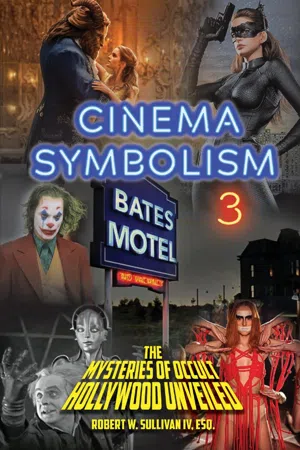
Yes, you can access Cinema Symbolism 3 by Robert W. Sullivan IV in PDF and/or ePUB format, as well as other popular books in Scienze sociali & Cultura popolare. We have over 1.5 million books available in our catalogue for you to explore.