- English
- ePUB (mobile friendly)
- Available on iOS & Android
eBook - ePub
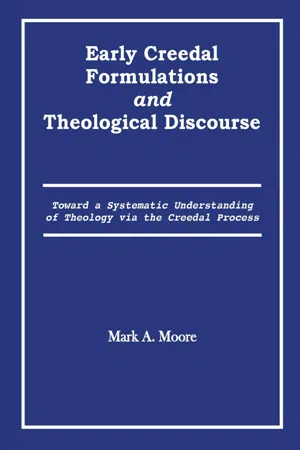
Early Creedal Formulations and Theological Discourse
Trusted by 375,005 students
Access to over 1.5 million titles for a fair monthly price.
Study more efficiently using our study tools.
Information
Subtopic
Byzantine HistoryIndex
History1
A Historical Overview of
Creedal Development
Creedal Development
(From New Testament Creedal
Formulations to the Nicene Creed)
Formulations to the Nicene Creed)
The historical development of Christian theology has shown that from its very origins Christianity has placed a high value on what a person believes. This emphasis on orthodoxy stands in contrast to more orthopraxy-oriented religions like Hinduism and Buddhism.
Frances Young even contrasts Christianity with its Judaic roots, noting that while “Christianity arose within Judaism...Judaism is not an orthodoxy, but an orthopraxy — its common core is ‘right action’ rather than ‘right belief.’”1 Young’s argument highlights the fact that the Christian tradition has uniquely placed a high value on the need for its adherents to believe a particular thing about God. Though the creedal process finds roots in Judaism and certain Hebrew Bible passages clearly influenced the creedal development of the New Testament and the early church, one can state that Christianity is a particularly creedal religion, continually summarizing its core beliefs in short yet powerful formulations.2
Faced with this realization, one wonders why Christianity is particularly concerned with orthodoxy and expressing this right belief in creedal statements. As Timothy Johnson traces the historical development of the creedal process from the pages of the New Testament up to the major councils of the fourth century, he makes a critical observation. Johnson notes that for the early church, “the experience of Jesus demanded a new telling of the biblical story, and the proper understanding of that story needed to be defined and defended.”3
Two key words from Johnson’s observation not only explain the unique emphasis Christianity placed on creedal affirmations but also help uncover the purpose and function of the creeds: they defined and defended. As asserted in the initial chapter, the creeds were designed to define the great theological conversation as this new story of Jesus was being retold and passed on to new generations and new cultures. The creeds passed on the essential identity markers of the Christian story. The design of the creeds provided a defense of the new Christian story from a retelling of the story that was inconsistent with the experience of the earliest followers of Jesus. As it traces the historical development of the creedal process from New Testament creedal statements to the more formalized Apostles’ Creed and Nicene Creed, this chapter will also stress the function of the creeds as defining the theological conversation and defending the true Christian story.
Before beginning to examine the various creedal statements found in the New Testament, it will be helpful to note the different types of creeds that emerged in the first four centuries of the church. Badcock notes three main types of creeds: baptismal, conciliar, and personal professions of faith.4 While noting that baptismal creeds were used to prepare candidates for baptism, Badcock further breaks down this classification into two parts: interrogatory and declaratory.5 Interrogative creeds were a formulated series of questions answered in the affirmative by the baptismal candidate, while declarative creeds were worded as “I believe” or “We believe” professions of faith.6 For Badcock, conciliar creeds were crafted by church councils as tests of orthodoxy. With these distinctions in mind, Badcock associates the Apostles’ Creed with the baptismal classification and the Nicene Creed with the conciliar classification.7 Before tracing the development of these two great creeds of Christendom, the roots of creedal development in the New Testament should first be examined.
New Testament Creedal Statements
The great creeds of the church did not simply appear at the turn of the fourth century; rather they emerged from a process that was in motion even before Christianity arose. In tracing the historical development of New Testament creedal statements, the Hebrew Bible origins of such statements, the structure of the statements, and the general function the statements served for the New Testament authors will be surveyed. This section will also more closely examine a few New Testament creedal statements to understand their particular function in the development of early Christian theology.
Hebrew Bible Origins
Michael Bird, in agreement with other prominent scholars,8 traces the creedal roots of the New Testament to Deuteronomy 6:4–5, the Shema: “Hear, O Israel: The Lord is our God, the Lord alone. You shall love the Lord your God with all your heart, and with all your soul, and with all your might.”9 The Jews committed the Shema to memory and recited it daily. Bird considers the Shema the simplest confession of Israel’s faith in one God and notes that it served to differentiate Judaism from the various polytheistic religions in practice at the time.10 Neufeld considered the Shema as a summary of the “homologia” of Judaism, noting Josephus’s assertion that the acknowledgement of God as one served to unify the Jews.11 Neufeld also noted that a copy of the Shema was carried by Jewish males in their phylacteries to serve as a reminder of who the God of the Jews truly was and what God called them to do in response.
Johnson highlights three features of the Shema that will aid us in understanding the origins of the creedal process as well as the function of the creeds.12 First, Johnson notes that the Shema calls the whole community, rather than just specific individuals, to a commitment to God. It is a communal affirmation of commitment, not simply an individual confession.
Second, it is distinctly exclusive. The God of Israel, YHWH, is the one and only God and worthy of Israel’s worship and allegiance. This exclusivity stands as an essential identity marker for the Jews. In a polytheistic world, they worshiped YHWH above all other gods. Lastly Johnson notes that the Shema is also a personal commitment. Each individual Israelite is called to love God with his or her whole being. In light of these three features, Johnson draws out a dual functionality for the Shema in that it “both defines the one to whom loyalty is given and defines Israel among the nations by its unique loyalty to this deity.”13
John Leith, in his exhaustive compilation of the creeds of the church, also recognizes the latter half of 1 Kings 18:39, along with the Shema, as a declaratory affirmation of Judaism: “When all the people saw it, they fell on their faces and said, ‘The Lord indeed is God; the Lord indeed is God.’”14 While considering both the Shema and 1 Kings 18:39 declaratory affirmations, Leith also describes Deuteronomy 26:5–9 as a historical creed, retelling and summarizing the story of Israel:
You shall make this response before the Lord your God: “A wandering Aramean was my ancestor; he went down into Egypt and lived there as an alien, few in number, and there he became a great nation, mighty and populous. When the Egyptians treated us harshly and afflicted us, by imposing hard labor on us, we cried to the Lord, the God of our ancestors; the Lord heard our voice and saw our affliction, our toil, and our oppression. The Lord brought us out of Egypt with a mighty hand and an outstretched arm, with a terrifying display of power, and with signs and wonders; and he brought us into this place and gave us this land, a land flowing with milk and honey.”
Here a historical creed served the same function as the declarative creed, in that it summarized the action of God in uniquely calling and caring for the Jews.
The foundation of the New Testament creedal state...
Table of contents
- Cover
- Title Page
- Copyright Page
- Dedication
- Contents
- Acknowledgments
- Introduction
- 1. A Historical Overview of Creedal Development (From New Testament Creedal Formulations to the Nicene Creed)
- 2. Case Study 1 — Trinity and Christology in the Creeds
- 3. Case Study 2 — Creation in the Creeds
- 4. Case Study 3 — Atonement in the Creeds
- 5. Implications for Teaching Theology Using the EIM Model
- Bibliography
Frequently asked questions
Yes, you can cancel anytime from the Subscription tab in your account settings on the Perlego website. Your subscription will stay active until the end of your current billing period. Learn how to cancel your subscription
No, books cannot be downloaded as external files, such as PDFs, for use outside of Perlego. However, you can download books within the Perlego app for offline reading on mobile or tablet. Learn how to download books offline
Perlego offers two plans: Essential and Complete
- Essential is ideal for learners and professionals who enjoy exploring a wide range of subjects. Access the Essential Library with 800,000+ trusted titles and best-sellers across business, personal growth, and the humanities. Includes unlimited reading time and Standard Read Aloud voice.
- Complete: Perfect for advanced learners and researchers needing full, unrestricted access. Unlock 1.5M+ books across hundreds of subjects, including academic and specialized titles. The Complete Plan also includes advanced features like Premium Read Aloud and Research Assistant.
We are an online textbook subscription service, where you can get access to an entire online library for less than the price of a single book per month. With over 1.5 million books across 990+ topics, we’ve got you covered! Learn about our mission
Look out for the read-aloud symbol on your next book to see if you can listen to it. The read-aloud tool reads text aloud for you, highlighting the text as it is being read. You can pause it, speed it up and slow it down. Learn more about Read Aloud
Yes! You can use the Perlego app on both iOS and Android devices to read anytime, anywhere — even offline. Perfect for commutes or when you’re on the go.
Please note we cannot support devices running on iOS 13 and Android 7 or earlier. Learn more about using the app
Please note we cannot support devices running on iOS 13 and Android 7 or earlier. Learn more about using the app
Yes, you can access Early Creedal Formulations and Theological Discourse by Mark A Moore in PDF and/or ePUB format, as well as other popular books in History & Byzantine History. We have over 1.5 million books available in our catalogue for you to explore.