- English
- ePUB (mobile friendly)
- Available on iOS & Android
eBook - ePub
Information
Subtopic
North American History- 9 -
Cody Canada and Cross Canadian Ragweed
“It was like a drug,” Cody Canada said.
“It made me want to just do more and more.”
Ah, yes. That classic rock-and-roll cliche. The thing is, someone would need a pretty compelling reason to kick off the story of Cody Canada and Cross Canadian Ragweed with it.
Sure, a good crowd fits the metaphor (Ragweed had those).
So does a veritable catalog of music that defines a genre for a generation (Ragweed had it). Hell, actual drugs do that too (Ragweed? Again, yes). Generally, everything about being the gold standard for Red Dirt music and for Texas music, back when those two were not considered the same thing, is like a drug, almost by definition, if not by practice. The phrase could fit so much.
But that’s never been how Canada thinks.
Artists are complex creatures—driven by fame, spite, sex, demons, love, money, fear, passion and permanent residence atop a pedestal.
Canada may be complex, too, but part of it is chalked up to his simplicity.
Through the arc of Cross Canadian Ragweed, fronted by Canada and flanked by Jeremy Plato on bass guitar, Randy Ragsdale on drums and Grady Cross on rhythm guitar, Canada got an up-close look at all those driving forces. Some got a closer look than others, but none of them stuck to him.
From riding the wave of The Great Divide to breaking through at Larry Joe Taylor’s annual festival to crowds that could drink any venue up to and including Billy Bob’s Texas completely out of beer to the most outwardly stunning band breakup in Red Dirt history, Canada took it all in.
“It was like a drug.”
Here is the kicker, though. Canada was reflecting on the first time he looked down at a setlist made up of nothing but Ragweed songs.
This is the story of a garage band that caught fire.
•••
Beginnings
It is really easy and really inaccurate to cast Yukon as some kind of prodigal Red Dirt town when in reality, Garth Brooks happened to live there, and later, Cross Canadian Ragweed happened to live there. Yukon is the suburb that keeps the wheat fields to the west from enveloping Oklahoma City. The state’s sprawling capital and largest city sits immediately to the east of Yukon, permanently instilling an identity crisis in its 22,000 residents. It’s as much a bedroom suburb as it is a gateway to waving wheat and oil fields—too close to The City to be its own small town while fiercely fighting that notion at all times. Yukon is designed to keep people in, and it’s a wonder that anybody who turned to music saw a path out.
For a 15-year-old Cody Canada, a relic theater in Oklahoma City’s Capitol Hill district less than 10 miles from Yukon was the first glance at a life away from the burb. Originally from Pampa, Texas, and raised in a broken home, it’s fairest to say he had simply been planted in Yukon during his teenage years.
“I was 15 and a half, playing the Oklahoma Opry. I really don’t even know how I got there. It was basically America’s Got Talent in Oklahoma City. They wouldn’t let me play during school hours. They made me wait until evenings. My grades were so bad, I don’t even know why it mattered. I met Dave Dodson, a DJ, there one night. He asked me what I was doing and why I was playing cover songs. He said, ‘This doesn’t really seem like you,’ and I told him that I didn’t really know what ‘me’ is. And he said, ‘Well, if you need any help, I’m here.’
“Fast-forward a year. I got a fake ID, and I saw him at Incahoots [Oklahoma City’s best-known country dance hall]. He told me not to tell anybody that I saw him there, because he wasn’t supposed to be partying. I wasn’t going to say anything because I wasn’t even 17 years old yet. He said, ‘I’d like to take you to Stillwater to introduce you to this band called The Great Divide.’
“I had never heard of them.”
Turned out, The Great Divide, itself just a fledgling band, yet to make its 1996 breakthrough album, Break in the Storm, was in the market for a guitar player. Canada got and nailed an audition. He joined up with Mike McClure, J.J. and Scotte Lester and Kelley Green.
“So I played with them for a few months, working at a western-wear store on the side, with McClure telling me the whole time that this whole cowboy thing wasn’t my gig,” Canada said. “They took me on the road with them. We went to Larry Joe’s sixth annual festival in Possum Kingdom. That was my introduction. I met Rusty Weir, Gary P. Nunn and Larry Joe Taylor—all these people who I had only slightly heard of.”
That introduction ended up being the primary benefit of Canada’s nailing his audition. After a roughly three-month stint, The Divide voted 3 to 1 to boot Canada, with McClure the one.
“They said, ‘We’re not kicking you out because we don’t like you. We’re kicking you out because you need to do your own thing.’ Mike didn’t like it, but he was outvoted.
“So I said, ‘Well, I’m gonna go home. I know this guy that’s been bugging the crap out of me to start a band.’”
So circa 1994, Canada and Randy Ragsdale started a band.
Teenagers to a man, they nabbed Cross, along with bass player Matt Weidemann—all friends since elementary school—mashed up their last names and called themselves Cross Canadian Ragweed.
“We practiced for seven months, seven days a week, busting our asses,” Canada said. “We were all working, too. This was all after work.”
Ragsdale came from a musical family, and his father, Johnny C. Ragsdale, proved to be the enabler, allowing the band to practice in the family room, up to and including in front of the TV during the Super Bowl.
There were also several trips to Stillwater. They didn’t make the drive to play, though. Rather, they would drive up to watch The Divide practice. They were young, and Canada wanted to take it in.
“I wasn’t a very patient person. I wanted a gig,” Canada said. “They invited us up to The Underdog [the Wormy Dog Saloon’s downstairs 18-and-over outpost] to watch them practice. Well, Mike showed us something then: When the band’s jamming and it’s loud, you come down from that and you play softer and sing. That’s dynamics! I didn’t know that, man. It was an eye-opener. So we went back and started practicing really, really hard.
“About then is when McClure handed me Songs for the Daily Planet by Todd Snider. He said, ‘You won’t like this, but I dig it.’ Mike got busy and trailed off with Todd, and now the person who follows him like crazy today is me.”
Stillwater infected Canada, and crossing paths with Tom Skinner gave him the push he needed to relocate.
“Skinner was playing the Bullpen. Mike was in and out of town, but he loaned me his bicycle a lot,” Canada said. “So I biked over to the Bullpen. I walked up, 17 years old, and Skinner was walking in. He said, ‘Hey, Cody!’
“And I said, ‘Hey, Tom. Can I come watch you tonight?’
“He goes, ‘Why couldn’t you?’
“I said, ‘Because I’m 17 years old.’
“He goes, ‘Ohhh.’
“And the next thing he says is, ‘Well, tonight, you’re my nephew. Take my guitar. Come in, don’t drink or anything.’ I really didn’t anyway. It wasn’t my thing. I was clear-headed.
“I sat there all night long, listening to him. And then he invited me out to The Farm.
“Weeks later, we’re at The Farm, and he sang in the Gypsy Cafe, and I sat in the front row in a lawn chair watching him. And he goes, ‘I wanna get my friend Cody up.’
“I don’t think I’ve ever been as terrified in my life.
“It was Bob [Childers] and [Eric] Hansen. Medicine Show lived there. Brad James was the...
Table of contents
- Foreword
- Introduction
- Essential Red Dirt: Tom Skinner
- The Farm and Red Dirt’s Roots
- The Godfather: Bob Childers
- Why I Wrote This Book
- The Legacy of Jimmy LaFave
- The Red Dirt Rangers’ Thirty-Year Success Story
- Garth Brooks and Red Dirt
- The Divide
- Cody Canada and Cross Canadian Ragweed
- January 27, 2001
- The Wormy Dog and Red Dirt’s Wings
- Boland
- Stoney
- Hold My Beer: Wade Bowen and Randy Rogers
- The Braun Brothers’ Ragged Road Through Red Dirt
- How The Dirt Was Spread
- You’re Gonna Be My Friend: Jamie Lin Wilson
- A Hard Question: Where Are the Women of Red Dirt?
- Oklahoma’s Roots Landscape
- Turnpike
- In the Thick of It: Medicine Stone 2018
- Red Dirt Roundtable: McClure, Canada, Boland
- The Loose Ends
- Back to the Roots: Mike McClure
- The Departed
- Home
- Photo Gallery
Trusted by 375,005 students
Access to over 1.5 million titles for a fair monthly price.
Study more efficiently using our study tools.
Frequently asked questions
Yes, you can cancel anytime from the Subscription tab in your account settings on the Perlego website. Your subscription will stay active until the end of your current billing period. Learn how to cancel your subscription
No, books cannot be downloaded as external files, such as PDFs, for use outside of Perlego. However, you can download books within the Perlego app for offline reading on mobile or tablet. Learn how to download books offline
Perlego offers two plans: Essential and Complete
- Essential is ideal for learners and professionals who enjoy exploring a wide range of subjects. Access the Essential Library with 800,000+ trusted titles and best-sellers across business, personal growth, and the humanities. Includes unlimited reading time and Standard Read Aloud voice.
- Complete: Perfect for advanced learners and researchers needing full, unrestricted access. Unlock 1.5M+ books across hundreds of subjects, including academic and specialized titles. The Complete Plan also includes advanced features like Premium Read Aloud and Research Assistant.
We are an online textbook subscription service, where you can get access to an entire online library for less than the price of a single book per month. With over 1.5 million books across 990+ topics, we’ve got you covered! Learn about our mission
Look out for the read-aloud symbol on your next book to see if you can listen to it. The read-aloud tool reads text aloud for you, highlighting the text as it is being read. You can pause it, speed it up and slow it down. Learn more about Read Aloud
Yes! You can use the Perlego app on both iOS and Android devices to read anytime, anywhere — even offline. Perfect for commutes or when you’re on the go.
Please note we cannot support devices running on iOS 13 and Android 7 or earlier. Learn more about using the app
Please note we cannot support devices running on iOS 13 and Android 7 or earlier. Learn more about using the app
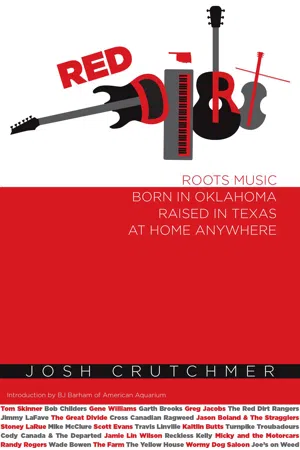
Yes, you can access Red Dirt by Josh Crutchmer in PDF and/or ePUB format, as well as other popular books in Media & Performing Arts & North American History. We have over 1.5 million books available in our catalogue for you to explore.