eBook - ePub
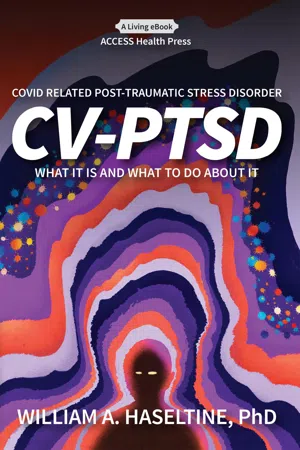
Covid Related Post Traumatic Stress Disorder (CV-PTSD)
What It Is and What To Do About It
- English
- ePUB (mobile friendly)
- Available on iOS & Android
eBook - ePub
Covid Related Post Traumatic Stress Disorder (CV-PTSD)
What It Is and What To Do About It
Information
Chapter 1
A societal trauma

In the early months of 2020, our lives changed abruptly, as countries and cities began to lockdown, schools and businesses closed, events were canceled, and travel was halted. Fear and anxiety were rife as we started an undefined quarantine period to protect ourselves from a virus we knew very little about.
“One of the things we know about trauma, especially mass trauma.…is how effective social connection is in buffering the mental health impacts.”
Regardless of our level of personal privilege or security, fear of the unknown still had an immediate impact on our mental health. We consumed news at all hours of the day and night, desperate to learn about new symptoms, infection rates, or how the virus was transmitted. Many were isolated from loved ones and critical social support systems, compounding anxieties with feelings of unbearable loneliness as our worlds shrunk.
Dr. Karestan C. Koenen, a Professor of Psychiatric Epidemiology at the Harvard T.H. Chan School of Public Health, holds concerns about how typical coping mechanisms for processing trauma such as social support have been restricted during the pandemic. “One of the things we know about trauma, especially mass trauma, like disasters, for example, is how much social support really is important and how effective social connection is in buffering the mental health impacts.”
“There have been studies on disaster after disaster, some of which I've been involved in if people have the social support or social connections, whether it's at a community or individual level, that helps mitigate some of the depression, anxiety, PTSD afterward. In Covid, that was basically taken away from us. So the normal thing that would probably most have helped with the traumatic aspects of Covid, we weren't allowed to do, and I think that has had such a profound effect on people.”
Dr. Shannon O’Neill, a psychologist at Mount Sinai, made the chilling observation about quarantining to New York Magazine “that we were instructed to behaviorally mimic symptoms of depression” by isolating from one another.
4 in 10 adults in the U.S. reported symptoms of anxiety or depressive disorder during the pandemic.
As the pandemic began to impact the economy, lay-offs, furloughs, and pay cuts created an additional source of financial stress. Aside from these financial pressures, many saw their jobs as a fundamental part of their identity and struggled to find purpose and fulfillment during a time of isolation and few distractions. Studies from the previous economic crisis show that job loss is associated with increased depression, anxiety, distress, and low self-esteem.
Physical manifestations of stress
Chronic stress related to the pandemic has had an impact on our mental health and our physical health. Persistent adrenaline surges triggered by this chronic stress took their toll on our bodies, as we lived in perpetual fight or flight mode. Overexposure to adrenaline can damage blood vessels and arteries, increase blood pressure, raise the risk of heart attacks and strokes, and leave us nervous and jittery, with a general sense of anxiety that is nearly impossible to shake. Reports of insomnia and trouble sleeping throughout the pandemic are also likely due to an excess of adrenaline. Many women also experienced a physical manifestation of stress, reporting delayed or absent menstrual periods and hair loss triggered by telogen effluvium.
As the pandemic progressed, anecdotal evidence of a rise in mental health conditions was quantified by data. In a CDC survey of 5,412 Americans during June 2020, 40.9% of respondents reported at least one adverse mental or behavioral health condition, including symptoms of anxiety disorder or depressive disorder (30.9%), symptoms of trauma, and stress-related disorder arising from the pandemic (26.3%). Four in Ten adults in the U.S. reported symptoms of anxiety or depressive disorder during the pandemic, a dramatic increase from the one in ten-figure reported January to June 2019.
A myriad of stressors
Each new stage of the pandemic brought different stressors, during the third and largest wave of infections in the U.S., we saw the worrying evolution of “pandemic fatigue” as many who were initially cautious with regards to public health guidelines threw caution to the wind. Unclear and conflicting public health messaging throughout the pandemic eroded trust in the public. Many are exhausted from more than a year of impossible risk calculations. Arguments over what is considered “safe” or “acceptable” behavior during the pandemic continue to cause divisive social fractures in the same way polarising political beliefs have in the last few years but with potentially higher stakes.
A UK study noted that 56% of 2237 participants reported having had arguments, felt angry, or had fallen out with others because of COVID-19; 22% of participants reported that they had confronted or reported someone. As we emerge from the pandemic, this will leave some with reduced social support networks during a time when they will need them the most.
At this late stage in the pandemic, many of us have hit a wall and are struggling with a lack of productivity and brain fog in our personal and professional lives. Mike Yassa, a neuroscientist at UC Irvine, was quoted in The Atlantic asserting that at this stage in the pandemic, “We’re all walking around with some mild cognitive impairment...based on everything we know about the brain, two of the things that are really good for it are physical activity and novelty. A thing that’s very bad for it is chronic and perpetual stress.”
“Languishing” can lead to more serious conditions
For those who are not experiencing more serious mental health symptoms, they may be “languishing,” a term popularized by organizational psychologist Adam Grant in a New York Times article. Grant adopted the phrase (first coined by sociologist Corey Keyes) to capture the sense of stagnation and emptiness that he believes could be the dominant emotion of 2021. While languishing doesn’t initially manifest as depression, it is more difficult to identify the slow dulling of delight and drive with languishing, making it more difficult to seek help. Keye’s research shows that those who are more likely to experience major depression and anxiety disorders in the next decade aren’t showing those symptoms today; they are more likely languishing. A study from Italy shows that pandemic health care workers who were languishing in the spring of 2020 were three times more likely than their peers to be diagnosed with Post Traumatic Stress Disorder.
Need for preventative mental healthcare
While we must care for those, who have severe mental illness and PTSD, the pandemic-driven spotlight on mental health also gives us a chance to reassess how we think about treating and defining mental health and invest heavily in preventative care. As the old adage goes, prevention is better than a cure. California Surgeon General Nadine Burke Harris advocated for a stronger focus on preventive mental health care during an interview with the Washington Post.
The amplification of societal, racial, and health inequities by the pandemic can also not be ignored.
We need to work with the greatest minds in media, advertising, and the performing arts to create public awareness and public education campaigns that resonate, destigmatize and drive behavior change across different generations. We need to reinvent mental health screenings to encompass a far broader range of conditions and language than just anxiety and depression or vague euphemisms such as “feeling blue” or “feeling down.” With the public already missing or lacking access to so many preventative physical health screenings, we also need to consider taking screenings outside of the doctor's offices to schools, workplaces, and community organizations, while still instituting the same privacy standards.
The addition of licensed clinical social workers trained in cognitive behavioral therapy to 13 CVS minute clinic locations is just one example of how this can be accomplished, creating greater visibility and accessibility. CVS plans to provide mental health assessments, referrals, and counseling through the minute clinics. For some patients, they may just need a few sessions without the hassle of waiting weeks for an appointment or tracking down a provider. Mental health issues can be addressed at the earliest stage. Patients who have more serious needs can be referred onwards. We have long relied on urgent care clinics to triage patients whose issues aren’t an emergency but cannot access a primary care doctor. This is to avoid overwhelming emergency rooms ill-equipped to handle those patients; why couldn’t we follow a similar model for behavioral health.
Concurrent traumas during the pandemic
More than a year into the pandemic, we know so much more about the Covid-19 virus, how it is transmitted and what public health interventions work best. We have mRNA vaccines that have shown to be highly effective at preventing infection, and severe disease and new treatments are on the way. Yet old anxieties are simply replaced by new stressors for many. Questions remain about the impact of the rapidly mutating variants, the duration of protection by the vaccines, and the impact of vaccine hesitancy. The amplification of societal, racial, and health inequities by the pandemic can also not be ignored.
As the pandemic unfolded, we were not spared from concurrent traumas, including mass shootings, a record-breaking wildfire season, the deaths of Breonna Taylor, George Floyd, and many other Black people at the hands of police officers, the insurrection in the U.S. Capitol, and the Texas power crisis to name just a few. UC Irvine Psychologist Roxane Cohen Silver described the year 2020 as “an ongoing set of cascading collective traumas that have really not abated” in an article for Nature.
Unique challenges of treating CV-PTSD
While mental health has been a frequent topic of discussion during the pandemic, less time has been spent analyzing how many will be specifically vulnerable to developing CV-PTSD from the pandemic. In a Hong Kong study, the post-SARS...
Table of contents
- Foreword
- Introduction
- Chapter 1:
- Chapter 2:
- Chapter 3:
- Chapter 4:
- Chapter 5:
- Chapter 6:
- Chapter 7:
- Chapter 8:
- Chapter 9:
- Chapter 10:
- Part 1:
- COVID-19 Traumatic Stress Disorder: A Definition Of A New Disease: CVTSD.
- The Mental Health Toll Of Covid-19
- COVID-19 Survivors At Risk Of Depression And Other Disorders
- How COVID-19 Changes Our Understanding of Mental Health
- Covid-19 Increases Stress And Traumatic Stress Disorders Including Drug Abuse And Fatal Overdoses
- Part 2:
- The Moral Trauma of COVID-19: How the failures of our national leaders have torn the moral fabric of our lives
- The Premonition By Michael Lewis Highlights A Longstanding Need For Structural Reform Of The US Public Health Service
- Clearer COVID-19 Guidelines Cause Less Stress for Us All
- Part 3:
- Young People Hit Hardest By Loneliness And Depression During Covid-19
- Pediatric Mental Health Is In Crisis
- We Need to Prioritize Mental Health for Healthcare Workers
- The Covid Syndemic: The Mental Health Crisis Of Mental Health Workers
- Written From The Frontlines Of The Pandemic, Rachel Clarke’s Memoir ‘Breathtaking’ Is A Must Read
- 19% Of People Infected With COVID In The US Are Healthcare Professionals. Almost Three Quarters Of Them Are Women
- Women’s Health And The Ripple Effect Of The COVID-19 Pandemic
- Pregnant Women Are At Higher Risk For Severe Covid-19 And Death
- In Brazil, New Study Shows The Poor And Indigenous Suffer The Most From Covid-19
- “Covid-19 Has Laid Bare The Inequities In Our Health System. What Are We Going To Do About It?”
- Acknowledgments
- References
Trusted by 375,005 students
Access to over 1.5 million titles for a fair monthly price.
Study more efficiently using our study tools.
Frequently asked questions
Yes, you can cancel anytime from the Subscription tab in your account settings on the Perlego website. Your subscription will stay active until the end of your current billing period. Learn how to cancel your subscription
No, books cannot be downloaded as external files, such as PDFs, for use outside of Perlego. However, you can download books within the Perlego app for offline reading on mobile or tablet. Learn how to download books offline
Perlego offers two plans: Essential and Complete
- Essential is ideal for learners and professionals who enjoy exploring a wide range of subjects. Access the Essential Library with 800,000+ trusted titles and best-sellers across business, personal growth, and the humanities. Includes unlimited reading time and Standard Read Aloud voice.
- Complete: Perfect for advanced learners and researchers needing full, unrestricted access. Unlock 1.5M+ books across hundreds of subjects, including academic and specialized titles. The Complete Plan also includes advanced features like Premium Read Aloud and Research Assistant.
We are an online textbook subscription service, where you can get access to an entire online library for less than the price of a single book per month. With over 1.5 million books across 990+ topics, we’ve got you covered! Learn about our mission
Look out for the read-aloud symbol on your next book to see if you can listen to it. The read-aloud tool reads text aloud for you, highlighting the text as it is being read. You can pause it, speed it up and slow it down. Learn more about Read Aloud
Yes! You can use the Perlego app on both iOS and Android devices to read anytime, anywhere — even offline. Perfect for commutes or when you’re on the go.
Please note we cannot support devices running on iOS 13 and Android 7 or earlier. Learn more about using the app
Please note we cannot support devices running on iOS 13 and Android 7 or earlier. Learn more about using the app
Yes, you can access Covid Related Post Traumatic Stress Disorder (CV-PTSD) by William Haseltine in PDF and/or ePUB format, as well as other popular books in Psychology & Health Policy. We have over 1.5 million books available in our catalogue for you to explore.