![]()
Chapter 1:
The Age of Empires
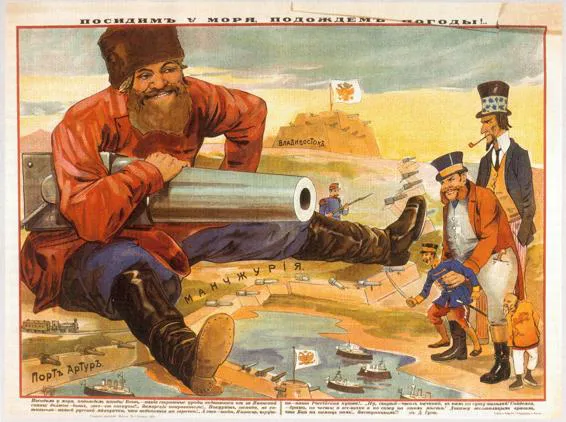
“Let’s sit by the sea and wait for the weather!”
Russian propaganda poster at the beginning
of Russo-Japanese war. February 28, 1904
Mighty Russia, represented by a Cossack (left), is ready for an attack by Japan, shown here as a diminutive officer holding a sword. It would be understood by the intended audience that Japan was backed by England (John Bull) and the United States (Uncle Sam). While overestimating Russian strength, the poster correctly describes the geopolitical situation and the favorite Anglo-American tactic of the waging a war by proxy.
![]()
Pop Quiz
What is the most peaceful form of government?
a) Democracy
b) Dictatorship
c) There is no peaceful form of government
![]()
“Strange as it may seem, England, being to the core monarchical and conservative at home, in her foreign relations always acted as the patroness of the most demagogic aspirations, always indulging in all popular movements aimed at weakening the monarchical principle.”
Peter Durnovo. Report to the Czar, 1914.
Most Americans are taught that democracies seek peace, while dictators wage wars. As U.S. President Woodrow Wilson observed, “A steadfast concert for peace can never be maintained except by a partnership of democratic nations. No autocratic government could be trusted to keep faith within it or observe its covenants.”
The truth, however, is that both democratic and authoritarian regimes may have expansionist and aggressive ambitions. After all, the most successful and powerful imperialists of the modern history were the great democracies—Great Britain, France, and the United States. Autocratic empires such as Russia and Japan operated in essentially the same manner as their democratic counterparts.
Democracies or Empires?
At the dawn of 20th century, there were only five major power centers in the world. Great Britain had the most colonies around the world and the most powerful navy. France was also a great colonial power, second only to Britain in terms of wealth and reach. Continental Russia spread across vast areas of northern Eurasia and had fast-growing population. The United States, another huge continental country, had the whole South American continent as its sphere of influence, while the recently annexed Hawaii and Philippines were its outposts in the Pacific. The fifth main power, Germany, lacked colonies but had the best army, great science, and fast-developing industry.
Of these five major powers, who would you say were the “good guys”? Who were the “bad guys”? The answer is not that simple as some may think. Dominant opinion always held that the “democratic” England, France, and the United States were morally superior to the “oppressive” and even “barbarian” Russia, while “civilized” but “autocratic” Germany fell somewhere in between.
We may expect the “good guys” to have respected human rights and wanted to save peace, while the “bad guys” were racist aggressors. Yet in that respect, we can see that so-called “civilized democracies” were actually the leading world racists and the most successful aggressors. While British or Americans like to think of themselves as the people of civilization and democracy, others around the world often see them as imperialists and aggressors. How else do you think they got their empires? Imperialists at the time believed strongly in white supremacy and saw their colonial expansions as a mission to bring “civilization” to “third world” countries. This thin justification allowed Western democracies to consistently suck resources out of less developed nations for their own use.
The British Empire was the best at subjugating and ruthlessly exploiting peoples around the world. India, for example, was run by a corporation called British East India Company for more than a century. The huge nation with rich ancient culture was reduced to the status of an English business. Another great example of Britain bringing “civilization” was the Opium Wars with China. When the Chinese emperor forbade the sale of British opium—which had turned millions of Chinese into drug addicts—British forces invaded. With Chinese cities in flames, Chinese government acquiesced to the opium trade and was forced to pay a huge restitution and cede control of Hong Kong.
Americans also had long history of waging the wars of aggression. In 1899 while the British were plotting a war for control of gold mines in South Africa, the Americans were busy trying to subdue a local resistance in the Philippines. U.S. Senator Albert J. Beveridge captured the national mood well in a speech on the Senate floor in 1900, which he addressed to President William McKinley:
“Mr. President, the times call for candor. The Philippines are ours forever, ‘territory belonging to the United States,’ as the Constitution calls them. And just beyond the Philippines are China’s illimitable markets. We will not retreat from either. We will not repudiate our duty in the archipelago. We will not abandon our opportunity in the Orient. We will not renounce our part in the mission of our race, trustee, under God, of the civilization of the world. And we will move forward to our work, not howling out regrets like slaves whipped to their burdens but with gratitude for a task worthy of our strength and Thanksgiving to Almighty God that He has marked us as His chosen people, henceforth to lead in the regeneration of the world.”
The Philippine-American War would end two years later, though the U.S. would retain a strong military presence in the region for the next four decades.
Apart from direct occupation, the United States also routinely installed puppet governments in the countries of Latin America and the South Pacific. The humiliating term “Banana Republic” could have been applied to quite a few governments that were controlled and, if needed, forcefully overthrown by the U.S. government to profit corporations like the infamous United Fruit Company.
For example, in 1893, in one of so many similar acts, Americans overthrew the Hawaiian monarchy. Five years later, they annexed the country. In 1903, when the Colombian government refused to give up the rights to area surrounding the recently completed Panama Canal, Americans gave support to the local separatists. Following a coup, the newly independent state of Panama and gave the United States the rights to build and indefinitely administer the Panama Canal Zone and its defenses. The American Naval Base at Guantanamo Bay, Cuba—as well as its infamous prison—have been in active service since 1903 because the United States “leased” it indefinitely in the wake an invasion of the island during the Spanish-American War. The Cuban government has long demanded that the U.S. vacate the territory, but instead the Treasury simply sends a yearly “rent check” for the never-prorated funny sum of $4,085 to the Cuban government. Americans may not realize how much respect communist Cuba gained in Latin America because it could successfully defy the might of the United States.
In contrast to Britain and America, turn-of-the-century Russia seems rather tame. While Russia was also expanding by conquering its neighbors, she did not exterminate native populations, nor did she not treat those countries like inferior colonies to exploit. Newly acquired provinces and their peoples were simply absorbed into the Russian Empire. Christian Georgia, suffering from persecution by its powerful Muslim neighbors, actually begged the Russian Czar for protection. What is today modern Armenia was actually a small part of the ancient Armenia that was saved by incorporation into Russian Empire; elsewhere Armenians were either dispersed or outright exterminated. The sharp contrast between white “master race” and subjugated people of color in the democratic empires, was not so sharp in the multi-ethnic and multi-sectarian society of Russian empire, although of course Ethnic Russians still clearly held much more power and prestige than the newly absorbed peoples.
Indeed, even before the modern era, the “civilized” West was not superior to Russia on the question of human rights. For example, unlike in Europe, the death penalty was relatively rare in Russian Empire, and there were long periods of time when it was banned. Even so, stories about the cruel and barbarous Russians circulated in the West for centuries. Perhaps those rumors started in the 16th century, when Russian Czar Ivan the Terrible (1530-1584) executed many members of his opposition while expanding his country. It is odd, though, that English King Henry VIII (1491-1547) did not acquire a similar “terrible” moniker despite the fact that his executions were no less cruel or widespread—including two of his six wives. The French were no better, as the brutal St. Bartholomew’s Day massacre on August 24, 1572 shows. In one day, the French government slaughtered more people, including wedding guests, than Ivan the Terrible executed during his entire reign.
Despite this, unjustified attitudes about “Russian barbarity” have continued ever since, even while “civilized” Europeans were burning women as witches and hanging citizens for pickpocketing. Up until the beginning of the 19th century, under the so-called “Bloody Code,” 220 crimes in England were punishable by death.
Americans could be proud that they established democracy and had a constitution while Russia was still an absolute monarchy. However, the celebrated U.S. democracy allowed both slavery and the extermination of Native Americans. Many of the vaunted Founding Fathers were in fact slave-owners. What kind of democracy is that?
Americans in general tend to always be proud of themselves. They are proud of Abraham Lincoln for liberating slaves and of Rosa Parks for refusing to give up her sit in the bus. They forget that by having slavery in the second half of 19th century and segregation in the second half of 20th century, they looked barbarians in the eyes of the rest of the world. As a matter of fact, Russian serfdom was abolished in 1861, four years before slavery was abolished in the United States in 1865, and there never were segregated buses in Russia.
By the way, there are curious historical parallels between Russian Czar Alexander II (1818-1881) who abolished serfdom and U.S President Lincoln (1809-1865) who abolished slavery. During American Civil War (1861-1865) Alexander II send Russian fleet to American shores thus preventing British intervention into the civil war on the side of Confederation. Alexander II also sold Alaska to the United States in 1867. And sadly enough both great statesmen were assassinated.
At the dawn of the 20th century, democratic countries could not claim moral superiority, but they still used liberal ideas to undermine their autocratic rivals. Many of the powerful Western states actually sponsored revolutionary movements in Russia and other countries. The first big success of Russian revolutionaries was the assassination of Alexander II, the Czar who actually started democratic reforms, in 1881. Just before his assassination, Alexander II proposed the establishment of a parliament in Russia. After the Czar’s gruesome death in a carriage bombing, his outraged son Alexander III cracked down on revolutionaries and ended democratic reforms.
Who could support and fund Russian revolutionaries at the time? Well, the number one geopolitical rival of Russia was England, the great organizer of revolutions. Other great powers could have been involved too. Although democratic countries always used wars as a tool of foreign politics, wars are costly, and covert operations present the great alternative. Assassinations, coups, or even revolutions are so much cheaper than wars, but bring similar results.
Starting with the first communist Karl Marx (1818-1883), revolutionaries always found safe haven in London. Karl Marx’s idea to destroy capitalism was supposed to hit the most advanced industrial countries like England and the United States, but somehow it detonated in Russia instead. In fact, the Russian Communist Party was actually founded in London in 1903.
London gave refuge to criminal revolutionaries too. One classic example was Maxim Litvinov (1876-1951, born Meir Wallach), the future famous diplomat of Communist Russia. In 1907, Litvinov was involved in a daring bank robbery in Russia, designed to finance arms trading from the West. Unfortunately for the revolutionaries, the captured bank notes had such a large denomination that it was not easy to cash them. In 1908, when Litvinov tried to cash some of the notes in France, he was arrested. Instead of being deported back to Russia, however, he ended up in London, where he lived in safety and continued his struggle against Russian autocracy.
The exporting of revolutions has continued until today. Remember when, in 2005, U.S. Secretary of State Condoleezza Rice stated, “it is time to abandon the excuses that are made to avoid the hard work of democracy,” signaling the start of the Arab Spring? As I write these lines, Americans are busy sponsoring yet another revolution in the Ukraine. Then and now, powerful nations have not needed any excuses to support terrorists, nationalists, communists, fascists, radical Islamists—you name it—in the glorious task of toppling “regimes.” A bloodbath is sure to follow in most cases, but it is easy to make sacrifices for “the hard work of democracy” when it is not your people who are going to suffer. Of course, any given revolution in any given country has to be caused not only by external but by internal factors as well, and it can bring not only destruction, but the progress as well. However, failing to analyze a revolution in the context of the global geopolitical struggle means failing to see the big picture. Selfish interests often lie behind the ideals of peace and freedom.
The titanic struggle that culminated into World War II started at the beginning of the 20th century as casual international rivalries. Germany and Russia had conflict of interests in Eastern Europe, while France wanted revenge over Germany for their humiliating defeat in 1871. As a result, France and Russia entered a military alliance aimed against Germany. Meanwhile, Germany challenged Great Britain by building a powerful navy, and Russia challenged Great Britain by expanding in Central Asia. True to her spirit, Great Britain would try to avoid direct confrontation with Russia or Germany, but instead would play a complex game to weak...