- English
- ePUB (mobile friendly)
- Available on iOS & Android
eBook - ePub
Information
Subtopic
LeadershipIndex
BusinessPART 1
What Makes
a Nonlinear Thinker
Different?
a Nonlinear Thinker
Different?
CHAPTER 1
First NL Distinction
Orientation to the World
“To be a champion, I think you have to see the big picture.”
— Summer Sanders,
Olympic gold medal swimmer, sports commentator, actress
Graphic Chapter Overview
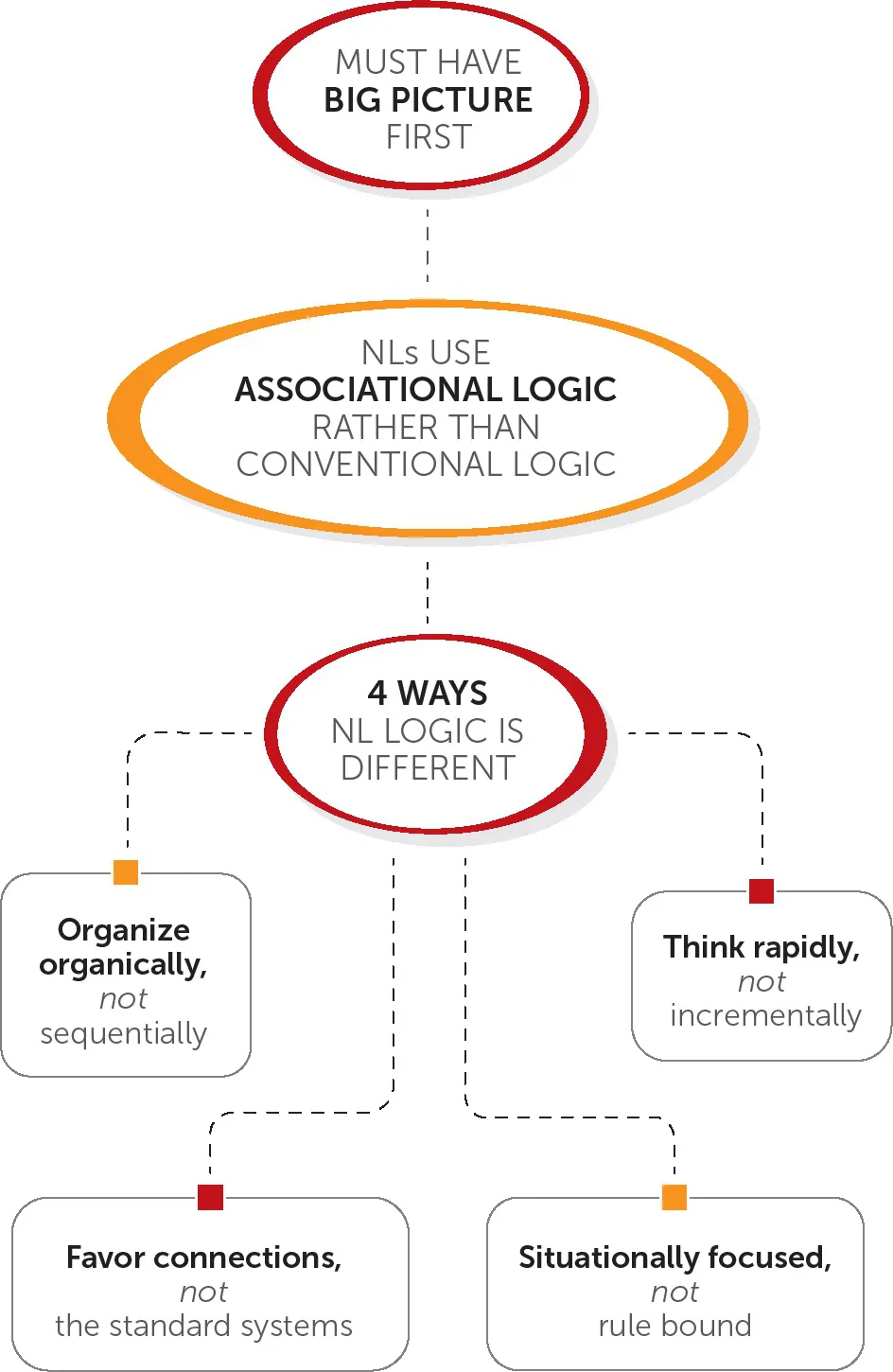
The nonlinear thinking process
Dave is a CPA and financial planner. He’s also a nonlinear thinker. When new clients come to him for financial advice and want to get right into the specifics, instead he takes a different approach. He hits the brakes and asks a lot of questions about the clients’ goals, dreams, family, and
short- and long-range plans. He does that because he wants to see the big picture and understand the entire context of his clients’ concerns.
Dave’s approach is somewhat like a doctor diagnosing a patient’s entire set of symptoms and seeing the big picture before proceeding to treatment. If the doctor had to isolate and gather data sequentially from each one of the 37.2 trillion cells in a patient’s body, she’d be overwhelmed by the sheer volume of data. Instead, she begins by creating an overview, by taking vital signs and observing the patient’s key symptoms.
Similarly, when a detective arrives at a murder scene, he first steps back and looks over the entire scene — the physical environment, the orientation and condition of the body, and possible suspects — to get the whole picture. He then gathers evidence, reconstructing events as fully as possible, and fits them into his puzzle. All his preliminary work helps establish context and give him the big picture — just as it does for the doctor and Dave.
Regardless of the vocation or task, nonlinear and linear thinkers process information in different ways, using different, invisible priorities. For linear thinkers to understand, they need to see the details first and build their big picture from them. Nonlinear thinkers — NLs — look to see the big picture first and work in the variety of details as they make sense to that larger view.
The Big Picture and Context
For NL thinkers, the big picture is fundamental to understanding the world and any task before them. It’s not enough to have the big picture revealed to them at the end because, without the big picture, NLs don’t know where to put the details — or how to put order to what’s presented to them.
“I get bombarded with all this detail before it has any meaning for me, and I don’t have anywhere in my mind to put it. So, it goes in one ear and out the other.”
— Dave, client
Looking at the whole picture first does take extra time. So an NL may sometimes seem to be wasting time or slow. But you aren’t slow. In fact, you frequently arrive at the solution first. That’s because — before you take action — you take the time to orient yourself to the whole context.
Your relationship to the whole is the key.
How thinking styles differ
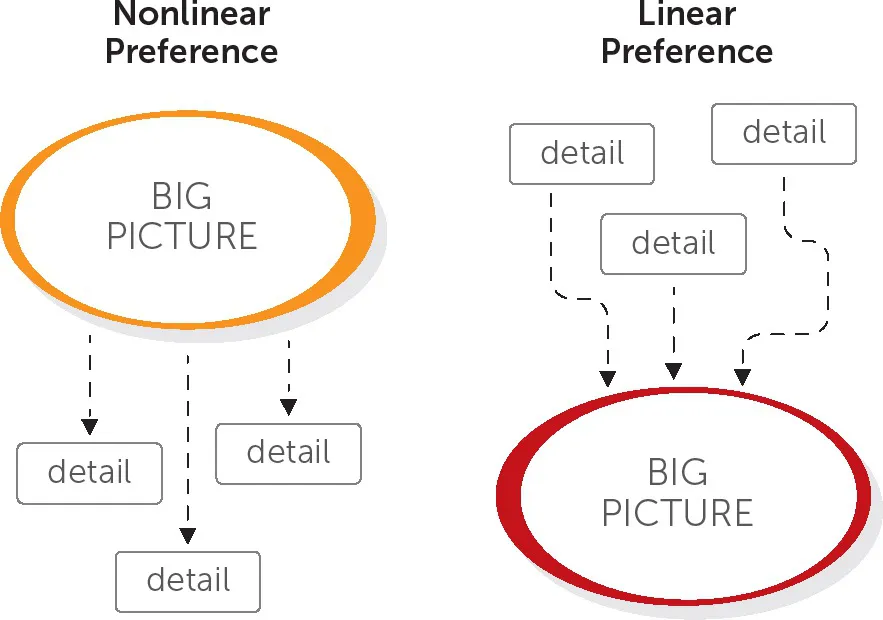
Nonlinear thinkers remember details when they start with the big picture first.
Here’s how Dave describes it: “The core thing for me is to get the big picture before I can do anything else. When I work with clients, I’m always interested in what’s motivating their questions, what they are really asking. Often there’s something underneath driving their question.
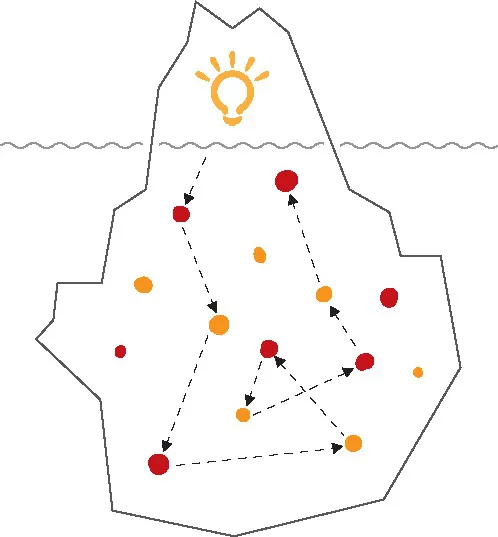
“It’s like an iceberg, where what you see above the water is only a fraction of the whole thing. My goal is to see and understand as much of the whole picture as possible because that’s the context that will reveal the most complete solution.
“It’s when I have access to the whole iceberg that I can see the relationships and make the connections that make all the difference.”
Dave recognizes now how his natural nonlinear orientation not only affects his approach to his work but also shaped his experience as a student in high school.
Iceberg thinking
“I’m most engaged when I’m learning about one thing — but within its broadest context. For example, if I’m reading about history, I want to know the context of what’s going on at the same time in the art, politics, and economics of the period. This lets me make connections that make sense to me and helps me remember. If I don’t have those things, I have difficulty relating to and remembering information.”
Back in high school, Dave rarely got the full picture. So, he couldn’t make the connections that help him get inspired. As a result, he did just enough to get by — because without a puzzle to solve, it all seemed formulaic and limiting, not enough of a challenge. He wanted to find out new things. He loved the challenge when a solution was uncertain. Without that, he just cruised.
This need for the big picture requires its own logic; a way of thinking and problem-solving that’s both unconventional and, for NLs like Dave, wholly natural.
NLs’ Associational Logic
Traditionally, logic is considered to be analytical and sequential. It arrives at conclusions by following a methodical, linear series of deductions. When Dave sees his clients’ questions as an iceberg, he uses an entirely different kind of logic, one that’s intrinsic to NL thinking.
This associational logic is what allows NLs to be highly gifted as creative problem-solvers and visionary communicators. And this nonlinear logic is based on making previously undetected connections among seemingly unrelated elements.
This kind of thought process releases explosions of energy similar to the rapid synaptic firing of the brain when it’s learning something exciting. Making associational connections creates breakthroughs that are multi-directional, multi-dimensional, and virtually instantaneous.
How did Wilbur and Orville Wright discover the secret of controlled flight? The story goes that while Wilbur was talking with a customer in their bicycle shop, he was holding a small cardboard box. As he talked, he idly twisted the box in his hands.
The slight warping of the flat surfaces reminded Wilbur of something — buzzard wings! He’d seen buzzards gently twist their wings to soar on thermal updrafts.
Suddenly, he understood the answer to the centuries-old mystery of controlled flight. All he and Orville had to do was figure out a way to warp the plane’s wings to create something similar.
The brothers designed wires that would give the pilot manual control of wing warping so the pilot could actually steer the plane. Wilbur’s associative leap from box to bird to the critical roll control of airplane wings was hardly a straight line of logic. But his associational logic solved a problem that had stumped everyone before him.
NL thinkers are in a continual state of associating. It comes naturally from their big-picture orientation. Relationships and connections don’t emerge when we focus only on the obvious details right in front of us. It’s like the iceberg. Expanding the view to include not just the obvious but also everything below the surface allows us to see relationships and make critical connections not evident previously.
For NLs, creating associations among the diverse objects, actions, people, and events around them doesn’t stop with the present moment. Past associations and future potentialities can easily be in the mix.
So, don’t assume that that faraway look on the face of an NL friend is empty daydreaming. You might actually be witnessing unique connections being made in another mental time zone.
Associational thinking frees NLs from trying to fit their unique logic into standard, sequential threads of thought that don’t serve their natural approach. Nonlinear, associational logic is distinctly different from the common linear method in four principal ways.
The Four Features of Associational Logic
1. Organically Ordered
Nonlinear, associational thinking is organically, not sequentially, ordered.
The trunk of a tree might appear to spring vertically from the soil and grow upward until it reaches its natural height. But the tree is always growing multi-directionally and multi-dimensionally. As the trunk and branches grow above ground, the roots grow downward and outward. The “vertical” tree is really a spherical life form.
Associational thinking is invisibly and organically ordered in the way that a tree’s growth is organically stru...
Table of contents
- Cover
- Title Page
- Copyright Page
- Dedication
- Contents
- Introduction
- Part 1: What Makes a Nonlinear Thinker Different?
- Part 2: Leveraging Your Nonlinear Thinking
- Part 3: Orchestrate Life Easily and Confidently
- Afterword
- Acknowledgments
- Resources
Trusted by 375,005 students
Access to over 1.5 million titles for a fair monthly price.
Study more efficiently using our study tools.
Frequently asked questions
Yes, you can cancel anytime from the Subscription tab in your account settings on the Perlego website. Your subscription will stay active until the end of your current billing period. Learn how to cancel your subscription
No, books cannot be downloaded as external files, such as PDFs, for use outside of Perlego. However, you can download books within the Perlego app for offline reading on mobile or tablet. Learn how to download books offline
We are an online textbook subscription service, where you can get access to an entire online library for less than the price of a single book per month. With over 1.5 million books across 990+ topics, we’ve got you covered! Learn about our mission
Look out for the read-aloud symbol on your next book to see if you can listen to it. The read-aloud tool reads text aloud for you, highlighting the text as it is being read. You can pause it, speed it up and slow it down. Learn more about Read Aloud
Yes! You can use the Perlego app on both iOS and Android devices to read anytime, anywhere — even offline. Perfect for commutes or when you’re on the go.
Please note we cannot support devices running on iOS 13 and Android 7 or earlier. Learn more about using the app
Please note we cannot support devices running on iOS 13 and Android 7 or earlier. Learn more about using the app
Yes, you can access Thinking Differently by Jan Thomas in PDF and/or ePUB format, as well as other popular books in Business & Leadership. We have over 1.5 million books available in our catalogue for you to explore.