This book will explain Aster Data so that users are instant experts. It will explain how things are set up, how things work, and all of the advanced analytics that Aster can provide. Like the other Genius Series books, it begins at a very basic level and gradually gets more and more detailed.
- 285 pages
- English
- ePUB (mobile friendly)
- Available on iOS & Android
eBook - ePub
Teradata Aster Data
About this book
Information
Subtopic
Data WarehousingIndex
Computer ScienceChapter 1 – The Aster Data Architecture
“Design is not just what it looks like and feels like. Design is how it works.”
- Steve Jobs
What is Parallel Processing?
“After enlightenment, the laundry”
- Zen Proverb
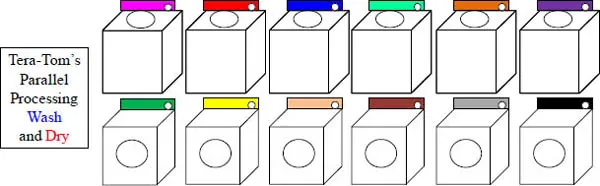
“After parallel processing the laundry, enlightenment!”
-Aster Zen Proverb
Two guys were having fun on a Saturday night when one said, “I’ve got to go and do my laundry.” The other said, “What?!” The man explained that if he went to the laundry mat the next morning, he would be lucky to get one machine and be there all day. But, if he went on Saturday night, he could get all the machines. Then, he could do all his wash and dry in two hours. Now that’s parallel processing mixed in with a little dry humor!
Aster Data is a Parallel Processing System
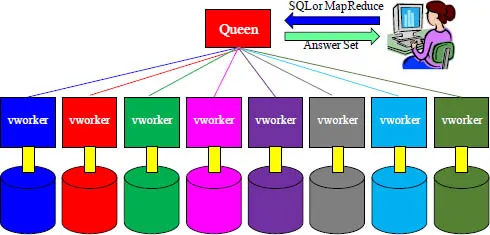
The queen takes the request from the user and builds the plan for the vworkers. The vworkers retrieve their portion of the data and pass the results to the queen. The queen delivers the answer set to the user.
Each vworker holds a portion of every table and is responsible for reading and writing the data that it is assigned to and from its disk. Queries are submitted to the queen who plans, optimizes, and manages the execution of the query by sending the necessary subqueries to each vworker. Each vworker performs its subquery or subqueries independent of the others, completely following only the queen’s plan. The final results of queries performed on each vworker is returned to the queen where they can be combined and delivered back to the user.
Each vworker holds a Portion of Every Table
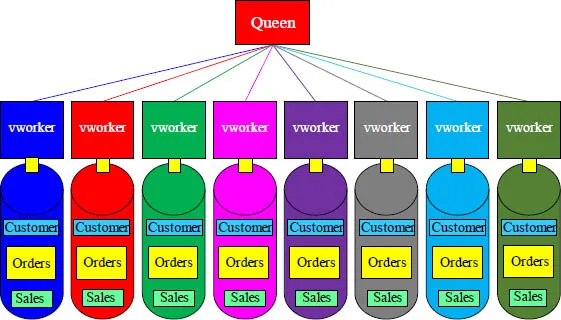
Every vworker has the exact same tables, but each vworker holds different rows of those tables.
When a table is created on Aster, each vworker receives that table. When data is loaded, the rows are hashed by a distribution key, so each vworker holds a certain portion of the rows. If the queen orders a full table scan of a particular table, then all vworkers simultaneously read their portion of the data. This is the concept of parallel processing.
The Rows of a Table are Spread Across All vworkers
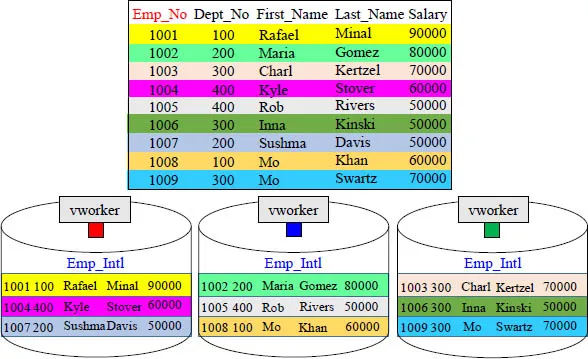
A Distribution Key will be hashed to distribute the rows among the vworkers. Each vworker will hold a portion of the rows. This is the concept behind parallel processing.
The Aster Data Architecture
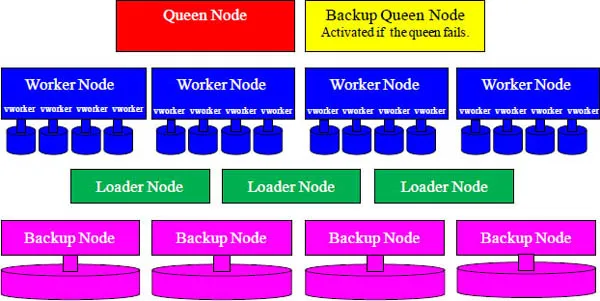
Aster can scale to thousands of nodes which are standard, inexpensive commodity x86 servers with locally-attached disk storage and networked with other nodes using commodity Gigabit Ethernet (GigE) technology. The Queen Node is the brains behind the operation. The Worker Nodes hold the data and do the processing based on the Queen’s plan. The Loader Nodes load the data and export data off of Aster. The Backup node provides large disks that backup and restore data to the Aster system.
The Queen Node
Queen Node
• The queen node comes up with a plan for the vworkers to retrieve their portion of the data.
• The queen is the coordinator of how the data is distributed across vworkers.
• The queen delivers the answer set to the end user.
• The queen node is the software coordinator and keeper of the data dictionary and other system tables.
• You can maintain an inactive queen as a backup.
• The queen provides the cluster logic that glues all nodes of the system together. The queen is responsible for all cluster, transaction, and storage management aspects of the system.
The Worker Node
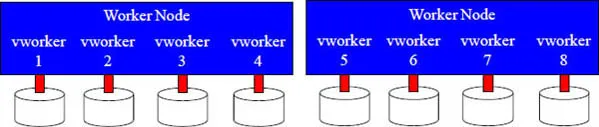
• Worker nodes are where the data is stored and analyzed.
• A worker node is comprised of multiple vworkers.
• Each vworker has their own storage, and the vworkers work in parallel to process data simultaneously.
• The queen communicates with vworkers via standard SQL, and the vworkers on various worker nodes communicate with each other.
The Loader Node

• The Aster Database Loader utility and loader nodes form the massively parallel backbone of the Aster Database for performing data loads and exports.
• Loader nodes are designed to be CPU-heavy nodes that have no major disk capacity.
• These independent nodes also help isolate loads and exports from query processing.
• The Aster Database Loader utility communicates with loader nodes and acts as a landing zone for bulk data during both loads and exports.
• Because of this brilliant design, Aster can process queries while loading fresh data, and it can process queries and loads while exporting data off of Aster.
The loader nodes handle all aspects of load and export: transforming and reformatting data. When loading, the loader nodes also generate the hash keys and perform compression. The loader nodes handle the processor intensive functions normally required by the host in most systems, thus providing great import and export capabilities while queries and backups are running simultaneously.
The Backup Node

• Aster can backup your entire Aster system or just individual tables on backup nodes.
• The backup nodes are not an Aster Database. Instead, they are a set of disk-heavy Aster Database Backup Nodes designed for backup purposes only.
• The Backup Nodes can be used to restore data to the Aster Database.
• A backup administrator starts a backup by interacting with the Aster Database Backup Terminal.
• The data on the Backup Nodes are compressed (about 3:1 ratio) for smart space savings on data storage. Recovery is f...
Table of contents
- Cover
- The Tera-Tom Genius Series
- Tera-Tom- Author of over 50 Books
- The Best Query Tool Works on all Systems
- Trademarks and Copyrights
- About Tom Coffing
- About John Nolan
- Contents
- Chapter 1 – The Aster Data Architecture
- Chapter 2 – Fact and Dimension Tables
- Chapter 3 – How Aster Processes Data
- Chapter 4 - Four Options for Aster Data Table Design
- Chapter 5 - How Joins Work Inside the Aster Engine
- Chapter 6 - Temporary and Analytic Tables
- Chapter 7 – Aster Modeling Rules
- Chapter 8 – Tera-Tom's Top Tips
- Chapter 9 - Indexes
- Chapter 10 – Aster Windows Functions
- Chapter 11 – SQL-MapReduce
Trusted by 375,005 students
Access to over 1.5 million titles for a fair monthly price.
Study more efficiently using our study tools.
Frequently asked questions
Yes, you can cancel anytime from the Subscription tab in your account settings on the Perlego website. Your subscription will stay active until the end of your current billing period. Learn how to cancel your subscription
No, books cannot be downloaded as external files, such as PDFs, for use outside of Perlego. However, you can download books within the Perlego app for offline reading on mobile or tablet. Learn how to download books offline
Perlego offers two plans: Essential and Complete
- Essential is ideal for learners and professionals who enjoy exploring a wide range of subjects. Access the Essential Library with 800,000+ trusted titles and best-sellers across business, personal growth, and the humanities. Includes unlimited reading time and Standard Read Aloud voice.
- Complete: Perfect for advanced learners and researchers needing full, unrestricted access. Unlock 1.5M+ books across hundreds of subjects, including academic and specialized titles. The Complete Plan also includes advanced features like Premium Read Aloud and Research Assistant.
We are an online textbook subscription service, where you can get access to an entire online library for less than the price of a single book per month. With over 1.5 million books across 990+ topics, we’ve got you covered! Learn about our mission
Look out for the read-aloud symbol on your next book to see if you can listen to it. The read-aloud tool reads text aloud for you, highlighting the text as it is being read. You can pause it, speed it up and slow it down. Learn more about Read Aloud
Yes! You can use the Perlego app on both iOS and Android devices to read anytime, anywhere — even offline. Perfect for commutes or when you’re on the go.
Please note we cannot support devices running on iOS 13 and Android 7 or earlier. Learn more about using the app
Please note we cannot support devices running on iOS 13 and Android 7 or earlier. Learn more about using the app
Yes, you can access Teradata Aster Data by Tom Coffing,John Nolan in PDF and/or ePUB format, as well as other popular books in Computer Science & Data Warehousing. We have over 1.5 million books available in our catalogue for you to explore.