- English
- ePUB (mobile friendly)
- Available on iOS & Android
eBook - ePub
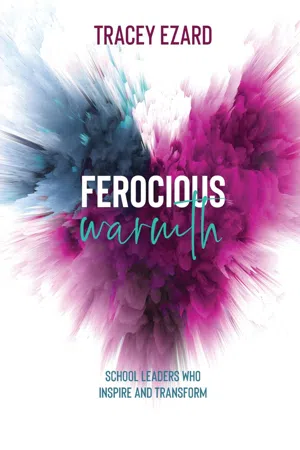
Ferocious Warmth - School Leaders Who Inspire and Transform
Information
Topic
EducationSubtopic
Education Theory & Practicechapter one
THE WORLD NEEDS MORE COURAGEOUS AND CARING LEADERSHIP
Leaders who can balance results and relationships are needed now more than ever. The stakes are high. Quality wellbeing and learning outcomes for students, educators and support staff, schools and systems, not to mention leaders themselves is becoming more complex. High levels of mental health issues and disengagement are changing the dynamics of classrooms and the role of the teacher. The democratisation of knowledge and increased learning occurring outside the classroom via technology, mounts pressure on teaching and learning within the school system to remain relevant and engaging. Education is at a time of immense and needed change. It takes both courage to address these wicked problems, as well as deep understanding of how humans work and what we need to thrive in change. Creating this change as a collective is critical to dealing with our most pressing challenges:
•Up to 40% of our students are disengaged in learning.1
•Youth mental health issues are continuing to rise, as is youth suicide.2
•Disadvantaged students are more likely to experience inequity in educational opportunities and outcomes.3
•Youth unemployment is at the highest rate in twenty years.4
•Families disenfranchised from school lower student outcomes.5
•Lack of student voice and agency increases disengagement in learning.6
•Education that helps students thrive now and in the future beyond school requires three types of skills: social and emotional, cognitive and meta-cognitive; practical and physical skills. Fostering these authentically is a challenge for both schools and systems.7
As education is essentially about learning and growing, it’s ironic that most schools and school systems have not evolved much over the last 150 years. The move to remote learning during the 2020 COVID-19 pandemic has seen the biggest radical shift in education delivery since schooling began. Some schools found it a perfect opportunity to learn new ways of working and connecting with students, the community adapting as they learnt about what worked and what didn’t. The audacious shift of education to deal with the context was exciting to witness, as it showed just how adaptable and responsive educators can be.
I am privileged to be exposed to many leaders and teachers who are continually evolving learning and teaching. They are pushing against ‘the way we’ve always done it’ to grow strong learning cultures that are not prepared to accept the status quo. They are true learners in partnership with their students, co-constructing a teaching and learning environment responsive to the Imagination Age, the age of entrepreneurial opportunity and a democratisation of knowledge. They are ferocious about this purpose, and have the warmth and belief in people to create a movement towards a different paradigm. You’ll find some of these leaders and teachers within the pages of this book. Yet there are many more out there who are, together, fuelling a movement to provide education that not only helps our young people gain the skills and attitudes they need for a fulfilling life in a complex world, but also experience joyful, connected relationships and learning along the way. They are courageously pushing against the comfort zone in a way that compels others to join. I call them Ferocious Warmth leaders.
Ferocious Warmth leaders help those around them lift the quality of daily interactions in schools to transform education. Ferocious Warmth leaders aim to eradicate mediocrity. Beige thinking and relationships do not sit well with Ferocious Warmth leaders.
How do you spot mediocrity? Researchers in the Netherlands used the term ‘mentality of mediocrity’ when identifying factors in higher education students described as ‘strategically exerting the minimum effort necessary to get passing grades.’ 8 This was found to be a strategy utilised by students to get the grades good enough to get through, perhaps reducing cognitive dissonance, and not an indicator of their abilities, or their learning regulation. It also showed that the students used this approach strategically depending on the perceived importance of the task. If you put the lens over your school, can you sense a ‘mentality of mediocrity’ where you don’t believe it’s appropriate? Are there educators that accept mediocrity for their teaching practice? Do too many of your students aim for ‘just good enough’?
The word mediocrity doesn’t fit the purpose of schools. It doesn’t serve education or quality relationships. Ferocious Warmth is about rejecting cognitive or emotional ‘average’. Cognitive and emotional mediocrity won’t help us deal with the big challenges we face.
Cognitive mediocrity is feeling comfort with the status quo: happy with the strategy and thinking that keeps us stagnant or, at the very least, only just keeping up with what society needs from us, rather than leading the education directions that respond to a changing world. In this realm we are OK with underperformance or teachers who don’t really want to be there, content to keep doing things the way we’ve always done.
Emotional mediocrity is being satisfied with low levels of trust and empathy in our cultures, punitive management of behaviours and poor adult performance. It’s leadership that gets results via emotional negligence or emotional manipulation. It creates an environment where the professional relationships are parent/child-like rather than adult to adult. Relationships between students and teachers are aloof, disconnected and based on content rather than learning.
To get to extraordinary in both emotional and cognitive approach, you need both courage to lift the bar and care to support a culture of wellbeing.
WHAT IS YOUR EXTRAORDINARY?
As a leader, what would you do if you and your team were bolder? What is your vision? What transformation, shift of the status quo or rise above mediocrity are you leading? Is it teaching and learning or relationships and culture? Perhaps it’s all of these? Is it building professional trust to learn more from each other or implementing a new approach to literacy or numeracy? Or perhaps it’s time to innovate into the next phase of 21st century learning? What big picture impact do you want for your students? What do your students want for their learning?
“WHAT IS EXTRAORDINARY FOR YOUR SCHOOL AND COMMUNITY? WHETHER IT’S A SMALL EVOLUTION OR A LARGE REVOLUTION, FEROCIOUS WARMTH PROVIDES THE BALANCE YOU NEED TO HAVE THE COURAGE FOR CHANGE AND THE PROFESSIONAL TRUST TO ENABLE THE MOVEMENT.”
If you haven’t thought much about your ‘extraordinary’, I encourage you to imagine where you would take your school with the momentum, strategy and commitment to get there? What are you ferocious about? Committed to? How can you co-create this vision with your community? Have you the trust and relationships to get there? Do people see both conviction and connection as your strengths? Are you ferocious and warm?
LOOKING WITHIN
Leadership is messy. School leadership is especially so. Everyday there are myriad cross relationships and interactions that go on in classrooms, staff rooms, corridors and playgrounds. Leading in the messy middle is hard work, constantly pulling us in one direction or another. Our ability to lead with balance and calmness can be a daily challenge. Yet many of us walk through the world totally unconscious of the affect our leadership has on others.
While self-awareness is usually first on the agenda for many leadership programs, these often do not go deep enough, failing to open our eyes to the internal drivers of our underpinning, often unconscious beliefs.
Leadership is about a way of being, not doing. It’s nebulous, nuanced and elusive. It is as much to do with feeling and energy as thinking and planning. It’s contextual and responsive, and can never be one size fits all.
When you meet a Ferocious Warmth leader you know it. You feel the vibe. When I share the Ferocious Warmth approach with others, many can immediately name one or two leaders who fill the criteria outlined in this book. These leaders have built more leaders through an environment characterised by high challenge and high support. They have brought together community and school, mended broken trust and lifted outcomes for students. They’ve instilled hope and joy in those they lead and created a collaborative culture that fronts up to the hard conversations. Ferocious Warmth leaders also have a Ferocious Warmth leadership team. If they move into a school without one, building leadership capacity in others is one of their first strategies.
Yet, too often more people have experienced leaders who’ve led in an unbalanced and uncentered way, focussed too much on results or too much on relationships. This is not useful to anyone. One is a win-at-all-costs approach, the other usually entails indecisive direction and a greater focus on the welfare and relationships of the teachers over the good of the students.
Leanne was a deputy principal in a primary school. She often felt caught in the vortex of having to play the other half to her principal. Leanne’s principal was a person with strong compassion for others who listened deeply to what others thought. Unfortunately, though, when inappropriate staff behaviours occurred, Leanne was called in to deal with it. This became a good cop/bad cop exercise that no one won. Highly stressed by this, Leanne felt her principal was not standing up for what she believed. In private to Leanne, the principal would acknowledge what she thought the teacher should do, but not say it directly. This was left up to Leanne, while the principal herself made overtly empathetic acts to the teacher without mentioning the actual issue. Apart from an unfair responsibility on Leanne to hold the person to account, this also created a habit of leadership that expected one person to be responsible for accountability and the tougher conversations.
Others have the opposite situation. Joe was a fearsome leader who was so focussed on data and student outcomes that he badly affected morale and staff engagement. Joe was acting principal at a school that had focussed clearly on their professional culture, and teaching and learning practice. During the two years prior to Joe’s arrival, there’d been a positive shift in attitudes to school, collaborative culture and consistent pedagogy. But over a six-month period, it seemed as if a systematic destruction of the work they’d done took place. After actively building professional trust and breaking down silos with the previous principal, this leader rarely had the staff meet together. There was a divide and conquer approach. People no longer felt safe to open their mouths. Unbelievably, one person was terminated in front of others. Implausible, but true. The acting principal continued on, obsessing over results and displaying abysmal emotional intelligence, while staff morale went from 98% the previous year to 48%. When the principal returned, she had to lead the rebuilding. Fortunately, she is a Ferocious Warmth leader.
FOCUSSING ONLY ON RESULTS
Leading a results-at-all-costs culture at the expense of support and empathy ends in cultural and wellbeing demise. How do we inspire our people for the stretch that transformational work requires while providing the safety nets to thrive and grow? More broadly: how do educational leaders ensure we zero in on results that matter, wider than the narrow definitions the media and bureaucracy encourage the community to focus on?
There is incredible pressure on school leadership to lead a school that performs. As it should. No one wants to send their children to a school with unskilled educators or who don’t care about student wellbeing. Unfortunately, our measurement systems are geared to a narrow concept of success, characterised by a snapshot assessment of literacy and numeracy in the form of standardised testing leading to the pointy end of a university entrance score only useful for a small percentage of university courses. While many schools believe that this one-eyed focus is in no small measu...
Table of contents
- Cover
- Praise For Ferocious Warmth
- Copyright Page
- Dedication
- Title Page
- Foreword
- Acknowledgements
- Contents
- Introduction
- 1. The world needs more courageous & caring leadership
- 2. Ferocious warmth
- 3. The paradox of yet
- 4. Strength and shadow
- 5. The impact of imbalance
- 6. Uncovering our unmet needs
- 7. Lack of connection
- 8. Recalibration – back in balance
- Expansive
- Connected
- Courageous
- Authentic
- Ripples
- Endnotes
- Bibliography
- About the author
Trusted by 375,005 students
Access to over 1.5 million titles for a fair monthly price.
Study more efficiently using our study tools.
Frequently asked questions
Yes, you can cancel anytime from the Subscription tab in your account settings on the Perlego website. Your subscription will stay active until the end of your current billing period. Learn how to cancel your subscription
No, books cannot be downloaded as external files, such as PDFs, for use outside of Perlego. However, you can download books within the Perlego app for offline reading on mobile or tablet. Learn how to download books offline
Perlego offers two plans: Essential and Complete
- Essential is ideal for learners and professionals who enjoy exploring a wide range of subjects. Access the Essential Library with 800,000+ trusted titles and best-sellers across business, personal growth, and the humanities. Includes unlimited reading time and Standard Read Aloud voice.
- Complete: Perfect for advanced learners and researchers needing full, unrestricted access. Unlock 1.5M+ books across hundreds of subjects, including academic and specialized titles. The Complete Plan also includes advanced features like Premium Read Aloud and Research Assistant.
We are an online textbook subscription service, where you can get access to an entire online library for less than the price of a single book per month. With over 1.5 million books across 990+ topics, we’ve got you covered! Learn about our mission
Look out for the read-aloud symbol on your next book to see if you can listen to it. The read-aloud tool reads text aloud for you, highlighting the text as it is being read. You can pause it, speed it up and slow it down. Learn more about Read Aloud
Yes! You can use the Perlego app on both iOS and Android devices to read anytime, anywhere — even offline. Perfect for commutes or when you’re on the go.
Please note we cannot support devices running on iOS 13 and Android 7 or earlier. Learn more about using the app
Please note we cannot support devices running on iOS 13 and Android 7 or earlier. Learn more about using the app
Yes, you can access Ferocious Warmth - School Leaders Who Inspire and Transform by Tracey Ezard in PDF and/or ePUB format, as well as other popular books in Education & Education Theory & Practice. We have over 1.5 million books available in our catalogue for you to explore.