eBook - ePub
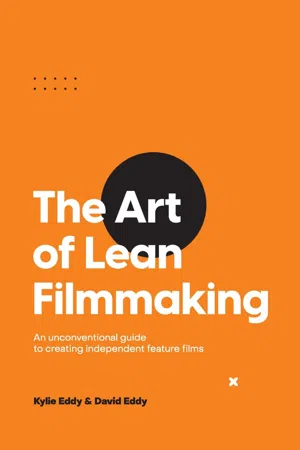
The Art of Lean Filmmaking
An unconventional guide to creating independent feature films
- English
- ePUB (mobile friendly)
- Available on iOS & Android
eBook - ePub
The Art of Lean Filmmaking
An unconventional guide to creating independent feature films
Information
Subtopic
Film & Video
Part 1:
Core Values
Core Values

The Lean Filmmaking Philosophy
We’re standing in front of twelve daring filmmakers.
The nervous energy is palpable.
No one knows what to expect.
After months of hypotheticals, we’re finally putting Lean Filmmaking into practice for the first time.
Can we really make films using our method?
We’d designed the Filmmakathon (our version of a tech hackathon for filmmakers) to make short films in a weekend using iterative cycles. We’d start from scratch on Friday night, work all Saturday, then on Sunday afternoon screen whatever was made to a live audience.
There was no script, no advance pre-production and no budget. None of the participants had even worked together as teams before now.
We were hoping for paradigm shifts, exponential learning and major breakthroughs (and we expected some intense meltdowns too).
All of that happened – but it also helped to crystallize our ideas about this new way of making films, test the core values and solidify the definition of Lean Filmmaking.
Lean Filmmaking is a new way of making films with creativity at its heart that enhances collaboration, uses ongoing iterative cycles and forges a deep connection between filmmakers and their fans.
The Lean Filmmaking philosophy has four core values:
×Collaboration is key
×Fan focused first
×Story before production values
×Learn by doing
The core values remain relevant even as technology improves, storytelling techniques change and shiny new gadgets are invented. They are applicable regardless of genre or format, documentary or narrative, episodic series or feature film.
The core values are reassuring touchstones to help get you unstuck, provide direction and give clarity.
Understanding the core values of the Lean Filmmaking philosophy empowers you to take ownership of the method and integrate it into your creative practice.
Let’s take a look at the values in detail and see how they truly transform the way films can be made when combined with Make-Show-Adjust Cycles.
Collaboration is key
We prioritize working together in ways that strengthen meaningful collaboration.
This is achieved by operating in small squads that are cross-functional, non-hierarchical and self-organizing, with everyone sharing responsibility for delivering the film.
The benefits of working collaboratively include:
×Improving communication and increasing transparency
×Using overlapping activities to maximize output
×Quickly adapting to avoid costly delays
×Finding and solving problems early
×Enhancing squad members’ potential (and opportunities to learn more skills)
We use the term squad rather than cast and crew (or even team). It’s more inclusive of all the skills required to create a film and suggests a different style of working together.
Squad
A group of three to nine multi-skilled people with the combined experience to make a film, including writing, directing, acting, editing, shooting, producing and marketing. Everyone is involved for the duration of making the film, from development to distribution. The overarching purpose of each squad member is to successfully deliver a film to fans, not just execute their specific role.
Collaboration is enhanced by having a cross-functional squad with all members having multiple skills, for example writing/acting/producing or directing/shooting/editing.
It’s useful to think about the range of skills needed rather than formal job titles. This allows other valuable skills to be included in the mix like audience development, marketing and Lean Filmmaking coaching.
Being a generalist, rather than a specialist, is an advantage.
To keep squads small, everyone is expected to jump in when required, performing tasks not normally in their job description, like holding a boom mic, conducting audience interviews or carrying gear.
And we’re not kidding when we say that all squad members are involved throughout the entire process of making the film.
Actors and editors are in the squad from the very beginning and writers are there right until the end. This one change radically affects many elements of filmmaking that are taken for granted.
The structure of the squad is non-hierarchical. The director isn’t in charge in the traditional sense; they’re more of a “servant leader”. Squad members have shared power in decision-making.
This doesn’t mean it’s filmmaking by committee.
Rather, it’s a much more rigorous way for each squad member to be responsible for their contribution to the project. Creative decisions are made by all squad members based on what’s best for the whole film, not just one department.
Developing all aspects of the film together builds trust, provides transparency and highlights areas for workflow improvements.
Because the squads are small, problems are detected earlier, communication is simpler and it’s easier to quickly adapt to changing circumstances.
As the squad is self-organizing, they don’t solely rely on the director or producer to assign tasks. The priorities are decided together then squad members are empowered to organize and manage their own work.
The person closest to the work has the autonomy to make choices based on their expertise. For example, if story changes are needed, execution of these can be deferred to the writer; if the pacing of the edit needs to be tightened, the editor can determine the best way forward.
This makes it possible to completely restructure how the work is done.
It doesn’t have to be completed in a linear way but can be accomplished more efficiently by overlapping activities that go into making a film.
It also changes the power dynamics, giving everyone an equal voice and encouraging constructive conversations about ethics, inclusion, diversity and representation.
We’ve devised a range of practical activities, ceremonies and techniques that are integrated into the five-step method to foster teamwork and cooperation.
Fan focused first
We challenge the squad to see their film through the eyes of their fans, from inception to completion, for a compelling fan experience.
This is achieved by forging enduring connections with fans through ongoing research, interviews and practical tools so feedback can be timely and relevant.
The benefits of being fan focused include:
×Not wasting time on elements that aren’t important to fans
×Assessing if a film is worth making
×Improving the film before it’s too expensive to make changes
×Developing marketing and sales strategies while making the film
×Retaining creative control over the final film
We use the term fan, rather than audience, which is too broad and generic for our purposes.
Fan
A person willing to invest their time, attention and money in a film. They’re the ideal customer who will buy, watch and recommend the film. The squad gathers knowledge about these fans: their feelings, motivations and preferred means of communication.
The aim of the squad is to articulate the story they want to tell and find fans who want to see that story.
Knowing how many fans are interested in your film, and how to authentically communicate with them, ultimately determines the viability of the project.
It takes so much effort to make a film. After all the blood, sweat and tears, you want your film to be seen!
You can improve your chances of success by involving fans as early, and as often, as possible.
The squad validates their story ideas by conducting research first, then as the film goes through Make-Show-Adjust Cycles, fans give feedback on each version.
The goal is for the film to resonate so deeply with fans ...
Table of contents
- Cover
- Title Page
- Copyright Page
- Contents
- Introduction: A new way to make films with creativity at its heart
- Part 1: Core Values
- The Lean Filmmaking Philosophy
- Part 2: Step by Step Guide
- The Lean Filmmaking Method
- Step 1: Form Squad
- Step 2: Discover Fans
- Step 3: Develop Drafts
- Step 4: Produce Polishes
- Step 5: Launch Film
- Conclusion
- Glossary
- About Lean Filmmaking
- Acknowledgments
Trusted by 375,005 students
Access to over 1.5 million titles for a fair monthly price.
Study more efficiently using our study tools.
Frequently asked questions
Yes, you can cancel anytime from the Subscription tab in your account settings on the Perlego website. Your subscription will stay active until the end of your current billing period. Learn how to cancel your subscription
No, books cannot be downloaded as external files, such as PDFs, for use outside of Perlego. However, you can download books within the Perlego app for offline reading on mobile or tablet. Learn how to download books offline
Perlego offers two plans: Essential and Complete
- Essential is ideal for learners and professionals who enjoy exploring a wide range of subjects. Access the Essential Library with 800,000+ trusted titles and best-sellers across business, personal growth, and the humanities. Includes unlimited reading time and Standard Read Aloud voice.
- Complete: Perfect for advanced learners and researchers needing full, unrestricted access. Unlock 1.5M+ books across hundreds of subjects, including academic and specialized titles. The Complete Plan also includes advanced features like Premium Read Aloud and Research Assistant.
We are an online textbook subscription service, where you can get access to an entire online library for less than the price of a single book per month. With over 1.5 million books across 990+ topics, we’ve got you covered! Learn about our mission
Look out for the read-aloud symbol on your next book to see if you can listen to it. The read-aloud tool reads text aloud for you, highlighting the text as it is being read. You can pause it, speed it up and slow it down. Learn more about Read Aloud
Yes! You can use the Perlego app on both iOS and Android devices to read anytime, anywhere — even offline. Perfect for commutes or when you’re on the go.
Please note we cannot support devices running on iOS 13 and Android 7 or earlier. Learn more about using the app
Please note we cannot support devices running on iOS 13 and Android 7 or earlier. Learn more about using the app
Yes, you can access The Art of Lean Filmmaking by Kylie Eddy,David Eddy in PDF and/or ePUB format, as well as other popular books in Media & Performing Arts & Film & Video. We have over 1.5 million books available in our catalogue for you to explore.