- English
- ePUB (mobile friendly)
- Available on iOS & Android
eBook - ePub
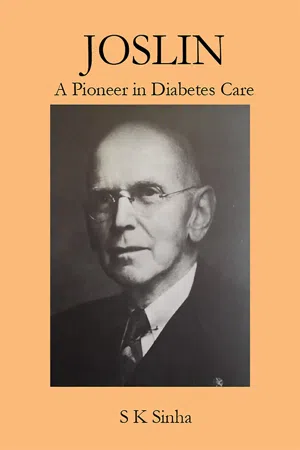
Joslin A Pioneer in Diabetes Care
Information
Topic
MedicineSubtopic
Education BiographiesPart 1.
History and Ancestry
The Gallows of Salem an Inauspicious Beginning?
On the 19th of August 1692, in Salem, a small town in Massachusetts, John Proctor, the thrice-married father of 17, known for his robust physique and firm adherence to Puritan principles, was sent to the gallows.
His crime?
Supporting his wife who had been found guilty of witchcraft during the infamous Salem witch trials. Her sentence was suspended because she was expecting a child. Inexplicably, she escaped punishment, even though the death sentence for witchcraft was not abolished till 4 months after she had given birth.
The child she bore was a son, and even though she had remarried shortly after John Proctor was hanged – remember there were seventeen mouths to feed- she called him John Proctor 2nd, thus continuing the Proctor lineage.
One hundred and seventy seven years later, another Proctor woman was to give birth to a male child.
On 6 June 1869 Sarah Emerson Waters Proctor, the second wife of Allen Lafayette Joslin, a shoe store owner in Oxford, Massachusetts, produced the child who would be the first in his generation of the Joslins to carry the Proctor lineage.
They called him Elliott Proctor Joslin.
A Country Upbringing
Joslin was the youngest in a family of three children. Allen Lafayette Joslin had two children from a previous marriage. The eldest, a girl, Ada was 9 and the second, a son Homer was 7 years old. Joslin was the only surviving child of Allen Joslin’s second wife, Sarah Proctor Joslin.
The families on both sides of Joslin’s parents played important roles in his upbringing, especially in his formative years.
Also important was the influence of Joslin’s birthplace, Oxford. A small town with a population of about 2000, it remained a focus for him throughout his life. Barnett attributes Joslin’s fondness for agrarian metaphors to his early formative years in Oxford where farming, agriculture and cottage industries were the main enterprises.
The importance of the history of New England was stressed on the children of the Joslin family, especially by Joslin’s mother. It is therefore pertinent to review some aspects of the history of the English settlers in the New World, especially their turbulent beginnings in an isolated village some 60 miles from Boston. This village later came to be known as Oxford.
Historical Background: Arrival of the English in the New World
The American flag is dominated by stars and stripes. 13 stripes occupy the largest area. The founding of the American nation began with the struggles of the original thirteen colonies represented by the stripes. Their story has never been forgotten.
“A country without memory is a country of mad men.” George Santayana.
The earliest white settlement in the north-eastern United States dates back to the early to mid-1600s with the arrival of English settlers and French Huguenots. However, English explorers had ventured into the New World even earlier. One of the best known was John Smith who founded Jamestown. Smith is also credited with giving the name, New England to the north-eastern part of America.
The English presence in the New World can be traced to 10 April 1606, when King James 1st of England granted a charter to the London and Plymouth Virginia Company, to establish trading relationships in the New World. In actual fact, this was a licence to engage in aggressive land acquisition.The following year, 1607, John Smith, previously known for his acts of piracy, but at that time employed by the Plymouth Virginia Company, founded James Fort. This was the first permanent British settlement in North America. Later James Fort became known as Jamestown.
Smith carried out important explorations in North America, mainly Chesapeake Bay and Potomac and Rappahannock Rivers. Skilled in cartography, he made detailed and accurate maps of the area, including locations of various Indian villages. In 1608 he was elected President of the colony. He introduced regulations which brought about an orderly settlement by the English. One regulation which is often quoted included a clause “… He that will not work shall not eat.” An effective administrator, Smith kept the Fort in good repair. He encouraged cultivation of the land and a reliable supply of safe drinking water by having a well dug. Trees were cut for clapboard which, together with other products such as pitch, tar, and soap, was shipped back to England.
Importantly, Smith also kept a well - drilled and equipped army which ensured peace, as Chief Powhaton, the leader of the predominant local tribe which Smith had defeated, feared English weapons. At the same time, the vanquished warrior harboured secret hopes that by maintaining cordial relations with the resident English administrator, he might acquire modern weapons with which he could subjugate other Indian tribes, thus increasing his own wealth and power.
Smith was recalled to London in 1615 and reassigned to different duties. He never returned to America. Relations between the local Indian tribes and the English were never maintained with the same care and diplomacy as in his time. Isolated incidents of thieving and looting led to a gradual deterioration of the comparatively harmonious working relationship established by the first president.
The violent confrontations which are part of Oxford’s early history had their beginnings in several full-scale armed conflicts in the early years of the English presence in New England. Two of the most notable engagements were the Pequot War, 1636-1638, and King Philip’s War, 1675–1678.
The Pequots, who were the dominant tribe at that time, having subjugated other tribes, engaged in armed conflict with colonists from Massachusetts Bay, Plymouth and Saybrook together with their native allies from the Narragansett and Mohegan tribes for over two years. Although they were defeated by the colonists, the resentment felt by the Indians continued to simmer and an even more bloody conflict followed several decades later. This was King Philip’s War.
Perhaps the most widely known and recorded, King Philip’s War, which took place in the New England area, has been referred to as “the bloodiest war in American history on a per capita basis.” It left 5000 inhabitants of New England dead, three quarters of that number being Indians. In terms of the percentage of the population killed, King Philip’s War led to the death of twice as many soldiers as the American Civil War and seven times more than the American Revolution.
Led by their Chief Metacom, (dubbed Philip by the English), the settlers were confronted by skilled Indian warriors. Fierce and crafty himself, Metacom, who was worshipped by his soldiers, inflicted heavy losses on the intruders. It was only through a plot hatched by a wily English officer, who bribed an Indian warrior to betray his leader, that Metacom was ambushed and killed by the traitor. The English beheaded the Indian leader, whose body was then drawn and quartered. The captors celebrated their victory by triumphantly displaying his head on a stake in Plymouth. The lingering resentment caused by this incident would continue to reverberate through the Indian community, leading to an uneasy relationship between the indigenous people and the new settlers for decades to come.
New Settlers in New England and the Arrival of Joslin’s Ancestors, the Proctors
The first European settlement in New England was a colony in Plymouth established by 100 Puritans who had travelled on the Mayflower from England, reaching the American shores on a very cold day on 11 November 1620.Although now known as the Pilgrim Fathers, at the time of their arrival, and indeed for the next 200 years, they were called Pilgrims or “old comers”. It was during the Bicentennial Celebrations in 1820 that they were first referred to as “Pilgrim Fathers” in a speech by the well-known politician and orator Daniel Webster, and the term has persisted since.
In 1626, more English immigrants arrived and established another community, this time in Salem, a coastal city in Essex, Massachusetts. The Massachusetts Bay Colony was initially established around two natural harbours and in areas surrounding them in Salem and in Boston. It also included Connecticut, as it covered most of the New England area in the 1630s.
The first John Proctor and his wife Mary and their three year old son, also called John, had arrived in 1635.
Joslin’s strongly Puritanical background can be traced to the very beginnings of the English settlement in New England. The largest group of settlers who arrived during this early period numbered some 20,000. They set about organising their day-to-day lives in their new home in a way which reflected their culture and religion. They elected governors and restricted the electorate to “free men” selected through a thorough examination of the religious views before formal admission to the local church. The Puritans were intolerant of other religious denominations, including Anglicans, Quakers and Baptists.
An important, perhaps the major reason for the decision of some groups of settlers like the pilgrims, to come to the New World was religious freedom. There were, however, other attractions as well, including the possibility of acquiring wealth, the adventure and excitement of exploring a new country, and the prospect of owning land. Thus it is easy to understand the broad mix of interests and priorities which motivated these newcomers to the New World.
Oxford, Its Early History
The history of Oxford has been an abiding interest for its citizens for over 300 years. Successive generations have celebrated its development in its 200- and 250- year anniversaries. The 100-year celebrations were overtaken by the events surrounding the First World War, 1914-18.
Oxford’s earlier years, however, were marked by repeated and protracted disputes with the indigenous dwellers of the area.
First There Were Indians
The indigenous presence in the New World had been a fact of history from the time of Columbus’s discovery in 1492. Whether or not the early settlers had expected to find natives inhabiting their new-found haven is not known. Or had they taken too literally the account of Columbus’s assessment of the natives when, upon his return to Spain, he had reported to Queen Isabella that in his opinion it would not need more than fifty men to subjugate the indigenous dwellers?
The Massachusetts History Timeline dates the origins of Indians back to 10,000 BC, the Paleo Indian Era, when the earliest inhabitants dwelt in caves. They were nomadic hunters.
The modern occupation of this part of Massachusetts was by Nipmuc Indians whose current history dates from the early 1600s before the arrival of white settlers. Today’s Oxford occupies the middle of the territory then known as Nipmuc or Nipmuck or Nepmug country. Within the territory close to the actual location of Oxford was a settlement originally called Mauchaug.
The nomadic lifestyle of the Indians had stood the test of time. When the new settlers arrived, the temporary dwellings of the Indians dotted the region. The camps were usually located on the plain, which, judging by the luxuriant vegetation, had rich soil, especially in the south-eastern region.
George F Daniels’ book on the history of the town includes geographic and botanical details as existed towards the end of the 1800s.
“Its natural attributes are varied and rich, it is full of streams supporting a wide variety of fish, and it has natural ponds, hills, and meadows. There are cedar swamps which yield wood and timber useful for the construction of fences and production of clapboard, shingles and coopers’ materials for making casks, buckets, and barrels as well as a special container called Hogshead, which was used to ship large quantities of tobacco from the colonies to England.Cedar swamps, useful for providing ‘fencing stuff’, and meadows were allotted to settlers.”
The soil in the town area was rich enough to support grazing while the plains had a warm alluvial soil easily cultivated to produce farm products, including garden vegetables and grapes, strawberries, and other small fruit.
According to the beautifully descriptive report on this area of New England in 1890 by Nason and Varney, “nearly a third of the town area is forested mostly with oak, chestnut, pine and maple.” The quality of its soil is praised again as supporting “numerous apple trees, and blueberries, huckleberries, strawberries and cranberries, being a source of more than usual profit.”
The river flowing southward through the basin on which Oxford is situated was an integral part of its early history for both the Indians as well as the new settlers. It was an important route for travel and destination for fishing for the Nipmuck people who lived in the surrounding hills and rode through the plain to their hunting grounds. For the first settlers, the Huguenots, its left bank was favoured as the site on which they built their homes. It is called French River after the early settlers from France.
Harsh Realities: The Huguenot Experience in the New World
Although the English had come to New England earlier and, as already noted, had acquired land in Oxford, they did not physically occupy the territory. The first people to actually settle in Oxford were Huguenots who arrived in Oxford in the summer and autumn of the 1686. They had been driven out of France by the Edict of Nantes which revoked a previous royal decree granting them religious freedom. Their reputation for craftsmanship and industriousness was well-known. The English owners of the land in Oxford, keen to avail themselves of the opportunity to enlist the services of the talented newcomers, welcomed them with a generous offer. They arranged a grant of land for the Huguenots to build homes as well as other structures needed by their community. The original grant of 2500 acres was given to Gabriel Bannon. This parcel of land was situated in the eastern part of the town.
The newcomers who were deeply religious and skilled artisans had a strong work ethic. They built a grist mill, a saw mill, a glove factory, a church and a fort, as well as a garrison house to live in.
After an initial period of harmonious relations with the local Indian tribe, the Nipmucs, the newcomers began to encounter increasing hostility. There were frequent skirmishes as the Indians continued to harass the new settlers, often setting fire to their farms and crops and stealing their stock and household goods.
The Johnson Massacre
In 1696 the Indians attacked the settlement and killed an owner John Johnson and three of his children. His wife, with a child in arms, was carried by a neighbour across the French River to a garrison in Worcester.
For the Huguenots, this was the last straw. The plantation was broken up and the French returned to Boston. After two further attempts at resettling failed, they returned the land granted to them by the owners and settled permanently in Boston.
Some of their descendants returned later or had remained in Oxford. Today they are known as “valuable citizens.” Relics of their habitation in Oxford remain and are preserved for historical interest...
Table of contents
- Cover
- Title
- Copyright
- Dedication
- Contents
- Preface
- Introduction – A Life That Cannot Be Forgotten
- Characters
- Part 1. History and Ancestry
- Part 2. Youngest in the Family
- Part 3. Yale
- Part 4. Harvard
- Part 5. 1897
- Part 6. Elizabeth
- Part 7. Shadows Fall
- Part 8. The Select Band
- Part 9. 1906
- Part 10. Writer
- Part 11. Teacher
- Part 12. War
- Part 13. 1919
- Part 14. Insulin
- Part 15. The Banker
- Part 16. Leadership
- Part 17. Arizona
- Part 18. Triumph
- Part 19. 1959
- Part 20. 1962
- Part 21. 1970
- Part 22. Timeline
- Part 23. Acknowledgements and Sources
- Index of names
Trusted by 375,005 students
Access to over 1.5 million titles for a fair monthly price.
Study more efficiently using our study tools.
Frequently asked questions
Yes, you can cancel anytime from the Subscription tab in your account settings on the Perlego website. Your subscription will stay active until the end of your current billing period. Learn how to cancel your subscription
No, books cannot be downloaded as external files, such as PDFs, for use outside of Perlego. However, you can download books within the Perlego app for offline reading on mobile or tablet. Learn how to download books offline
Perlego offers two plans: Essential and Complete
- Essential is ideal for learners and professionals who enjoy exploring a wide range of subjects. Access the Essential Library with 800,000+ trusted titles and best-sellers across business, personal growth, and the humanities. Includes unlimited reading time and Standard Read Aloud voice.
- Complete: Perfect for advanced learners and researchers needing full, unrestricted access. Unlock 1.5M+ books across hundreds of subjects, including academic and specialized titles. The Complete Plan also includes advanced features like Premium Read Aloud and Research Assistant.
We are an online textbook subscription service, where you can get access to an entire online library for less than the price of a single book per month. With over 1.5 million books across 990+ topics, we’ve got you covered! Learn about our mission
Look out for the read-aloud symbol on your next book to see if you can listen to it. The read-aloud tool reads text aloud for you, highlighting the text as it is being read. You can pause it, speed it up and slow it down. Learn more about Read Aloud
Yes! You can use the Perlego app on both iOS and Android devices to read anytime, anywhere — even offline. Perfect for commutes or when you’re on the go.
Please note we cannot support devices running on iOS 13 and Android 7 or earlier. Learn more about using the app
Please note we cannot support devices running on iOS 13 and Android 7 or earlier. Learn more about using the app
Yes, you can access Joslin A Pioneer in Diabetes Care by S K Sinha in PDF and/or ePUB format, as well as other popular books in Medicine & Education Biographies. We have over 1.5 million books available in our catalogue for you to explore.