
eBook - ePub
Study Skills for Success
How to Learn, Know and Show You're "The Expert"
- English
- ePUB (mobile friendly)
- Available on iOS & Android
eBook - ePub
Information
Topic
ÉducationSubtopic
Formation pour adultesPART I: The Neuroscience of Learning, Simplified
In Part 1, we will cover two things:
- the brain and how it works when we are learning, and
- the stories we can use to help things along.
Then, in Part 2, we cover studying:
- how we study when we are alone, and
- how to study with others.
And finally, in Part 3, we will explore some quick ways to reduce stress and anxiety:
- how to avoid stress and anxiety through preparation, and
- how to alleviate stress and anxiety when you are panicking.
Chapter One: The Brain and How to Use it
“You have power over your mind - not outside events. Realise this, and you will find strength.”(Marcus Aurelius).
As a cognitive neuroscientist, I find your brain fascinating. It’s full of so much potential, and even though it grows all on it’s own, you can nurture it into something truly amazing!
Let’s think of your brain simply as a storage container. How do you get stuff in? You don’t, not without all the other wonderful parts of your body! You use all your senses, even the ones you didn’t realise you had.
Did you know that you have more than 5 senses? Normally, we are born with some ability to see, hear, taste, smell and touch. We also have pheromones, which some scientists think are in the olfactory system (along with smell), but I think the pheromonal system works independently. How do animals know if you’re safe to approach? How do you know if someone likes you? Pheromones.
There are other things that we perceive through other systems too. Do you ever get a “gut feeling”? Our intuition is something that’s with us from early on, but it’s not well-researched. Then there are the things that have plenty of science behind them, like “salience”. Salience is the strength of an experience, like being bitten by a dog, winning a race, dancing with someone you fancy, finding the answer to a difficult problem.
How you feel when you experience something will affect the way your brain stores the information about that experience, too. If you’re scared when a dog jumps up at you and bowls you over, you will feel scared whenever you see dogs.
The point is, if you want to use your brain to help you to study, you will need to know the following (and we’ll talk about it in this book):
- How to get information into your brain – this is called “encoding” (just like computer language).
- How to get information out of your brain – which is called “retrieval”.
- How to make retrieval cues, because getting information out of your brain is easier with more “retrieval cues”.
- How to use more senses and tricks when studying – called “elaborate encoding”: the more retrieval cues you have, the easier retrieval is.
- The more retrieval cues you have, the more doorways into your storage container where your information is being kept.
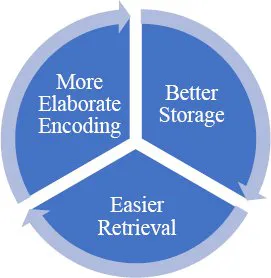
Make “sense”? Think about a house. A simple house will have a front door and maybe a window. It might have a front door with a peep hole, eight windows, a letterbox, and a chimney.
Let’s imagine there is a hallway just inside the front door, and you have a letter for your neighbour on a table in that hallway, but you are outside, here with me. How many ways can you get to the letter in the front hallway? Well, if you’re a regular person like me, you might walk through the door, but if it’s locked and you don’t have a key you might climb in a window. If you’re Santa Claus, you’ll try the chimney. If you’re a fly or a cockroach, you will have many more ways of getting inside the house to find the letter in the hallway.
You need ways to get in. Those ways are the retrieval cues. You need to attach retrieval cues to the information you want to remember, when you encode. The more retrieval cues, the better, because sometimes we forget things when we are stressed. Have you ever been stressed during an exam or a test? That stress can make you forget the one retrieval cue you have, and that’s why it’s good to have more. Make your retrieval cues “elaborate”.
Elaborate Retrieval Cues
Your senses provide you with retrieval cues. Think about some of your favourite childhood memories. Mine include going to our family’s holiday house at Mallabula in Port Stephens. We would go fishing and swimming, splashing around and playing; we would skim across the wet grass in the mornings after high tide would flood the front yard. I have sensory memories attached to these times – the salty scent of the water; the cool dampness of the grass; the slimy skin of the just-caught fish and the sharpness of a dorsal fin as I’d unhook it; the lightly spiced taste of pan-fried fish and the crunchiness of it’s tail. I have good memories!
How many senses have I mentioned? Sight, smell, taste, touch, hearing …. Happy memories help with encoding!
Apparently, I was bitten by our family dog when I was very young, and I grew up with a morbid fear of dogs for most of my life. As much as I don’t remember the experience of being bitten, I remember the fear. And the fear included big dogs, black dogs, and big dogs that were black!
Fear gets stuck in encoding too. But fear can interfere with how correct the encoding is, just as much as it can stop you from being able to encode everything. My fear was always associated with big black dogs, but when I recently found a photo of our dear dog, Nicky, I discovered that he wasn’t all-black, and he was medium-sized. I discovered that I used to lift his tail and examine him, so it is pretty clear he was provoked into defending his personal space!

This is Nicky and me (the baby), with my big sister, Beth.
Doesn’t this dog make you feel secure and happy?
Doesn’t this dog make you feel secure and happy?
Emotions, places, other people, conditions - these are the things of “context”, possibly the biggest of all retrieval cues.
You Tell Me: Is Context the Biggest Retrieval Cue?
So, how you feel when you are studying can be a big retrieval cue. Think about the conditions under which you will be examined. Try to find somewhere relatively private to concentrate on your study so it’s quiet (your room, the library, a quiet park) – it will help you to concentrate, but it will also give you a very important contextual cue – the silence of an exam hall. Get all your summaries down on paper and practise what it will feel like when you are under exam or test conditions.
Many teachers and university professors will provide previous exams so you can learn what to expect; try them out, and get a feel for the timing you will need to complete one question or a whole section of questions. These previous exams are gold!! You can start feeling how it feels when you are being examined! And .. you will have a great idea of what to expect in your exam.
Will you be in a big room with lots of other students, writing your answers with a black pen or pencil? Or, will you be standing in front of a panel, having to recite something or perform?
When you study, try to have the same (or similar) conditions as your examination conditions. Like using a lead pencil. If you are having a driving test, then try to practise driving in many conditions, with one person in the front passenger seat with a clipboard and notes! If you are not allowed to take any food in to the examination room, then don’t snack while studying. And whatever you do, don’t do drugs!
Think about timing too, because your exam will be timed! Some experts will say that multiple choice questions take 60-90 seconds to answer, short answer questions (2-3 lines) are about 2-4 minutes, long answer questions (4-6 lines) are about 5-7 minutes, while extended response (1 page) is 7-12 minutes and an essay is one hour. But the fact is, your teacher or professor will tell you (on the exam question sheet) how long each section should take, so you can practise these timings in your practice exams. If you don’t have the timing from your teacher, then ask!
So, where does music fit in? Some experts suggest that classical music composed by Bach and others, but I believe that if you don’t like this type of music, it will just distract you. The same can be said for music that you love – it won’t help you to focus. If you absolutely need music to drown out the noise around you, then it needs to have no lyrics, for a start.
Music that might help can be from your video game soundtracks – they’re developed to keep a player’s attention on the game, so why not use them for study? Again, if you don’t like that kind of music, it won’t help; and more importantly, playing music might not help you to have the same conditions in study as you would have at test/exam time. It’s your call; see what works for you by trying it out for the smaller tests throughout semester.
Chapter Summary/Key Takeaways
In this chapter, we talked about how brains work, and you learned:
- When encoding information, use retrieval cues from as many senses as possible.
- Find different ways to access your information.
- Your emotions can help or hinder, so note how you feel when you are studying, and reinstate that feeling when you are under exam conditions.
- Your surroundings play a part, too, so try to have similar conditions when studying to the conditions you’ll be under for your exams.
- If you must listen to music, it should have no words...
Table of contents
- Cover
- Copyright
- Contents
- Who, What and Why?
- PART I: The Neuroscience of Learning, Simplified
- PART II: Use It, So You Don’t Lose It!
- Part III: Reducing Stress and Anxiety
- Last Word(s)
- Acknowledgments
- About the Author
- Further Reading
Trusted by 375,005 students
Access to over 1.5 million titles for a fair monthly price.
Study more efficiently using our study tools.
Frequently asked questions
Yes, you can cancel anytime from the Subscription tab in your account settings on the Perlego website. Your subscription will stay active until the end of your current billing period. Learn how to cancel your subscription
No, books cannot be downloaded as external files, such as PDFs, for use outside of Perlego. However, you can download books within the Perlego app for offline reading on mobile or tablet. Learn how to download books offline
Perlego offers two plans: Essential and Complete
- Essential is ideal for learners and professionals who enjoy exploring a wide range of subjects. Access the Essential Library with 800,000+ trusted titles and best-sellers across business, personal growth, and the humanities. Includes unlimited reading time and Standard Read Aloud voice.
- Complete: Perfect for advanced learners and researchers needing full, unrestricted access. Unlock 1.5M+ books across hundreds of subjects, including academic and specialized titles. The Complete Plan also includes advanced features like Premium Read Aloud and Research Assistant.
We are an online textbook subscription service, where you can get access to an entire online library for less than the price of a single book per month. With over 1.5 million books across 990+ topics, we’ve got you covered! Learn about our mission
Look out for the read-aloud symbol on your next book to see if you can listen to it. The read-aloud tool reads text aloud for you, highlighting the text as it is being read. You can pause it, speed it up and slow it down. Learn more about Read Aloud
Yes! You can use the Perlego app on both iOS and Android devices to read anytime, anywhere — even offline. Perfect for commutes or when you’re on the go.
Please note we cannot support devices running on iOS 13 and Android 7 or earlier. Learn more about using the app
Please note we cannot support devices running on iOS 13 and Android 7 or earlier. Learn more about using the app
Yes, you can access Study Skills for Success by Mary-Claire Hanlon in PDF and/or ePUB format, as well as other popular books in Éducation & Formation pour adultes. We have over 1.5 million books available in our catalogue for you to explore.