How Robespierre's career and legacy embody the dangerous contradictions of democracy
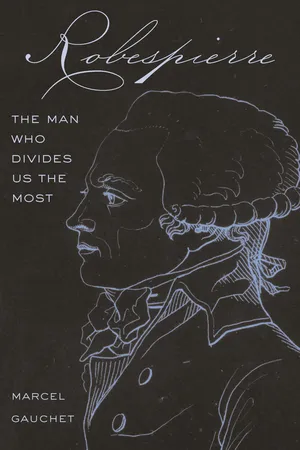
Maximilien Robespierre (1758–1794) is arguably the most controversial and contradictory figure of the French Revolution, inspiring passionate debate like no other protagonist of those dramatic and violent events. The fervor of those who defend Robespierre the "Incorruptible," who championed the rights of the people, is met with revulsion by those who condemn him as the bloodthirsty tyrant who sent people to the guillotine. Marcel Gauchet argues that he was both, embodying the glorious achievement of liberty as well as the excesses that culminated in the Terror.
In much the same way that 1789 and 1793 symbolize the two opposing faces of the French Revolution, Robespierre's contradictions were the contradictions of the revolution itself. Robespierre was its purest incarnation, neither the defender of liberty who fell victim to the corrupting influence of power nor the tyrant who betrayed the principles of the revolution. Gauchet shows how Robespierre's personal transition from opposition to governance was itself an expression of the tragedy inherent in a revolution whose own prophetic ideals were impossible to implement.
This panoramic book tells the story of how the man most associated with the founding of modern French democracy was also the first tyrant of that democracy, and it offers vital lessons for all democracies about the perpetual danger of tyranny.
- 256 pages
- English
- ePUB (mobile friendly)
- Available on iOS & Android
eBook - ePub
About this book
Information
Publisher
Princeton University PressYear
2022Print ISBN
9780691234960
9780691212944
eBook ISBN
9780691234953
Topic
HistoireSubtopic
Biographies politiquesCHAPTER ONE
The Man of the Revolution of the Rights of Man
OF ROBESPIERRE BEFORE THE REVOLUTION, what is there to be said—except that it is futile to look there for insight into the Robespierre of the Revolution?
The thirty-one-year-old lawyer who came to Versailles in the spring of 1789 as a deputy of the Third Estate from Artois in no way stood out from the other representatives of his order. His childhood was rather ordinary for the period; even his unhappiness on being orphaned at an early age was not particularly unusual. He received a sound classical education, studying for twelve years as a brilliant scholarship student at the Collège Louis-Le-Grand in Paris. There followed a respectable career at the bar in Arras, soon marked by a few notable successes, accompanied by a promising start on a literary career, which gave him the opportunity, as a young member of the local academy and a man of the Enlightenment, to take part in the debates of the day. Like so many others, Robespierre was caught up in the excitement surrounding the elections to the Estates General held at the beginning of 1789, but the two polemical booklets he published in this connection, À la nation artésienne sur la nécéssité de réformer les états provinciaux and Les Ennemis de la patrie démasqués par le récit de ce qui s’est passé dans les assemblées du tiers état de la ville d’Arras, were aimed at a local audience. They aroused nothing comparable to the response that Sieyès’s Qu’est-ce que le tiers état? and Pétion’s L’avis aux Français sur le salut de la patrie met with in the National Constituent Assembly. Robespierre was only one of many minor provincial notables among the 1,100 members of the Estates General. Nothing in his career up to that point seemed to mark him out for a leading role in the long-awaited “regeneration” of the kingdom.
The events of 1789 were to reveal Robespierre to himself. It was his destiny to grasp the motive forces of the Revolution better than anyone else, to make himself its spokesman and to reveal its meaning, as it were, to the actors themselves. If there were anything worth searching for in his past, rather than improbable psychological motivations associated with emotional deprivation or social resentment, it would be the roots of his disposition to impersonality, a talent for self-abnegation that allowed him to identify himself wholly and unreservedly with the revolutionary impulse. Several of the traits his biographers commonly mention converge in this direction: a profound moral solitude; the sense of a separate destiny; an indifference to everyday comforts bordering on asceticism; and, not least, the lack of emotional attachment displayed by a chaste bachelor who enjoyed the company of women without feeling a need for them, any more than he sought to cultivate friendships with men. All these things inclined him to devote himself single-mindedly to a noble cause, assuming the burdens of public service without regard for his own personal interest; inclined him, in a word, to self-sacrifice. Even so, the events of 1789 made him another man, as though he had undergone a conversion. Very quickly he grasped the significance of what was taking place. He felt himself to be in the presence of one of “those unique revolutions that mark an era in the history of empires and that decide their destiny,” as he put it that April in Les Ennemis de la patrie. He threw himself into his work on its behalf utterly and completely. He was now determined to live for nothing else until the day he died.
He found himself at once at the forefront of the struggle to win recognition for the “rights of the nation” and the “will of the people,” even if his name was not yet familiar to observers. On 20 June he was the forty-fifth signer of the Tennis Court Oath. Seats in the galleries of the Constituent Assembly, convened on 9 July, were highly coveted in these tumultuous early days. Robespierre’s first reported interventions in parliamentary debate already gave a glimpse of what was to be his constant line and permanent theme, marked in the first place by intransigent opposition to the established authorities: “[W]hat does it matter to us what the ministers say, what the ministers think? It is the will of the people that must be inquired into; the force of the people resides in themselves; it is in the incorruptible probity of their representatives.” It was also marked by a dread of “the unprecedented conspiracy formed against citizens themselves” and a corresponding indulgence of the popular violence that resulted from it (“a few heads chopped off, of course, but the heads of guilty people”). Above all, it was marked by a reverence for principles that needed to be stated as clearly as possible. This became manifest during the debate over the Declaration of the Rights of Man, when Robespierre, speaking with regard to religious liberty and freedom of the press, inveighed against attempts to qualify the expression of these rights in their purest form: “[A]ny restriction, any exception in the exercise of rights must be entrusted to the Constitution. The Declaration of the Rights of Man must be clear, decisive, definitive, and without any modification.”
But it was with the publication of Dire contre le veto royal, an undelivered speech to the National Constituent Assembly that appeared in the form of a booklet in September 1789, that the core of the doctrine that Robespierre was later to tirelessly and unwaveringly defend was fully formulated for the first time. With unsurpassable clarity he expounded a radicalism unaware of its own power, but no less implacable for that, that was to propel the Revolution forward. Robespierre did not attack the monarchy as such. For the time being it was a question, not of challenging it, but of examining what it involved and what retaining it implied. The word, he reminded his readers, “refers solely to a state in which executive power is confided to a single person.” Under a constitutional monarchy, the duty of the executive is to apply the laws through which a nation governs itself—laws that are the expression of the general will, which in a large nation must be expressed through its representatives. Consequently, to grant a veto power of any sort to the executive means that “the man appointed by the nation to execute the nation’s will has the right to thwart and fetter the wills of the nation,” which is to say that “the nation is nothing and that one man is everything.” For Robespierre, this was abhorrent. He could not bring himself to accept the tactical resignation of those “very good citizens” among his colleagues who voted to approve a temporary (or “suspensive”) veto as a lesser evil by comparison with an absolute veto, knowing that they constituted a minority in the Assembly. For his part, he declared, he felt that “it was not good to compromise with liberty, with justice, with reason, and that an unshakable courage, an inviolable fidelity to great principles was the only resource suited to the current situation of the defenders of the people.” With these words his persona was fixed.
The manner in which Robespierre justified his position makes it possible to discover the fundamental proposition that was to determine both the course of the Revolution and Robespierre’s career within it, inasmuch as he identified the two things. One cannot help but be struck, in hindsight, by the blindness of the self-proclaimed patriots for whom Robespierre spoke to the implications of the premises from which they argued. If in fact, as he wrote, governments are established only by and for the people, so “that all those who govern, and therefore kings themselves, are only the agents and delegates of the people,” what then was left of royalty in the usual sense? For in that case it had been wholly emptied of its spirit—the supernatural unction and continuity of tradition. Robespierre’s statement of basic principle therefore led directly to a republic. But this was not yet understood; for the moment, the very idea remained outside the realm of the thinkable. The force of monarchical heritage in France was sufficiently great to sustain the illusion that accommodation was possible. One could still cling to the fiction, at this stage, that it was only a question of redefining the basic assumptions of government and the attributions of its various powers by reconciling the ancient prerogatives of royalty with modern law. On this point Robespierre could quote his favorite author, the “divine” Rousseau, who had made the case in the Contrat social (1762) for joining a popularly elected legislature to a monarchical executive. Robespierre himself long persevered in this conviction, as we will see, until finally events exposed him to the charge of being a halfhearted republican. He was, in his way, a moderate. He did not by any means envisage the total overthrow of established institutions. In this, his thinking reflected the ambiguity of the circumstances under which the revolutionary experiment was first conceived. His apparent moderation, in calling only for reform of the ancien régime, nonetheless contained the seeds of the utter destruction of an entire society and system of government. In September 1789, unbeknownst to himself, Robespierre was the bearer of an explosive radicalism.
Once the dissident assertion of a will to provide France with a Constitution was amplified by the popular uprising in Paris and the storming of the Bastille in July, to say nothing of the rage that mounted throughout the country with each passing day, the logic of the situation imparted a spiraling momentum to events. The Constituent Assembly, established on 9 July, faced a problem of legitimacy. The self-declared metamorphosis of the deputies of the Estates General into representatives of the nation had not gone uncontested. A defense of this change of institutional identity, in response to the complaint that the task this body had set for itself went beyond the mandate that had been confided to officials elected in accordance with rules laid down by the ancien régime—namely, to communicate the grievances of their orders and their communities—takes up a considerable part of Robespierre’s text. How could so substantial a work as a Constitution, he asked, be “the result simply of individual opinions that the representatives [commissaires] of local assemblies throughout the land [assemblées bailliagères] have written down in informal registers, composed in haste?” The remedy for this unsatisfactory state of affairs could only be an appeal to the primary truths concerning society and the aims of political association enunciated in the Declaration of the Rights of Man and of the Citizen. In taking cover behind this document, Robespierre’s colleagues caused the precariousness of their position to be overlooked, while appointing themselves as its interpreters, in order to extract from it, by reasoning alone, a Constitution in complete conformity with natural law. Faced with the uninterrupted force of royal authority, which no one then disputed, reference to the rights of man furnished the Assembly with an independent and higher source of legitimacy.
In this way a weakness was converted into a strength—a far greater one, in fact, than the deputies themselves imagined at the time. A few of them did perceive, however, that the nature of the mission they were entrusted with carrying out had changed. They had been elected to patch up the decayed monarchical edifice; but now “a revolution as marvelous as it was unforeseen,” as Robespierre put it, which promised to give back to the people “all the inviolable rights of which they had been deprived,” suddenly placed them in a position to refashion the old system from top to bottom. It was no longer a question of being content with correcting a few flagrant abuses or of “slavishly copying” the example of England and its institutions, “born in times of ignorance.” Instead the Constitution needing to be devised could be nothing less than “the masterpiece of the leading lights of this century” and “a model for Europe.” Just as the work of the Constituent Assembly had begun to gather a self-sustaining momentum, what was at stake had become vastly enlarged. A marvelous and unforeseen revolution had become the Revolution of the Rights of Man, with Robespierre as its foremost exegete.
The fierce competition for legitimacy between the king and an Assembly basing itself on rights was the driving force of the Revolution in its earliest phase. The virulence of the debate over the royal veto makes this clear. For it was not a matter simply of converting a de facto power into a de jure power. It was a matter of embedding in the immense legitimacy, both historical and sacral, that the royal government continued to enjoy an ahistorical and desacralized legitimacy—though no one yet detected the contradiction between them, so massively did the abiding prestige of the former outweigh the rationalist charms of the latter. Even the most resolute defenders of the rights of the nation were under no illusion as to the monarchy’s advantages. They could not imagine anything other than a negotiated settlement between the existing authority and the new one that was now emerging.
Paradoxically, it was the initial timidity of the French Revolution that gave rise to the extremism of its later phase. The perceived impossibility of attacking royal power head-on forced the revolutionaries to adopt a strategy of indirection that was to prove to be much more subversive. Instead of challenging the government on grounds of principle, something that was then still inconceivable, they sought to undermine it. A feeling of inferiority in relation to so formidable a power led them to try to create a countervailing force in the hope of wresting concessions from the monarchy. They found this force in the form of a popular movement whose vital usefulness was to provide a reason over and over again to excuse its excesses. Through a relentless determination to work out the implications of a logic of rights, they managed in spite of themselves to destroy the monarchy—and with it, the foundations of the old order—so completely that they found themselves confronted with the colossal task, likewise unanticipated, of having to establish a new system of government. Robespierre is the most striking personification of this dynamic.
The imbalance of power underlying the struggle between rival legitimacies was to have the greatest consequences, as much in the real world as in the realm of symbolism, for the revolutionaries’ conception of democratic government. It pushed them to look for a practical way, in keeping with the theoretical implications of a doctrine of rights, to more or less entirely subordinate executive power to the will of the people. Under the pressure of events, this prevented them from soberly considering the nature of executive power and its proper functioning, something that Necker only got around to doing several years later in Du pouvoir exécutif dans les grands États (1792). The revolutionaries were always inclined to see it as a potential danger against which no precautions were too great—a conviction that was to leave a lasting mark on republican thinking in France, well beyond the Revolution. Robespierre is once again typical in this regard. His dread of conspiracies was equaled only by his dread of abuses of executive power, which furnished him with one of his strongest arguments against the royal veto. Possible abuses of legislative power count for very little, he held, when they are weighed against the means available to “[a] monarch cloaked in enormous power, who has at his disposal armies, tribunals, the police forces of a great nation.” Was it not rather this power that an authentic government of the people ought to be concerned above all to limit and monitor? To his mind, the question answered itself.
Robespierre’s protest against the royal veto—to which, again with the benefit of hindsight, we are able to attribute a prefigurative significance—seems to have passed almost unnoticed in the flood of opinions, articles, and booklets inspired by debate in the Assembly. But when Robespierre rose to speak on the subject of the king’s acceptance of the Declaration of the Rights of Man, on 5 October, his main purpose was to draw attention to himself. If he provoked “murmurs” from some deputies, according to newspaper reports, he was “heartily applauded” by others. He seized the opportunity to vigorously affirm the ideas that he had developed earlier in his Dire contre le veto royal: “No authority is entitled to raise itself above a nation. No authority that emanates from the nation is entitled to censure a Constitution it gives to itself.” His vehement rejoinder to the king’s qualified approval of the Declaration of the Rights of Man is revelatory. “We are told that the principles of the Declaration are approved in principle; but we are told that they admit of different applications. This again is a great mistake. These are principles of justice, of natural law, that no human law can alter.… How could we wrongly apply them?” Here we have a glimpse of his axiomatic view of constitutional government. Given the premises, the consequences inexorably follow, so long as the reasoning is sound and uncontaminated by parasitic considerations. This is what makes the result irrefutable—and what a Constitution must assure.
The fifth of October was also the day that the women’s march on Versailles forced the king and the Assembly to return to Paris, decisively changing the conditions of parliamentary debate. Removed from the hermetic atmosphere of Versailles, the Assembly’s deliberations were henceforth to unfold under the immediate influence of popular feeling and in direct contact with the seething anger of the streets. This month of October was the moment when Robespierre first came into full public view, resolved to persist in the line of conduct that he had set for himself and from which he was never to deviate. Circumstances gave him the occasion to develop two themes that were to form the basis of his future popularity: hostility to martial law and rejection of any rule of suffrage based on tax qualification.
Bread shortages in Paris sparked protests and fueled rumors that speculators and monopolists were responsible for the growing famine and increasingly uncontrollable violence. One unfortunate baker was summarily hanged and decapitated. The Commune of Paris asked the Assembly to provide it with the means of reestablishing order: martial law, bread, and soldiers. Armed force was authorized in order to disperse the crowds. Robespierre, one of the few who opposed the measure, was emphatic in his dissent. To adopt martial law, he argued, amounted to saying that “the people are in revolt, they have no bread, we do not have any, they must be sacrificed.” The alternative he proposed was to “go back to the cause of the disturbances.” Behind this wave of discontent, he suspected, were people who foresaw it, perhaps even stirred it up, and who in any case counted on being able to turn it against the revolutionary movement. Stamping out “this formidable conspiracy against the safety of the state” required creating a permanent tribunal within the Assembly itself—charged with judging “crimes committed against the nation”—in order to hunt down the plotters. In the event, Robespierre’s proposal came to nothing. But in it we can see the advent of one of the driving forces of the Revolution, which Robespierre, more than anyone else, orchestrated, namely, a delusional overestimation of the strength of the opposition to the Revolution. This had two corollaries: an underestimation of real difficulties and an unshakable belief in the necessity of resorting to ever more drastic measures in order to combat the extraordinary power of these dark enemies.
On 22 October, the question of the right to vote was placed on the day’s agenda for debate on the Constitution. The Constitutional Committee of the Assembly recommended that it be reserved to citizens paying direct taxes equivalent to the...
Table of contents
- Cover Page
- Title Page
- Copyright Page
- Contents
- Foreword by David A. Bell and Hugo Drochon
- Preface
- Introduction: The Incorruptible and the Tyrant
- Chapter 1: The Man of the Revolution of the Rights of Man
- Chapter 2: I, the People
- Chapter 3: From the Authority of Principles to the Struggle for Power
- Chapter 4: Governing the Revolution: The Rule and the Exception
- Chapter 5: Governing the Revolution: The Undiscoverable Foundation
- Chapter 6: The Two Faces of the Revolution and Its Legacy
- Further Reading
- Index
Trusted by 375,005 students
Access to over 1.5 million titles for a fair monthly price.
Study more efficiently using our study tools.
Frequently asked questions
Yes, you can cancel anytime from the Subscription tab in your account settings on the Perlego website. Your subscription will stay active until the end of your current billing period. Learn how to cancel your subscription
No, books cannot be downloaded as external files, such as PDFs, for use outside of Perlego. However, you can download books within the Perlego app for offline reading on mobile or tablet. Learn how to download books offline
Perlego offers two plans: Essential and Complete
- Essential is ideal for learners and professionals who enjoy exploring a wide range of subjects. Access the Essential Library with 800,000+ trusted titles and best-sellers across business, personal growth, and the humanities. Includes unlimited reading time and Standard Read Aloud voice.
- Complete: Perfect for advanced learners and researchers needing full, unrestricted access. Unlock 1.5M+ books across hundreds of subjects, including academic and specialized titles. The Complete Plan also includes advanced features like Premium Read Aloud and Research Assistant.
We are an online textbook subscription service, where you can get access to an entire online library for less than the price of a single book per month. With over 1.5 million books across 990+ topics, we’ve got you covered! Learn about our mission
Look out for the read-aloud symbol on your next book to see if you can listen to it. The read-aloud tool reads text aloud for you, highlighting the text as it is being read. You can pause it, speed it up and slow it down. Learn more about Read Aloud
Yes! You can use the Perlego app on both iOS and Android devices to read anytime, anywhere — even offline. Perfect for commutes or when you’re on the go.
Please note we cannot support devices running on iOS 13 and Android 7 or earlier. Learn more about using the app
Please note we cannot support devices running on iOS 13 and Android 7 or earlier. Learn more about using the app
Yes, you can access Robespierre by Marcel Gauchet, Malcolm DeBevoise in PDF and/or ePUB format, as well as other popular books in Histoire & Biographies politiques. We have over 1.5 million books available in our catalogue for you to explore.