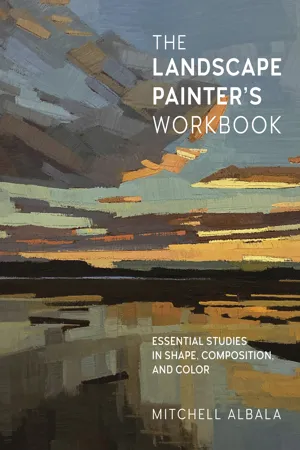
The Landscape Painter's Workbook
eBook - ePub

The Landscape Painter's Workbook

Essential Studies in Shape, Composition, and Color

  1. 176 pages
  2. English
  3. ePUB (mobile friendly)
  4. Available on iOS & Android
eBook - ePub

The Landscape Painter's Workbook

Essential Studies in Shape, Composition, and Color

About this book

The Landscape Painter’s Workbook is the definitive hands-on guide to the time-honored techniques and essential elements of landscape painting.

Written by celebrated landscape artist, instructor, and author Mitchell Albala, this richly informative and beautifully illustrated volume leads you step by step through his approach to the genre, from establishing a composition using basic shapes to applying time-tested color strategies, with all-new lessons, practical exercises, and special topics, including:

  • The Complete Color Strategy. What are the three aspects of color contrast that guide a painting’s strategy?
  • Notan. Explore this special type of compositional study, which identifies the underlying shapes and patterns of a composition.
  • Picture Formats. How does the picture format—horizontal, vertical, or square—affect the composition? What are the pros and cons of each?
  • Color Grouping. A full chapter details this special practice, which helps maintain harmony by organizing colors into a limited number of groups.
  • Composition. An in-depth review of variation, movement, and active negative space, with illustrations that diagram the action in each example.
  • Workshop Exercises. Instead of demonstrations that show how the author paints, The Landscape Painter’s Workbook includes 10 skill-building workshop exercises to help you work through essential lessons on your own.


With examples of work by 45 contemporary landscape painters—more than 80 paintings in all—​in oil, acrylic, pastel, and watercolor, the lessons are suitable for all mediums. Each painting is thoroughly analyzed in terms of shape, composition, or color, with supporting diagrams, thumbnails, and photographs.

The Landscape Painter’s Workbook inspires and informs all artists, from aspiring to accomplished, on how to successfully portray the majesty and subtlety of the natural world.

The For Artists series expertly guides and instructs artists at all skill levels who want to develop their classical drawing and painting skills and create realistic and representational art.

Frequently asked questions

Yes, you can cancel anytime from the Subscription tab in your account settings on the Perlego website. Your subscription will stay active until the end of your current billing period. Learn how to cancel your subscription.
No, books cannot be downloaded as external files, such as PDFs, for use outside of Perlego. However, you can download books within the Perlego app for offline reading on mobile or tablet. Learn more here.
Perlego offers two plans: Essential and Complete
  • Essential is ideal for learners and professionals who enjoy exploring a wide range of subjects. Access the Essential Library with 800,000+ trusted titles and best-sellers across business, personal growth, and the humanities. Includes unlimited reading time and Standard Read Aloud voice.
  • Complete: Perfect for advanced learners and researchers needing full, unrestricted access. Unlock 1.4M+ books across hundreds of subjects, including academic and specialized titles. The Complete Plan also includes advanced features like Premium Read Aloud and Research Assistant.
Both plans are available with monthly, semester, or annual billing cycles.
We are an online textbook subscription service, where you can get access to an entire online library for less than the price of a single book per month. With over 1 million books across 1000+ topics, we’ve got you covered! Learn more here.
Look out for the read-aloud symbol on your next book to see if you can listen to it. The read-aloud tool reads text aloud for you, highlighting the text as it is being read. You can pause it, speed it up and slow it down. Learn more here.
Yes! You can use the Perlego app on both iOS or Android devices to read anytime, anywhere — even offline. Perfect for commutes or when you’re on the go.
Please note we cannot support devices running on iOS 13 and Android 7 or earlier. Learn more about using the app.
Yes, you can access The Landscape Painter's Workbook by Mitchell Albala in PDF and/or ePUB format, as well as other popular books in Art & Art General. We have over one million books available in our catalogue for you to explore.

Information

eBook ISBN
9780760371367
Topic
Art
Subtopic
Art General

1

SHAPE INTERPRETATION

One of the recurring themes throughout this book is that landscape painting is an art of interpretation. Our goal is not to reproduce what we see exactly as we see it. Rather, all we observe—every color, shape, and detail—is filtered through an interpretive lens. The painting we produce may resemble a landscape, but is now a painting, a unique interpretation of the world in its own visual language. This process of translation is never more demanding than when trying to interpret the landscape at its most fundamental level: shape.
Nature is terribly complex. It has innumerable shapes, from the minute to the monumental, and in its raw, unedited state, can seem quite overwhelming. The key to translating all this into a painting is not to capture every bit of it but to reduce it into a simpler set of shapes and masses. This is the landscape painter’s first and most important task. Remarkably, this reductionist approach doesn’t detract from the overall impression—it enhances the painting, making it more comprehensible to the viewer.
image
Hester Berry, Bosley Mere
Oil on board, 12" × 8½" | 30.5 × 21.5 cm
A landscape painter’s first and most important task is to reduce nature’s vastness and complexity into clearer, more visually concise shapes. Each of Berry’s expressive brushstrokes is a distinct shape, defined from adjacent strokes through value and color differences.

A REDUCTIONIST APPROACH TO SHAPE

When we observe the natural world, in all its depth and breadth, we are able to apprehend its many values and colors, and all its parts and pieces, with no thought at all. Trying to paint that subject, however, requires us to look through a different visual lens. To convert such an overwhelming amount of information into the language of painting, we must begin to see the subject in simpler terms.
Every painting, even a complicated one, has a foundation that is built upon simplified shapes. Yet, this isn’t necessarily what we see first. We are distracted by a sea of details, colors, and narrative content. To simplify, we have to see through all the layers of complexity and busyness. We have to interpret and extrapolate.
Our goal isn’t to include everything we see, but to know what to leave out. One of the most satisfying “ah-ha!” moments a painter can experience is when they discover that a simplified picture structure captures the essence of a subject more effectively than small parts and details.
REDUCTIONISM
Reductionism is an approach used in many disciplines, from biology to philosophy. In a reductionist approach, one attempts to explain complex ideas by reducing them to more fundamental ones. This is precisely what landscape painters do when they try to reduce the landscape’s myriad forms into more simplified shapes and patterns.
image
A LESSON IN REDUCTIONISM
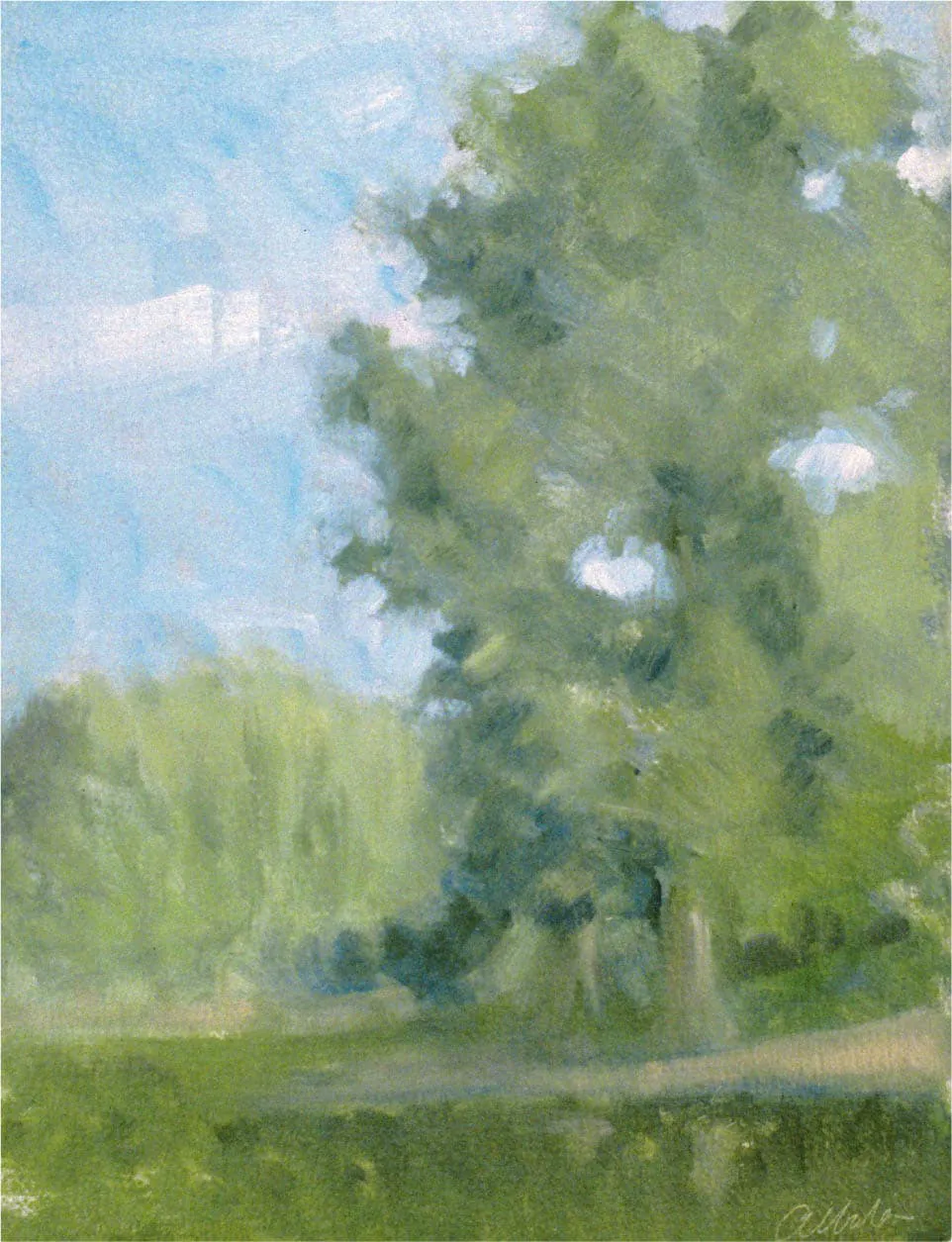
Mitchell Albala, First Easel
Oil on paper, 12" × 9" | 30.5 × 23 cm
One of my formative lessons in painting took place many years ago in New York City’s Central Park. I had just bought my first French easel. On my first day, after an hour or so, I had lost my way and disappointment was setting in. The shapes were spotty and the tree unconvincing. With a few furious strokes of the rag, I wiped out the painting. To my surprise, the hazy image that remained was a great improvement. My overworked and spotty tree had been consolidated into a more simplified mass. The frustrated wipes of my rag turned out to be the best strokes in my painting.
image
Frank Hobbs, Augusta County, VA, Near Staunton, Winter
Oil on canvas, 18" × 24" | 46 × 61 cm
Through a simplified approach, the whole truly becomes greater than the sum of its parts. Hobbs’ Augusta County is composed of just a few major shapes: the sky, the background hill, and the foreground tree and shadow. Smaller elements, like the trees in the background and the grasses in the foreground, are only hinted at. “We know that a tree is composed of millions of tiny leaves and branches,” Hobbs writes. “This knowledge alone nearly overwhelms us. Luckily, the eye is more intelligent than the mind, and in the end, it’s the eye that enables the painter to sift out the essential masses of nature into something that actually makes sense on the canvas.” (Also see Hobbs’ simplified shape painting on this page).
PLAYING WELL TOGETHER: SIMPLIFIED SHAPES AND DETAIL
When those new to landscape painting hear how much simplification is stressed, they are quick to ask, “What about the details?” Details play an important role in landscape painting. They have great descriptive potential and often hold information that is essential to the visual story. Leading with simplified shapes does not mean the exclusion of detail, however. Detail and simplified shapes can ...

Table of contents

  1. Cover
  2. Title Page
  3. Contents
  4. Introduction
  5. 1 Shape Interpretation
  6. 2 The Picture Window and its Format
  7. 3 Composition in Action
  8. 4 Notan and the Compositional Study
  9. 5 Color Precepts, Color Paradoxes
  10. 6 The Complete Color Strategy
  11. 7 Color Grouping
  12. 8 Palette Strategies
  13. Parting Thoughts: The Never-Ending Inquiry
  14. Resources
  15. Contributing Artists
  16. Acknowledgments
  17. About the Author
  18. Index
  19. Dedication
  20. Copyright