eBook - ePub
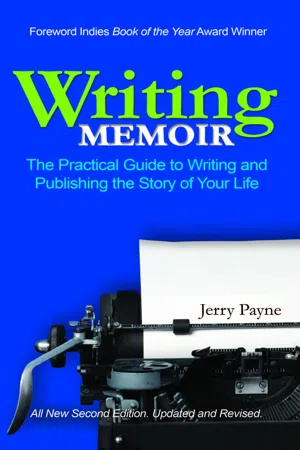
Writing Memoir
The Practical Guide to Writing and Publishing the Story of Your Life
- English
- ePUB (mobile friendly)
- Available on iOS & Android
eBook - ePub
Information
Topic
Lingue e linguisticaSubtopic
Scrittura creativa
ONE
A GOOD REASON TO WRITE
“Writing is easy. All you do is sit down at a typewriter and open a vein.”
People have all manner of reasons for writing a memoir. If you’ve picked up this book, you probably already have your own reasons. Far be it from me to second-guess them. Maybe you’re writing your memoirs because you want some record of your life to survive you after death, a lasting mark that you were here, something your grandkids and potentially your great-great-grandkids might one day read. That’s a good reason. Maybe you’re writing your memoirs because, over the years, you’ve learned some very important things about life that you believe others might be able to benefit from hearing, lessons you learned the hard way. You’ve overcome huge obstacles. Or mistakes. Maybe you have a story of inspiration to share. That’s a good reason, too.
Or maybe you haven’t overcome, and therein lies your story. Yours is a cautionary tale. Maybe you’re writing because you’re trying to make sense of a tragedy. Or maybe you just feel like your life would make more sense somehow if you saw it in print. (Remember the old Eagles song “James Dean”? Dean is imagined as believing that his life would “look all right” if he could just “see it on the silver screen.”)
Maybe by revealing the story of your life, you’ll get some publicity that’ll be good for your business. It’s an advertisement of sorts. Maybe you’re retired and you just want a nice, neat collection of all the successes (and failures?) from your long and storied career. Maybe your story can help advance a social or political cause that’s important to you. Maybe you’ve lived a life you know others are intensely curious about—that of a combat veteran, leader of an outlaw motorcycle gang, circus performer, porn star, drug addict, sports celebrity. Maybe you feel the need to tell your side of a story that someone else has publicly characterized wrongly, maybe even egregiously so.
Maybe you just want people to understand you better.
Maybe you want to understand yourself better.
These are all legitimate reasons, and while ghostwriting thirty or so memoirs, I’ve heard every one of these and more. But that last one...that might be the best reason of all. Maybe you want to understand yourself better. “We do not write in order to be understood,” the English poet Cecil Day-Lewis once said. “We write in order to understand.” No matter what reason you have for writing your memoir, I’ll guarantee one thing: if you write honestly, if you really plumb the depths of your own story, if you seek to tell the account of your life (or some part of your life) as objectively as you can, you’re going to learn something about yourself in the process. Something you never knew before.
“We do not write in order to be understood. We write in order to understand.”
—Cecil Day-Lewis
An Honest Memoir
Know thyself, goes the ancient proverb, and I don’t know of a better way to accomplish that than by examining one’s life with the level of objectivity that’s required to write an honest memoir. This, of course, assumes an honest memoir is the kind of memoir you want to write. Are there other kinds? I imagine a lot of memoirs have been written that weren’t honest. Some were probably written that way intentionally, and some were probably written that way unintentionally. I’m not referring here, of course, to the minor details. We’ll talk in the next chapter about how memory can sometimes fail us (her dress was really blue even though you can swear it was red), or about how it’s okay (sometimes) to fudge a minor point, or how sometimes you might have to conjure up some dialogue that may not be how it went down word for word. Much of this is unavoidable. Rather, the kind of dishonesty I’m referring to here is the kind of dishonesty where the memoirist ends up portraying him or herself as a different person from the one he or she is. We’re not talking about fudging the details. We’re talking about fudging the main character.
There’s a word for a book like that, and that word is fiction. Fiction is a fine thing to write, but fiction is not memoir. Fiction is fiction. Memoir is memoir. We’re not writing novels here. To characterize your piece of fiction as true does a disservice to the reader, and it doesn’t do you any good, either. Memoirs often live and die on their level of authenticity. There’s just something about disingenuous writing that people can see through. It’s hard to mislead or pull off embellishment or produce outright fakery over the course of an entire book. And the moment the reader senses the memoirist isn’t being sincere, the memoirist loses the reader.
Memoirs live and die on their level of authenticity.
In truth, most cases of insincere memoir writing come about unintentionally. Yes, there are memoirs where the author purposely exaggerated the events of his or her life to portray a “better” or more “interesting” person, but most cases of disingenuous writing come about simply because the memoirist hasn’t dug deep enough, perhaps hasn’t thoroughly examined her motivations or the consequences of her actions. The result is, at best, a superficial story; at worst, a phony one. This is often what happens when writers lack a certain level of self-awareness.
Aha!
Self-awareness brings us back to the idea of understanding, of knowing thyself. Here’s where it gets interesting. Writing an honest memoir requires self-awareness, and self-awareness is often the result of writing an honest memoir. It might seem like a catch-22, but it’s not. The writing feeds off the honesty, and the honesty, in turn, feeds off the writing. It’s a beautiful symbiosis. And it is in that symbiosis that you can learn something about yourself, something important, something you never knew before. I’ve never had a single client who, somewhere along the course of writing his or her memoir, didn’t have at least one aha! moment. Something epiphanic always occurs. Something hidden is revealed. Always. And I would submit that it is in that aha! moment (or those aha! moments) that you have every reason you ever need to write a memoir. Trust me on this.
I’ve never had a single client who, somewhere along the course of writing his or her memoir, didn’t have at least one aha! moment.
Here’s an example. I once had a client who overcame a severe weight problem. The book started out as a motivational memoir, centering on how “Tom” lost over two hundred pounds. Kind of a “you can do it, too” book. It was meant to be inspirational but also practical. There was a lot of technical stuff about diet and exercise and good nutrition. But a strange thing happened along the way. During the course of writing a couple of chapters about Tom’s background—his childhood and his adolescence, the times in his life when he really started putting all the weight on that he would eventually lose—Tom started picking up on some psychological patterns. He began connecting some dots that led him to better understand why he had ultimately headed toward obesity in the first place. These discoveries also helped him realize that today, even with all he knows about exercise and nutrition, he still often struggles to keep his eating, and therefore his weight, under control. Tom took a break from the book, and during this time, he sought some professional analysis that helped him identify the very root of his weight problem. Delving into his underlying issues wasn’t easy. But the result, about a year or so later, was a more self-aware person and, once we picked up the project again, a much different, and infinitely better, book.
Your epiphany might not be as life changing. It may, in fact, be small in the grand scheme of your life. That’s okay. It will still be worthwhile. And achieving it obviously doesn’t make the other reasons for writing a memoir invalid. Heck, they may even be better for their respective purposes. Having something your great-great-grandkids may someday want to read is a good enough reason in and of itself. The same goes for writing something that helps your business or summarizes your career or helps your cause. Whatever your motivation is, so long as it’s honest, it’s good enough as far as I’m concerned. You’ll never catch me trying to talk someone out of writing. But know that there’s another reason out there, too, and you may not even grasp its significance until you’ve finished your book. In the end, no matter your motivations, you’re going to be glad you wrote your book because of what you learned about yourself in the process.
Oprah’s Book Club
Okay, so maybe there is one reason I would question that would, in fact, cause me to try to talk you out of writing. If you’re looking to write a memoir because you think your book could be the next great bestseller, the next Educated or Tuesdays with Morrie or The Liars’ Club, I would recommend that you reconsider. If you think you’re going to become wealthy with your book, if you’re thinking Oprah’s Book Club, or if you have visions of attending the Hollywood premier of the film version of your book, I would tell you to please come back down to earth. We’re going to discuss publishing later. For now, suffice it to say that the odds of any of these things happening are slim to the point where you’d probably be better off playing the lottery. I know, I know—but your book is different. Your book is certain to be a bestseller. Believe me, I’ve seen enough great books get passed over, and I know enough about the economics and vagaries of the publishing industry to almost guarantee that your book will not make you a) wealthy or b) a household name. Sorry. That’s just the way it is.
Reality Check: Your book will not make you
a) wealthy or
b) a household name.
This doesn’t mean you can’t get published (or make a profit on your self-published book); it just means that you have to be more realistic and, hopefully, that your motivations for writing don’t include potential fame and money. If you don’t have different motivations, may I at least offer one: the opportunity to learn about yourself?
With all that said, and with your bubble hopefully not burst beyond repair (and maybe even your level of intrigue a little higher with all this talk about epiphanies and understanding), let’s now look a bit further into this idea of writing an honest book.
TWO
YOUR CONTRACT WITH THE READER. YOUR CONTRACT WITH YOURSELF
“A writer’s job is to tell the truth.”
If you’re going to write an honest memoir, maybe we should start by defining what a memoir is—and what it isn’t. As you may guess, the word has a lot to do with the word memory. In fact, it comes to us from the Anglo-French mémorie, meaning memory or remembrance. You often see it or hear it pluralized (“memoirs”) when the writer or speaker ought to have used the singular tense (“memoir”). Not that a person’s memoir won’t include a ton of individual memories, but the plural typically refers to enough memories to recall a person’s entire life, all (or most) of their memories. There’s another word for that kind of book: autobiography. You often hear about a retired general or politician or sports hero or business magnate writing his or her “memoirs.” What they’re doing is writing their life story, their autobiography.
In this case, we typically start by reading about the writer’s childhood and siblings and parents. Sometimes we even go back further in time, to their parents’ lives and their grandparents’ lives and even to the lives of their ancestors. We read about the writer’s schooling and home life and then about his young adulthood and his early influences. Then we read about his career: high points, low points, successes, failures, and all the moments in between. And we read about everything else, even up until the writing of the book itself! If you’re thinking about writing your “memoirs,” your autobiography, that’s okay. If you’re looking to make a record of your life for posterity, go for it. As you’ll see, we’ll be more concerned here with “memoir” than “memoirs,” but the same ideas apply. They just apply over and over again. A memoir plus a memoir plus a memoir (plus however many more) equals memoirs. Told well, each memoir is a story unto itself. There should be an overall storyline (your life) with continuity, but any given memoir therein ou...
Table of contents
- Cover
- Title
- Copyright
- Contents
- Introduction
- Chapter 1 A Good Reason to Write
- Chapter 2 Your Contract with the Reader. Your Contract with Yourself
- Chapter 3 Learning from the Masters
- Chapter 4 The Story of Your Life
- Chapter 5 Theme: Your Connection to the Reader
- Chapter 6 Building Your Birdhouse
- Chapter 7 Writing. Reading. Rewriting
- Chapter 8 Spotting the Weaknesses
- Chapter 9 Fumbling Towards Objectivity
- Chapter 10 Polishing it Up
- Chapter 11 Traditional Publishing
- Chapter 12 Self-Publishing: The Twenty-First Century Way
- Final Thoughts
- Appendix: Your Self-Publishing Checklist
- Acknowledgments
- About the Author
Trusted by 375,005 students
Access to over 1.5 million titles for a fair monthly price.
Study more efficiently using our study tools.
Frequently asked questions
Yes, you can cancel anytime from the Subscription tab in your account settings on the Perlego website. Your subscription will stay active until the end of your current billing period. Learn how to cancel your subscription
No, books cannot be downloaded as external files, such as PDFs, for use outside of Perlego. However, you can download books within the Perlego app for offline reading on mobile or tablet. Learn how to download books offline
Perlego offers two plans: Essential and Complete
- Essential is ideal for learners and professionals who enjoy exploring a wide range of subjects. Access the Essential Library with 800,000+ trusted titles and best-sellers across business, personal growth, and the humanities. Includes unlimited reading time and Standard Read Aloud voice.
- Complete: Perfect for advanced learners and researchers needing full, unrestricted access. Unlock 1.5M+ books across hundreds of subjects, including academic and specialized titles. The Complete Plan also includes advanced features like Premium Read Aloud and Research Assistant.
We are an online textbook subscription service, where you can get access to an entire online library for less than the price of a single book per month. With over 1.5 million books across 990+ topics, we’ve got you covered! Learn about our mission
Look out for the read-aloud symbol on your next book to see if you can listen to it. The read-aloud tool reads text aloud for you, highlighting the text as it is being read. You can pause it, speed it up and slow it down. Learn more about Read Aloud
Yes! You can use the Perlego app on both iOS and Android devices to read anytime, anywhere — even offline. Perfect for commutes or when you’re on the go.
Please note we cannot support devices running on iOS 13 and Android 7 or earlier. Learn more about using the app
Please note we cannot support devices running on iOS 13 and Android 7 or earlier. Learn more about using the app
Yes, you can access Writing Memoir by Jerry Payne in PDF and/or ePUB format, as well as other popular books in Lingue e linguistica & Scrittura creativa. We have over 1.5 million books available in our catalogue for you to explore.