- English
- ePUB (mobile friendly)
- Available on iOS & Android
eBook - ePub
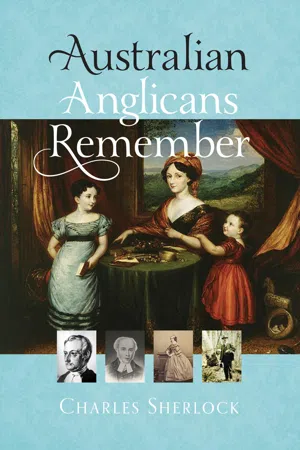
Australian Anglicans Remember
Information
Topic
Theology & ReligionSubtopic
Religious BiographiesJanuary 1: The Naming and Circumcision of Jesus
The Circumcision of Christ in BCP.
The Naming and Circumcision of our Lord Jesus Christ in AAPB.
The Naming and Circumcision of our Lord Jesus Christ in AAPB.
Why was the incarnate Word circumcised and named ‘Jesus’?
The naming and circumcision of a boy went together in Israel of old, a linking of particular significance for understanding the life and ministry of the Lord Jesus Christ.
In biblical times a person’s name said a lot about his/her character. So Isaac meant ‘laughing boy’, Sarai meant ‘princess’, and Jonathan and Elnathan meant ‘gift of God’. A change of name had considerable significance: thus Jacob meaning ‘trickster’ became Israel meaning ‘God-strengthened’ and Simon became Peter meaning ‘rock’.
Circumcision was the way by which a male infant, or a man joining Israel, was marked as belonging to the covenant that the Lord established with Abraham (Genesis 17:9–14; ). For a boy it was also when they received their name (cf Genesis 21:3–4). Jesus — the Greek transliteration of the Hebrew Joshua — means ‘rescuer, saviour’, marking him as one through whom God’s people would be saved from their sins (so Matthew 1:21).
Circumcision was a bodily sign that men of God rejected the phallic-centred, fertility-focused ways of life that predominated in the wider world. All Israel was called to ‘circumcise the foreskin of your hearts’ (Deuteronomy 10:16; Jeremiah 4:4), to live in accordance with the spirit of God’s law. This law provided that each male born into Israel would be circumcised on the eighth day (Leviticus 12:3) — a date which hinted at the boy beginning to take part in God’s new creation (cf Exodus 22:18–19; Leviticus 14:10, 23; 22:27).
Jesus was named and circumcised on the eighth day (Luke 2:21), thus marking him as a member of Israel, a Jewish male. Interestingly, his circumcision is the only direct evidence in the New Testament that he was male: apart from Ephesians 4:13 (aner, of the ascended Christ) he is elsewhere always referred to as ‘human’ (anthropos), most notably in the phrase ‘son of anthropos’.
A major question faced by the early Church was what to require of uncircumcised men — Gentiles — who responded to the Gospel. Despite the teaching of Genesis, the first Church Council, held in Jerusalem around 49AD, decided that this was not necessary, provided that such converts behaved in ways that did not breach Christian solidarity (Acts 15:1–29).
The apostle Paul in particular argued that requiring anything beyond faith in Christ — itself the gift of the Holy Spirit — contradicted the gospel of God’s free grace (cf Galatians 2–3). Christ’s ultimate ‘circumcision’ was his bloody death, which gained forgiveness for all — Jew or Gentile, slave or free, male and female (Galatians 3:28). Further, the abolition of the requirement of circumcision not only allowed Gentiles to enter God’s people directly, but also removed any barriers to women being in Christ together with men. Its spiritual significance remains, however: as Christ taught,” it is from the heart that all evils come” (Mark 7:21), so that believers need to continually cut off all ungodly thoughts and set their minds on what is true, good and worthwhile (Philippians 4:8).
Christ’s obedience saw his ministry transcend the cross, being raised by God to be the first fruits of the new creation, receiving the divine, unknowable Name (cf Exodus 3:13–17), marking him as Lord of all. As Paul wrote to the Philippians (2:9–11):
Therefore God also highly exalted him and gave him the name that is above every name, so that at the name of Jesus every knee should bend, in heaven and on earth and under the earth, and every tongue should confess that Jesus Christ is Lord, to the glory of God the Father.
This is the Name through whom we pray (John 14:13–14; 15:16; 16:23–26) and have eternal life (John 1:12; 20:31), the Name in which the apostles healed and preached (Acts 3:1–15).
‘The Naming and Circumcision of Jesus’ not only marks his entry into God’s people, but points to his opening the new creation to all believers through his atoning death — his ‘circumcision’ — for the sins of the whole world, from which God raised him to be Lord.
Resources for liturgical use
Service introduction
Christian faith looks to the blood of Jesus for healing — blood first shed when he was circumcised on the first day of his second week and named Jesus, that is, ‘saviour’. This is the Name through whom we pray, have eternal life, the Name in which the apostles healed and preached.
Sentences
God spoke of old by the prophets, but in these last days has spoken to us by a Son.
Hebrews 1:1–2
The angel said to Joseph, “The child conceived in Mary is from the Holy Spirit. She will bear a son, and you are to name him Jesus, for he will save his people from their sins.”
Matthew 1:20–21
Prayer of the day
God our Father,
you gave to your incarnate Son the name of Jesus
to be a sign of our salvation.
May every tongue confess
that he, who for our sake became obedient to the law,
is both Lord and Christ,
to your eternal glory;
for he now lives and reigns with you and the Holy Spirit,
one God, for ever and ever. Amen.
or
Christ our brother,
in you there is neither Jew nor Gentile,
neither male nor female,
yet you received the mark of the covenant,
and took upon yourself
the precious burden of the law.
May we so accept in our bodies
our own particular struggle and promise,
that we also may break down barriers,
in your name. Amen.
Readings
| Year One (daily cycle) | |
| Morning Prayer: | Psalm 113 |
| Genesis 17:1–13 | |
| Colossians 3:12–17 | |
| Evening Prayer: | Psalm 113 |
| Exodus 3:13–17 | |
| Colossians 2:8–15 | |
| Year Two (daily cycle) | |
| Morning Prayer: | Psalm 115 |
Table of contents
- Cover
- Title Page
- Copyright Page
- Contents
- Dedication
- Introduction
- January 1: The Naming and Circumcision of Jesus
- January 1: New Year’s Day
- January 2: Eliza Hassall
- January 6: The Epiphany of our Lord
- January 26: Australia Day
- February 3: First Anglican Service on Sydney Cove
- February 20: William Grant Broughton
- March 9: Sister Emma SSA
- March 19: Joseph, husband of the Blessed Virgin Mary
- April 6: Frederic Barker
- April 8: Georgiana Molloy
- April 11: George Augustus Selwyn
- April 25: Anzac Day
- May 27–June 3 Week of Prayer for Reconciliation
- July 1: Coming of the Light
- July 13: Sydney James Kirkby
- August 15: Mary, Mother of our Lord
- September 2: Martyrs of New Guinea
- September 3: Eliza Darling
- September 11: Mother Esther CHN
- September 15: John Oliver Feetham
- September 18: John Ramsden Wollaston
- September 20: John Coleridge Patteson
- November 2: All Souls
- November 25: James Noble
- December 2: Frances Perry
Trusted by 375,005 students
Access to over 1.5 million titles for a fair monthly price.
Study more efficiently using our study tools.
Frequently asked questions
Yes, you can cancel anytime from the Subscription tab in your account settings on the Perlego website. Your subscription will stay active until the end of your current billing period. Learn how to cancel your subscription
No, books cannot be downloaded as external files, such as PDFs, for use outside of Perlego. However, you can download books within the Perlego app for offline reading on mobile or tablet. Learn how to download books offline
We are an online textbook subscription service, where you can get access to an entire online library for less than the price of a single book per month. With over 1.5 million books across 990+ topics, we’ve got you covered! Learn about our mission
Look out for the read-aloud symbol on your next book to see if you can listen to it. The read-aloud tool reads text aloud for you, highlighting the text as it is being read. You can pause it, speed it up and slow it down. Learn more about Read Aloud
Yes! You can use the Perlego app on both iOS and Android devices to read anytime, anywhere — even offline. Perfect for commutes or when you’re on the go.
Please note we cannot support devices running on iOS 13 and Android 7 or earlier. Learn more about using the app
Please note we cannot support devices running on iOS 13 and Android 7 or earlier. Learn more about using the app
Yes, you can access Australian Anglicans Remember by Charles Sherlock in PDF and/or ePUB format, as well as other popular books in Theology & Religion & Religious Biographies. We have over 1.5 million books available in our catalogue for you to explore.