eBook - ePub
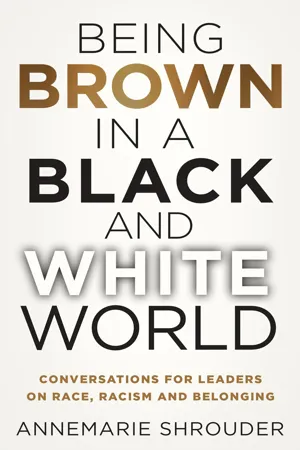
Being Brown in a Black and White World. Conversations for Leaders about Race, Racism and Belonging
- English
- ePUB (mobile friendly)
- Available on iOS & Android
eBook - ePub
Being Brown in a Black and White World. Conversations for Leaders about Race, Racism and Belonging
Information
CHAPTER 1
EITHER/OR (WHEN YOU’RE NOT ONE OR THE OTHER, WHAT ARE YOU?)
EITHER/OR (WHEN YOU’RE NOT ONE OR THE OTHER, WHAT ARE YOU?)
This book started many years ago as a title and an idea, or rather a feeling of not having a place to belong.
I was born in Montréal, Québec, Canada, in 1970 to immigrant parents.
My mother is from Austria. My father is Jamaican. Both had found their way to Montreal in their early 20s, for different reasons, to “start a new life.”
As someone who is “biracial,” I was never black enough for the black kids, and I wasn’t white. What that has meant for me is an energy of either/or—an energy that to me, for most of my life, felt like nothingness.
Nothing
As a kid
I think I’m nothing
not black enough for the black kids
Not white
Too brown for Austria
Too light for Jamaica
I race back and forth
trying to find a place
that is mine
that will claim me
“Come and rest,”
it will say
“Here
with us.
We want you…”
It’s a place I never find
Tired
weary
feeling empty
and never enough
Unless I am nothing
And then I can manage
to float
unseen
But that hurts too
In my family, “race” dynamics played themselves out between my Oma1 and my dad. I could feel the divide as a very young child and took it upon myself to fix it in the only way I knew how.
Do You Like…?
One of my
childhood pastimes
is running
between two sides
Checking to see
if the animosity I feel
is real
or imagined
If it’s safe
If there will be peace
“Dad, do you like Oma…?”
But the bookends
of my life
(one black,
one white,
both forces
to be reckoned with)
are not in accord
“Oma, do you like Dad...?”
Each time
the answer is yes
or sure
or a laugh
meant to dismiss
I know it isn’t real
If they like each other
I won’t have to pick
a side
What I am coming to understand, through the work of Isabel Wilkerson,2 is that the structure of the racial divide is about caste. Reading about history with this lens has shed a deeper and clearer light and insight into human behavior and interactions around “race”. It is also helping me to further my understanding of that knot in my stomach as a child, and that almost imperceptible (and not articulated) contempt I could sometimes feel in my Oma.
Picking Sides
Ultimately, my life experience has been about feeling like I have to pick. The result has been a life-long ping-pong game trying to align myself with each side, in turn, and depending on the context.
Culturally, this has been easier than visually. My mom was a stay-at-home parent for most of my life. This meant that I learned German (Austrian dialect, actually), and we spent whole summers in Austria every five years or so when I was a child—long enough to cultivate relationships with my cousins and become pen pals in a pre-internet world.
We always lived in neighbourhoods with predominantly white demographics. I went to schools with mostly white student populations. In fact, I distinctly remember wanting to go to the local public high school when we moved to Mississauga when I was 12. It felt like it would be more exciting, which for me was all about the fact that the building looked like the high schools I saw on TV and that there were more black kids. My dad told me in no uncertain terms that I would not be going there. Instead, he registered me in a separate school with a uniform because he felt there would be more discipline. He was probably right, but what that meant was that I was one of a handful of kids of colour. I’ll write more about that later.
While this is my story, my father was also finding his way in the corporate world as a black man. This meant experiencing subtle and overt racism in the workplace in the form of lower expectations, enduring racist comments, and having his knowledge questioned and his capabilities challenged. He also faced several barriers in finding work when we moved to Ontario in 1982. A few years after that move dad eventually ended up in the C-Suite. Based on the numbers today, I believe he could even have been one of the first black people to be C-Suite in Canada.
But it didn’t come without challenges.
“Among Fortune 500 companies, less than 1% of CEOs are black. Today there are only 4, down from a high of 6 in 2012, according to Fortune. And over the past two decades, there have only been 17 black CEOs in total. Of those, only one has been a woman -- Ursula Burns, who ran Xerox from 2009 to 2016.
But among Fortune 100 companies this year, black professionals account for just 3% of CEOs, 1% of CFOs and 3% of profit leaders like division presidents, according to the Stanford Corporate Governance Research Initiative.”3
Living in a White World
White is a world I was and am comfortable in; I get how it works. That may sound strange to you if your skin is white, but if you are a person of colour or black, I know you’ll understand what I mean.
The world people of colour live in, especially people who are black (North American or Caribbean, given my context and experience), has always felt foreign to me. And it has been a source of private pain and even shame.
The Bus Stop (Things You “Should” Know, if You’re Black)
Grade 3
My best friend
is Nicole
She is black
She introduces me
to the Jackson 5
and
The Little River Band
which we sing
at the back of the class
when the teacher isn’t watching
“Friday night, it was late, I was walking you home…”
Her parents are from Trinidad
her home is an oasis
New smells
hair products in the bathroom
a joy I can’t place
an energy I drink in
musi...
Table of contents
- What People Are Saying About Annemarie Shrouder
- Title Page
- Copyright
- A Note from Annemarie
- Foreword By Rodney Patterson
- Foreword by Candy Barone
- Contents
- Why This Book is Right on Time
- Why this Book? (The Sh*t just got Real)
- What This Book Is…and Isn’t. And Who It’s For.
- Chapter 1 Either/Or (When You’re not One or the Other, What are You?)
- Chapter 2 Microaggressions and Systemic Racism: Messages that Tell You what “Side” of Either/Or You are On
- Chapter 3 Not Black Enough
- Chapter 4 Neither—I’m not Black or White
- Chapter 5 On a Mission: Find Some Black Friends
- Chapter 6 I Don’t Want to Have to Prove that I’m My Daughter’s Mother (We Still Group People by Skin Colour)
- Chapter 7 New Mission: Be More Black
- Chapter 8 “Mom, I Want to be White”
- Chapter 9 Cracking Open (What if I Can Just Be Me?)
- Chapter 10 A White Man Taught Me that “Race” Isn’t Real
- Chapter 11 Coming Home…In Austria?!
- Chapter 12 Both/And
- Now What?
- Acknowledgement and Thanks
Trusted by 375,005 students
Access to over 1.5 million titles for a fair monthly price.
Study more efficiently using our study tools.
Frequently asked questions
Yes, you can cancel anytime from the Subscription tab in your account settings on the Perlego website. Your subscription will stay active until the end of your current billing period. Learn how to cancel your subscription
No, books cannot be downloaded as external files, such as PDFs, for use outside of Perlego. However, you can download books within the Perlego app for offline reading on mobile or tablet. Learn how to download books offline
Perlego offers two plans: Essential and Complete
- Essential is ideal for learners and professionals who enjoy exploring a wide range of subjects. Access the Essential Library with 800,000+ trusted titles and best-sellers across business, personal growth, and the humanities. Includes unlimited reading time and Standard Read Aloud voice.
- Complete: Perfect for advanced learners and researchers needing full, unrestricted access. Unlock 1.5M+ books across hundreds of subjects, including academic and specialized titles. The Complete Plan also includes advanced features like Premium Read Aloud and Research Assistant.
We are an online textbook subscription service, where you can get access to an entire online library for less than the price of a single book per month. With over 1.5 million books across 990+ topics, we’ve got you covered! Learn about our mission
Look out for the read-aloud symbol on your next book to see if you can listen to it. The read-aloud tool reads text aloud for you, highlighting the text as it is being read. You can pause it, speed it up and slow it down. Learn more about Read Aloud
Yes! You can use the Perlego app on both iOS and Android devices to read anytime, anywhere — even offline. Perfect for commutes or when you’re on the go.
Please note we cannot support devices running on iOS 13 and Android 7 or earlier. Learn more about using the app
Please note we cannot support devices running on iOS 13 and Android 7 or earlier. Learn more about using the app
Yes, you can access Being Brown in a Black and White World. Conversations for Leaders about Race, Racism and Belonging by Annemarie Shrouder in PDF and/or ePUB format, as well as other popular books in Social Sciences & Civil Rights in Politics. We have over 1.5 million books available in our catalogue for you to explore.