- English
- ePUB (mobile friendly)
- Available on iOS & Android
eBook - ePub
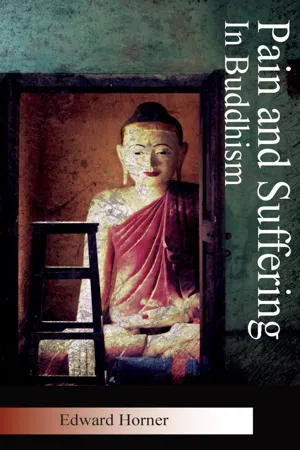
Pain and Suffering in Buddhism
Information
Topic
Theology & ReligionSubtopic
Buddhism
The Eightfold Path
_______________
Even though all the components of the Eightfold Path start with the word “right” it should be noted that the word isn’t being used to suggest right or wrong. It’s not to be taken as a condemnation that you be “right” otherwise you’re in the wrong. There is no judgment attached to these words. In this context, “right” simply means that we are attempting to support our efforts for personal development so that we may suffer less, and in so doing, not harm others.
Further, while the Eightfold path is generally laid out in a manner similar to what is outlined on the following pages, the path isn’t a series of steps to be mastered one at a time. They are best practiced together, for each supports the others in our quest for less suffering.
The Four Noble Truths
As The Buddha worked his way through the solutions to end human suffering, it eventually became clear that there were certain immutable truths that ruled humanity.
These are;
1.People suffer (all existence is dukkha)
2.Suffering has causes (the cause of dukkha is craving)
3.Ending the causes will end the suffering (the cessation of dukkha results from the cessation of craving)
4.The Eightfold Path is a path to ease suffering. (While The Buddha put the responsibility back on the individual to achieve their own liberation, he also provide a roadmap to ease that suffering)
_______________
The Eightfold Path has three sections;
1.Wisdom
2.Ethics and
3.Mental Development.
Wisdom
(Pali, paññakkhandha)
1. Right View
(Pali, Samma Ditthi)
Since wisdom is the antidote to ignorance and ignorance of how the world operates is a major hindrance that keeps us from ending our suffering, it follows that any view that supports us in the development of wisdom must first be developed in order to end suffering. This is called right view.
It’s been noted that the Eightfold Path isn’t so much a path as a set of disciplines to be practiced in concert, each supporting the other. So where does one begin?
It can be understood that without a view of the world that accepts we are the architects of our own suffering, then there can be no real beginning. Unless we recognize that when we participate in meritorious acts (generosity, donations, kindness towards others, giving alms, etc.) there is benefit not only to others, but to ourselves as well, then there can be no first steps. If we don’t realize that words and actions harm others and will have karmic consequences for us in the future, then there can be no initial setting out on the Eightfold Path.
Right view, then, assumes that you have given thought to the Four Noble Truths and agree with them. You may not know exactly what they mean, or exactly how they work, but you’ve at least developed a view that agrees with the conclusion that; all humans suffer, suffering has causes and once the causes are eliminated, we can end suffering. Without that fundamental understanding and acceptance, then there can be no right view, and without right view, there can be only a little benefit gained from following the Eightfold Path.
For these reasons, developing a right view of the workings of the world must proceed all else. Without such a view, why bother to try and end one’s suffering, if one believes that suffering is inflicted upon oneself from other sources over which there is no control?
2. Right Intention
(Pali, Samma Sankappa)
Sometimes called Right Thought. This, along with right view is supportive of our quest for wisdom.
Right Intention has three components;
1. Renunciation
Renunciation to counter the desire to seek sensual pleasures or worldly possessions. This isn’t to suggest that we give everything away and denounce material goods or sensual pleasure, but rather that we recognize our unhealthy attachment to these things. Giving away our goods, while maintaining an emotional attachment to them is not beneficial.
2. Goodwill
The intention of goodwill to counteract any inclination towards ill will. This is to suggest that we cultivate a “loving-kindness” towards all humanity (not just the people we like) to overcome anger, hatred and aversion. It is an effort to minimize the differences between, “you” and “I,” or “us” and “them.”
3. Harmlessness
The intention of harmlessness is to offset any intention to harm. This is the simple effort to not harm or do violence to anyone or anything. It is enhanced with an effort to arouse compassion for others.
I was listening to an interview with Thich Nhat Hanh the other day. He suggested four practices that might help us with our Right Intention;
1) Ask yourself, “Are you are sure?” Write the question on a piece of paper and tape it to the bathroom mirror. Wrong perceptions often lead to wrong intentions.
2) Ask yourself, “What am I doing?” This helps bring you back to the present moment where Right Thinking can once again arise.
3) Be mindful of your ‘auto pilot’ moments. When you realize that you’re doing something or thinking something wholly through habit, say, “Hello habit energy, old friend.” This can also help bring you back to the present moment.
4) Cultivate bodhicitta. This is the raising of compassion for all sentient beings and the wish to end their suffering, preferably by dropping one’s attachment to, “self,” and devoting one’s practice to helping others gain freedom from suffering.
3. Right Speech
(Pali, samma vaca)
•Abstain from telling lies or using words that deceive
•Avoid divisive language
•Do not participate in idle gossip
•Renounce uncivil, discourteous or insulting language.
Right speech is more than simply using the “right” words, it’s also about being skillful in how you use them. Avoid hurting others and speaking negatively behind people’s back. It’s about trying to bring light and civility to discourse, even when there is disagreement … especially when there is disagreement.
A few years ago, I took a cab downtown. The cabbie was listening to one of the popular talk shows on SiriusXM radio. The host was letting loose with a non-stop verbal assault on one group or another. His speech was loud and filled with hate, disinformation, misrepresentation and divisive comments. The cabbie seemingly listened to this poison all day long, day after day.
As he listen, it was clear he was agitated for he banged his hand on the steering wheel a few times and let loose something along the lines of, “That’s what I’m talking about!” I have to say it scared me a little, so I cut the ride short, paid the amount on the meter and got out of that poisonous environment. I walked the remaining 4 or 5 blocks.
I mention this incident only because it was clear to me at that point that right speech wasn’t just about my speech to others, but about having to listen to others use unskillful speech and the effect it has on me. By getting out of the cab, I chose not to baste myself in that negative environment and so minimize its effect on me.
I once worked under a supervisor who was competent enough for the work he was required to do, but he viewed every client interaction as a burden. After speaking with a client, he’d come away shaking his head as though they were an annoyance. It was a never-ending diatribe about how stupid, inconsiderate, ignorant or abusive our clients were. I realized early that I wasn’t going to have a positive effect on him, no matter what I did or said. I transferred to another division because of it, as I recognize that it was having an adverse affect on me.
I contrast the experiences above with an encounter I had, a couple of years back, with Ken Greenberg, then teaching a course on Urban Design at the University of Toronto. After a panel discussion about some specifics of urban design in our city, Ken was milling about in the hall, chatting and nibbling on appetizers. He doesn’t know me from a hole in the ground, but he graciously came up to me, introduced himself, shook my hand and asked what my interest was in urban planning. I told him about my recent short paper on in-fill condos and the ascension of the mid-rise form in Toronto. We had a brief, uplifting, inspiring and delightful three minutes. He politely listened to my not particularly insightful comments about urban design and I came away feeling that here was a guy who seemed to understand skillful speech and the effect it can have on others.
Words can easily hurt others, misrepresent them, reflect poorly on us and even undermine reality. Use your words wisely.
Ethics
(Pali, silakkhandha )
4. Right Action
(Pali, samma sammanta )
This means that we strive to put our actions in line with our thoughts and speech. When we think in a right manner and speak in a right manner, then with a conscientiously applied effort right actions naturally follow.
Of particular interest in this section are the Five Precepts;
1.Refrain from taking life
2.Refrain from stealing
3.Refrain from sexual misconduct
4.Refrain from lying
5.Refrain from taking intoxicants
The Five Precepts are core principles of training in Buddhism. Unlike the Ten Commandments, the precepts are to be undertaken, not as a matter of law or dictate, but a matter of conscious - undertaken freely. There are no dictates being handed down from a higher authority. There is no threat of punishment. There is no deity waiting to judge you. The precepts should not be a burden to your practice, but rather they become your practice.
Refrain From Taking Life
When we speak here of "taking of life," it should be noted that it isn't just about not taking the life of other humans, but the taking of life of any sentient being. For practical purposes, this means human, animal and insect. We tend to exclude plants, for while they exhibit some elements of sensitivity to their environment, they seem to lack any real sense of self awareness.
Some distinction must be drawn between the intentional taking of life and the non-intentional act. In the former we are able to consider our actions, consciously and make a choice to take life or not take life. In the latter, we may find our-selves having taken life by accident. One may have stepped on a snail in the ea...
Table of contents
- Cover
- Title Page
- Copyright Page
- Table of Contents
- Introduction
- What is Pain?
- Pain and MeditationWhat is Meditation?
- What is Suffering?
- Can We Reduce Suffering?
- The Ego
- The Eightfold Path
- Taming the Ego
- Final Thoughts
- 12 Pillars of Buddhist Wisdom
- Glossary
- About the Author
- Other Books by Edward Horner
Trusted by 375,005 students
Access to over 1.5 million titles for a fair monthly price.
Study more efficiently using our study tools.
Frequently asked questions
Yes, you can cancel anytime from the Subscription tab in your account settings on the Perlego website. Your subscription will stay active until the end of your current billing period. Learn how to cancel your subscription
No, books cannot be downloaded as external files, such as PDFs, for use outside of Perlego. However, you can download books within the Perlego app for offline reading on mobile or tablet. Learn how to download books offline
Perlego offers two plans: Essential and Complete
- Essential is ideal for learners and professionals who enjoy exploring a wide range of subjects. Access the Essential Library with 800,000+ trusted titles and best-sellers across business, personal growth, and the humanities. Includes unlimited reading time and Standard Read Aloud voice.
- Complete: Perfect for advanced learners and researchers needing full, unrestricted access. Unlock 1.5M+ books across hundreds of subjects, including academic and specialized titles. The Complete Plan also includes advanced features like Premium Read Aloud and Research Assistant.
We are an online textbook subscription service, where you can get access to an entire online library for less than the price of a single book per month. With over 1.5 million books across 990+ topics, we’ve got you covered! Learn about our mission
Look out for the read-aloud symbol on your next book to see if you can listen to it. The read-aloud tool reads text aloud for you, highlighting the text as it is being read. You can pause it, speed it up and slow it down. Learn more about Read Aloud
Yes! You can use the Perlego app on both iOS and Android devices to read anytime, anywhere — even offline. Perfect for commutes or when you’re on the go.
Please note we cannot support devices running on iOS 13 and Android 7 or earlier. Learn more about using the app
Please note we cannot support devices running on iOS 13 and Android 7 or earlier. Learn more about using the app
Yes, you can access Pain and Suffering in Buddhism by Edward G Horner in PDF and/or ePUB format, as well as other popular books in Theology & Religion & Buddhism. We have over 1.5 million books available in our catalogue for you to explore.