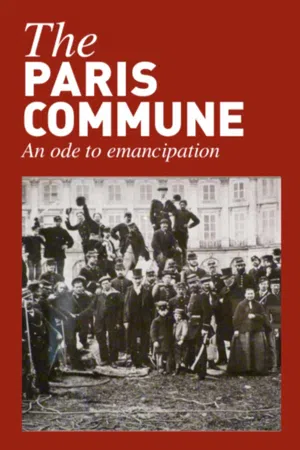
- English
- ePUB (mobile friendly)
- Available on iOS & Android
eBook - ePub
Information
1
Introduction: The Commune is not dead
Celebrating the 150th anniversary of the Paris Commune is not, and should not be, a simple exercise in historical memory. In the history of the revolutionary Marxist movement it holds a particularly important place because as Ernest Mandel put it:
The Paris Commune opened the historical era of proletarian and socialist revolutions. It offers us the first historical example of a true dictatorship of the proletariat. It allowed Marx and Lenin to perfect the Marxist theory of the state. (Ernest Mandel1: De la Commune a mai 68 : histoire du mouvement ouvrier international.)
As Lenin pointed out in The State and Revolution:
The only “correction” Marx thought it necessary to make to the Communist Manifesto he made on the basis of the revolutionary experience of the Paris Commune. The last preface to the new German edition of the Communist Manifesto, signed by both its authors, is dated 24 June 1872. In this preface the authors, Karl Marx and Frederick Engels, say that the programme of the Communist Manifesto “has in some details become out-of-date”, and then go on to say: “... One thing especially was proved by the Commune, viz., that ‘the working class cannot simply lay hold of the ready-made state machinery and wield it for its own purposes’....” The authors took the words that are in single quotation marks in this passage from Marx's book, The Civil War in France.
Karl Marx and Frederick Engels were of course not simply observers from across the Channel. They were leaders of the International Workingmen’s Association (First International) whose members in Paris were active and leading members of the Commune. Marx had also sent members of the International from London to be on the ground, notably Elisabeth Dmitrieff, and maintained correspondence (despite interruptions given the circumstances) not only with them but also other leading members of the Commune such as Leo Frankel.
The Commune was thus understood not only in the context of the situation in France since the Revolution of 1789, the previous revolutionary episodes of 1830 and 1848, and the Franco-Prussian war, but also for its meaning internationally. Marx wrote to Frankel:
I have written several hundred letters on behalf of your cause to every corner of the world in which we have branches. The working class, for the rest, was on the side of the Commune from the beginning. [Marx to Leo Frankel, 13 May 1871.]
Elisabeth Dmitrieff’s appeal for the creation of the Women’s Union for the Defence of Paris and Aid to the Wounded proclaimed that “all the civilized peoples have their eyes on Paris waiting for our victory so that they can in turn free themselves,” going on to cite Russia, Ireland, Poland, Spain, Italy, England and Austria. (We note that anti-colonialism was at this point undeveloped even among internationalists!) Nevertheless, to cite Mandel again:
The Paris Commune opened a new chapter in the tradition of proletarian internationalism, despite its Jacobin-national origin. It thus provided a first example of a process of permanent revolution. We know that it chose as its flag the red flag, that of the Universal Republic of Labour. We also know the prestigious role played by foreign revolutionaries like Frankel and Dombrowski.
The Paris of the Commune was a city that had suffered a siege, was in a country at war and was fighting to defend itself against both the Prussians and the French government which had tried to take the cannon the Parisians had paid for by popular subscription to defend the city. Nevertheless, at the same time as organizing its military defence, and the basic necessities of life such as collective canteens and medical care, the Commune was a moment where ideas of how to organize life differently emerged. Few of these were able to take substantial or practical form in the short time (seventy-two days) that it existed. However among the radical ideas put forward, discussed and that began to be put into practice were: suspension of rents; requisition of the workshops abandoned by their capitalist owners for workers’ cooperatives; separation of church and state; free access to secular education for girls and boys; equal pay (implemented for schoolteachers – one of the few professions where women and men did the same work); the payment of pensions to widows of national guardsmen whether legally married or not and recognition of their children; direct democracy through the accountability of elected representatives. Measures that are not fully achieved worldwide today…
These ideas emerged not only from the debates within and between the different traditions existing in French socialism (Blanquism, Proudhonism or followers of Marx) but also from the rich and creative discussions in the women’s clubs and in particular the work of the Women’s Union that ensured women’s voices were heard and taken into account in the deliberations of the Commune despite the fact women were not part of the electoral process (women’s right to vote was not a widespread demand at the time). However, the debates were far from easy and positions far from unanimous. Nevertheless, “The Paris Commune brilliantly demonstrated that it is possible to combine the dictatorship of the proletariat and the broadest workers’ democracy, with freedom of action assured to all currents of the workers’ movement.” Mandel continued “The audacity of the workers of Paris was remarkable in that the fundamental problems they posed in March 1871 have not yet been resolved.”
This has always been true but after a period of lesser interest the Commune is today becoming again a point of reference not only for the radical, Marxist left but for social movements, in France and worldwide. The French Nuit Debout movement (arising from protests against proposed labour laws) in 2016 took up an identification with the Commune, as do sectors of the continuing gilets jaunes movement today. Stathis Kouvelakis notes that “[part of the Kurdish national movement] has drawn inspiration from these ideas to inform the ‘democratic confederalism’ implemented in the northern Syrian territories under its control, often termed the ‘Rojava commune’.” (“On the Paris Commune: Part 1” published on the Verso blog.)
On the occasion of the 150th anniversary there is a flowering of books, broadcasts and other forms of commemoration. Some, notably in France, are institutionalized and treat the Commune as a single, preserved in aspic, historical event. But others are making the links between the experience of the Commune and today’s struggles despite the fact that the break, not just temporally but in terms of political references, is much greater between today and the Commune than it was at the 100th anniversary or in the 1930s when the 1936 commemoration in the year of the election of the Popular Front government attracted more than half a million working men and women.
Note
- Ernest Mandel (1923-1995) was a leading member and theoretician of the Fourth International from the immediate postwar period until his death. He was also a renowned economist. Among his best-known books are Introduction to Marxist Economic Theory (1968), Late Capitalism (1975).
2
The Paris Commune of 1871
The tradition of the oppressed
There is a wall at the Père Lachaise cemetery in Paris, known as “Le Mur des Fédérés”. It was there that the last fighters of the Paris Commune were shot in May 1871, by Versailles troops. Every year, thousands – and sometimes, as in 1971, tens of thousands – of French people, but also people from all over the world, visit this exalted place of memory of the labour movement.
They come alone or in demonstrations, with red flags or flowers, and sometimes sing an old love song, which became the song of the Communards: “Le Temps des Cerises”. We do not pay homage to a man, a hero or a great thinker, but to a crowd of anonymous people who we refuse to forget.
As Walter Benjamin said in his theses “On the Concept of History” (1940), the struggle for emancipation is waged not only in the name of the future but also in the name of the defeated generations; the memory of enslaved ancestors and their struggles is one of the great sources of moral and political inspiration for revolutionary thought and action.
The Paris Commune is therefore part of what Benjamin calls “the tradition of the oppressed”, that is to say, of those privileged (“messianic”) moments in history when the lower classes have succeeded, for a while, in breaking the continuity of history, the continuity of oppression; short – too short – periods of freedom, emancipation and justice which will, each time, serve as benchmarks and examples for new battles. Since 1871 it has continued to nourish the reflection and practice of revolutionaries, starting with Marx himself – as well as Bakunin – and then, in the twentieth century, Trotsky and Lenin.
Marx and the 1871 Commune
Despite their disagreements within the First International, Marxists and libertarians worked together in support of the Paris Commune, that first great attempt at “proletarian power” in modern history. Certainly, the respective analyses of Marx and Bakunin on this revolutionary event were poles apart.
We can summarize the theses of the first in the following terms: “the small group of convinced socialists who participated in the Commune were in a very difficult position…. They had to set up a revolutionary government and army against the government and army of Versailles.” Faced with this reading of the civil war in France, which opposes two governments and two armies, the anti–state point of view of the second was quite explicit: “It was a revolution against the State itself, of this supernaturalist abortion of society, a resumption by the people for the people of its own social life.”
Attentive and informed readers will have made the correction for themselves: the first opinion is that of ... Bakunin in his essay “The Paris Commune and the Idea of the State”. While the second is a quote from ... Marx, in his first draft of “The Civil War in France, 1871”. We have purposely muddied the waters, to show that the differences – admittedly very real – between Marx and Bakunin, Marxists and libertarians, are not as simple and obvious as is thought.
Moreover, Marx rejoiced in the fact that, during the events of the Commune, the Proudhonians forgot their master’s theses, while certain libertarians observed with pleasure that Marx's writings on the Commune abandoned centralism in favour of federalism.
Marx had proposed, as the central political slogan of the International Working Men’s Association – the First International – this formula which he inscribed in the Inaugural Address of the IWA in 1864: “The emancipation of the working classes must be conquered by the working classes themselves”. If the Commune of 1871 was so important in his eyes, it is precisely because it was the first revolutionary manifestation of this founding principle of the modern working class and socialist movement.
The Commune, Marx wrote in the Address in the name of the First International in 1871, “The Civil War in France” (and in the preparatory notices), was not the regime of a party or of a group, but “essentially a working class government”, a “a government of the people by the people”, that is to say, “the taking back by the people and for the people of their own social vocation”. For that, it was not enough to “conquer” the existing state apparatus: it was necessary to “break” it and replace it by another form of political power, as the Communards did, from their first decree – the abolition of the standing army and its replacement by the armed people. Here is what Marx wrote in a letter to his friend Kugelman on 17 April 1871, thus during the first weeks of the Commune: “If you look at the last chapter of my Eighteenth Brumaire you will find that I say that the next attempt of the French revolution will be no longer, as before, to transfer the bureaucratic–military machine from one hand to another, but to smash it, and this is essential for every real people’s revolution on the Continent. And this is what our heroic Party comrades in Paris are attempting.”
What seemed to Marx to be decisive was not only the social legislation of the Commune – certain measures of which, such as the transformation of factories abandoned by their owners into workers’ cooperatives, had a socialist dynamic – but above all its political significance as workers’ power. As he wrote in the Address of 1871, “this new Commune, which breaks the power of the modern state” was the work of “plain working men” who “for the first time dared to infringe upon the governmental privilege of their ‘natural superiors’”.
The Commune was neither a conspiracy nor a sudden surprise attack, it was “the people acting for themselves and by themselves”. The correspondent of the Daily News newspaper on 6 May found there was no leader exercising “supreme control”, which calls for an ironic comment from Marx: “This shocks the bourgeois who wants political idols and ‘great men’ immensely”.
While activists from the First International played an important role in the events, the Commune cannot be explained by the intervention of a vanguard group. In response to the calumnies of reaction, which presented the uprising as a conspiracy hatched by the IWA, Marx wrote: “The police–tinged bourgeois mind naturally figures to itself the International Working Men’s Association as acting in the manner of a secret conspiracy, its central body ordering, from time to time, explosions in different countries. Our Association is, in fact, nothing but the international bond between the most advanced working men in the various countries of the civilized world. Wherever, in whatever shape, and under whatever conditions the class struggle obtains any consistency, it is but natural that members of our Association, should stand in the foreground.”
If Marx speaks sometimes of workers and sometimes of “people”, it is because he was aware that the Commune was not only the work of the proletarian class in the strict sense, but also of sectors of the impoverished middle classes, intellectuals, women from various social strata, students and soldiers, all united around the red flag and the dream of a social republic. Not to mention the peasants, absent from the movement, but without whose support the uprising in Paris could only fail.
Another aspect of the Commune that Marx insists on is its internationalist character. Certainly, the people of Paris rose up in 1871 against the capitulating bourgeois politicians who reconciled with Bismarck and the Prussian army. But this national leap in no way took a nationalist form; not only because of the role of the militants of the French section of the First International, but also because the Commune appealed to combatants from all nations. The solidarity of the International Workingmen’s Association, and the meetings in support of the Commune held in Breslau and other German cities, at the initiative of socialist workers, are the expression of this internationalist significance of the uprising of the Parisian people. As Marx wrote in a resolution adopted by a meeting to celebrate the anniversary of the Commune in March 1872, the Communards were the “heroic vanguard” of the “threatening army of the proletariat of the whole world”.
There exists, according to Walter Benjamin in his Theses of 1940, a unique constellation between a...
Table of contents
- Half-Title
- Full-Title
- Contents
- About The Authors
- 1 - Introduction: The Commune Is Not Dead
- 2 - The Paris Commune Of 1871
- 3 - Remembering The Paris Commune
- 4 - In Memory Of The Commune
- 5 - Do You Know LefrançAis?
- 6 - All The More Monstrous Because They Were Women
- 7 - Genderquake: Socialist Women And The Paris Commune
- 8 - Glorious Harbinger Of A New Society
- 9 - An Ode To Emancipation
- 10 - The Paris Commune Of 1871, Banks And Debt
- Sources
- Events
- People
- Bibliography
- Resistance Books And The Iire
Trusted by 375,005 students
Access to over 1.5 million titles for a fair monthly price.
Study more efficiently using our study tools.
Frequently asked questions
Yes, you can cancel anytime from the Subscription tab in your account settings on the Perlego website. Your subscription will stay active until the end of your current billing period. Learn how to cancel your subscription
No, books cannot be downloaded as external files, such as PDFs, for use outside of Perlego. However, you can download books within the Perlego app for offline reading on mobile or tablet. Learn how to download books offline
Perlego offers two plans: Essential and Complete
- Essential is ideal for learners and professionals who enjoy exploring a wide range of subjects. Access the Essential Library with 800,000+ trusted titles and best-sellers across business, personal growth, and the humanities. Includes unlimited reading time and Standard Read Aloud voice.
- Complete: Perfect for advanced learners and researchers needing full, unrestricted access. Unlock 1.5M+ books across hundreds of subjects, including academic and specialized titles. The Complete Plan also includes advanced features like Premium Read Aloud and Research Assistant.
We are an online textbook subscription service, where you can get access to an entire online library for less than the price of a single book per month. With over 1.5 million books across 990+ topics, we’ve got you covered! Learn about our mission
Look out for the read-aloud symbol on your next book to see if you can listen to it. The read-aloud tool reads text aloud for you, highlighting the text as it is being read. You can pause it, speed it up and slow it down. Learn more about Read Aloud
Yes! You can use the Perlego app on both iOS and Android devices to read anytime, anywhere — even offline. Perfect for commutes or when you’re on the go.
Please note we cannot support devices running on iOS 13 and Android 7 or earlier. Learn more about using the app
Please note we cannot support devices running on iOS 13 and Android 7 or earlier. Learn more about using the app
Yes, you can access The Paris Commune by Michael Lowy,Penelope Duggan in PDF and/or ePUB format, as well as other popular books in Politics & International Relations & French History. We have over 1.5 million books available in our catalogue for you to explore.