- English
- ePUB (mobile friendly)
- Available on iOS & Android
eBook - ePub
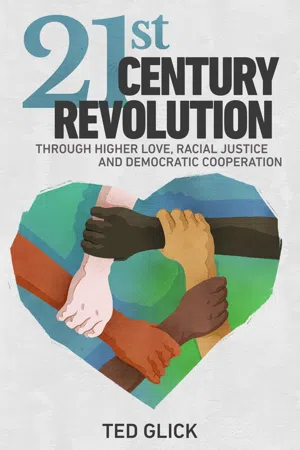
21st Century Revolution
Information
Chapter One:
Religion, Revolution and Higher Love
Introduction
Between 2016 and 2018 I read a lot about religion and revolution. It began when I found the New Oxford Annotated Bible that was my father’s “bible” in his last 25 or so years. I found it about a year after he died among a pile of books of his I had brought home from his funeral.
I was first struck by the fact that my mother had given it to him as a Christmas present in 1990 with the inscription, “For your enjoyment and illumination, Love, Barbara.” I was further struck by the underlining, markings and pieces of paper all throughout it which made clear he had used it a lot.
And so, finally, about 66 years after I started going (being taken) to church at a very early age, I decided to read the Bible from beginning to end, and I did, over a period of 4-5 months.
This experience got me going with what became my “religion and revolution,” long-term reading and writing project. I read about 30 other books after that, some about the Bible and religion, especially liberation theology, some about the historic practice and theoretical debate and interaction between God believers and secular socialists and revolutionaries over the last 170 years, since the publication by Marx and Engels of The Communist Manifesto in 1848.
As I did this reading I began to focus on one key personal objective for all of this past and future reading: to try to pinpoint what is at the root of the failure, by and large, of both organized religion and organized Marxism/socialism to do what Marx called for in words inscribed on his grave: “The philosophers have only interpreted the world, in various ways. The point, however, is to change it.”
Neither those who follow the teachings of Jesus, the Hebrew Prophets, the Prophet Mohammed or Buddha, nor those who use Marxist tools of analysis and see themselves as socialists, have been able to prevent the destructive and dehumanizing corporatization of much of the world. More urgently, the world as a whole is facing the very real and immediate threat of societal and ecological unraveling as extreme weather events grow both in frequency and in destructive impact. These are happening as the atmosphere and oceans are heated up, primarily because of the production and burning of oil, gas and coal. Tens of millions of people worldwide, predominantly people of color and low wealth, have died, been made homeless or displaced, or suffered significantly in other ways because of this deepening climate emergency.
Despite this very serious reality, our situation is not hopeless. There is concrete evidence that large numbers of people around the world want and are willing to organize for much more just, democratic and earth-protective societies. Two of the most recent examples are the 2015-2016 and 2019-2020 Bernie Sanders for President campaigns, happening within a country that has been leading the corporatization and imperialist charge for a long, long time.
Then there is Pope Francis, in his encyclical Laudato Si: On Care for Our Common Home, saying this, and so much more, about our situation:
“All of this shows the urgent need for us to move forward in a bold cultural revolution. Science and technology are not neutral; from the beginning to the end of a process, various intentions and possibilities are in play and can take on distinct shapes. We need to slow down and look at reality in a different way, to appropriate the positive and sustainable progress which has been made, but also to recover the values and the great goals swept away by our unrestrained delusions of grandeur.” 1
Fidel Castro, unquestionably the most prominent Marxist revolutionary of the Western Hemisphere, had this to say about religion and revolution:
“The Church says, ‘Love thy neighbor as thyself;’ this is exactly what we preach through feelings of human solidarity, which is the essence of socialism and communism, the spirit of fraternity among people, which is one of our most valued goals. The Church says, ‘Thou shalt not bear false witness;’ well, lying and deceit are among the things that we most severely criticize and censor.’” 2
I hope that this essay helps to advance the unity in action between those for whom spiritual beliefs are core personal beliefs, those who identify with one of the several secular, revolutionary traditions going back to 1848, and all those who fall into both categories or neither but who agree that revolutionary change is badly needed in our beautiful, wounded, struggling world.
Marx and Engels on Religion
Karl Marx and early scientific socialism, beginning in 1848, were antagonistic to organized Christianity because, in the main, it was a supporter of an economic system which was exploitative, oppressive and dehumanizing. Yet Marx appreciated that for people weighed down by day-to-day realities of suffering, religion offered something.
In his famous “opiate” quote in Contribution to the Critique of Hegel’s Philosophy of Right, he explained it this way:
“Religious distress is at the same time the expression of real distress and the protest against real distress. Religion is the sigh of the oppressed creature, the heart of a heartless world, just as it is the spirit of a spiritless situation. It is the opium of the people.” 3
Something which embodies heart and spirit, even if a drug, can be a positive thing, something to hold on to at the least.
Marx himself had a religious background as a young person. Yet he saw no hope for world-changing for the suffering masses coming from religion. He saw criticism of it for its collaboration with injustice as a necessary thing: “The criticism of religion disillusions man to make him think and act and shape his reality like a man who has been disillusioned and has come to reason. . .” 4 And again: “The criticism of religion ends with the teaching that man is the highest essence for men, hence with the categoric imperative to overthrow all relations in which man is a debased, enslaved, abandoned, despicable essence.” 5
For the next 100 years or more, as scientific socialism took root and grew throughout Europe and elsewhere in the world, “criticism of religion” and, particularly after the Bolshevik revolution, atheism became a staple of the dominant political parties of that movement. Yet even Frederick Engels understood that from within organized religion there had been people and movements which were motivated by similar sentiments as those that motivated socialists.
In the book The Peasant War in Germany Engels wrote approvingly about the leadership given by a Catholic priest, Thomas Munzer, to a peasant movement in the 1520’s which emerged as an outgrowth of Martin Luther’s challenge to Papal authority with the 95 Theses posted on the church door in Wittenberg, Germany in 1517. Here is how Engels described Munzer:
“To hold up the Bible against reason, [Munzer] maintained, was to kill the spirit by the letter, for the Holy Spirit of which the Bible speaks is not something that exists outside; the Holy Spirit is our reason. Through this faith, through reason come to life, man became godlike and blessed. Heaven is, therefore, not a thing of another world, and is to be sought in this life and it is the task of believers to establish the kingdom of God here on earth. . . 6
“Munzer’s political doctrine followed his revolutionary religious conceptions very closely. . . This programme demanded the immediate establishment of the kingdom of God. . . By the kingdom of God Munzer understood a society in which there would be no class differences or private property and no state authority independent of or foreign to the members of society. All the existing authorities, insofar as they refused to submit and join the revolution, were to be overthrown, all work and all property shared in common, and complete equality introduced.” 7
Engels had more to say along these lines, in The Book of Revelation: “[Quoting Ernest Renan] ’When you want to get an idea of what the first Christian communities were, do not compare them to the parish congregations of our day; they were rather like local sections of the International Working Man’s Association.’ And this is correct. Christianity got hold of the masses, exactly as modern socialism does, under the shape of a variety of sects, and still more of conflicting individual views. . . but all opposed to the ruling system, to the powers that be.” 8
Karl Kautsky’s Analysis
Foundations of Christianity, a Marxist analysis of Christianity by Karl Kautsky published in 1908, is probably the most definitive work produced by the socialist movement on this question prior to the emergence of the Liberation Theology movement in the 1960’s. Kautsky at the time was a top theoretician and practical leader of the European socialist movement and a leader of the German Social Democratic Party.
The book, all 472 pages, is impressive and comprehensive. Before analyzing Christianity, Kautsky analyzes the economic, social and political dynamics of the Roman Empire within which Christianity emerged and developed in the first century AD. In the three chapters in this section, he analyzes the slave-holding system, the life of the state, and currents of thought in the Roman imperial period. In the section following, he analyzes the history of the Jewish people as they migrated to the Palestine area, militarily conquered other peoples, and created monotheistic, patriarchal, religiously-suffused societies.
Kautsky, like Engels, is clear that early Christianity was all about raising up the lives of the poor and oppressed. He comments favorably on Jesus’ Sermon on the Mount: “The reader will observe to be rich and enjoy one’s wealth is regarded as a crime, worthy of the most cruel punishment.” 9
More than this, Christianity, with its “outspoken proletarian character,” naturally “aim(ed) to achieve a communistic organization. We read in the Acts of the Apostles: ‘And all that believed were together and had all things in common; and sold their possessions and goods and parted them to all men, as very man had need. Grace was among them, because none suffered lack, for the reason that they gave so generously that none remained poor. 10
Kautsky refers positively to the impact of early Christianity upon women: “With the dissolving, or at least the loosening, of the traditional family ties, there necessarily resulted a change in the position of women. Once she ceased to be bound to the narrow family activities, she was enabled to devote her mind and her interests to other thoughts, outside the family sphere. Their unselfish solicitude for the daily satisfaction of the needs of husbands and children became a solicitude for the liberation of the human race from all its wretchedness.” 11
Kautsky, understanding the importance of organization to efforts to transform society, identified this reality of early Christianity as the reason why the life and teachings of Jesus of Nazareth had such an impact not just in the early first century AD but for the next 2000 years. “If Jesus had merely gathered together bands for the purpose of insurrection, his name would have disappeared without a trace after his crucifixion. But Jesus was not merely a rebel, he was also a representative and a champion, perhaps even the founder of an organization which survived him and continued to increase in numbers and in strength. . . It was the organization of the congregation that served as a bond to hold together Jesus’ adherents after his death, and as a means of keeping alive the memory of their crucified champion. . . It was not the faith in the resurrection of the Crucified which created the Christian congregation and gave it its strength, but, on the contrary, it was the vigor and strength of the congregation that created the belief in the continued life of the Messiah.” 12
Things began to change, however, over time. As Christianity grew, as more people were drawn to it, the demands on the organization increased. They needed to expand what Kautsky called their “charity work,” which he likened to “the system of insurances in a modern nation. In the Gospels, it is the observance of this mutual insurance system that entitles one to the life eternal. When the Messiah comes, he will divide men into those that are to share in the splendor of the state of the future and life eternal and those destined to eternal damnation.” 13
The belief in the “second coming” of Jesus was central to the belief systems and theology of early Christianity. It wasn’t a unique belief for that period of time and that part of the world. These kinds of mystical, eschatological beliefs were prevalent, kind of like Marx’s “opium,” giving people hope for something different than the hard lives she and those around her were living.
As Christianity continued, going strong into the second century AD, “the expectation of the coming of the Messiah in all his glory dwindled, as the congregation became more and more convinced that it was necessary to acquire property in order to carry out its program of assistance. The proletarian class character of the Christian propaganda was violated. More and more effort was directed to the recruiting of wealthy members whose money could be put to use.
“As the number of the wealthy increased in the congregation, there was also an increase in the number of those participants in the common meals who were concerned only in the gathering and i...
Table of contents
- Cover
- Title page
- Copyright Page
- Table of Contents
- Introduction
- Chapter One Religion, Revolution and Higher Love
- Chapter Two Does God Exist? Does It Matter?
- Chapter Three Corrupt Capitalist Culture: Can We Change?
- Chapter Four US Class Structure and Revolution-Making
- Chapter Five A Winning Strategy for Power, Already Underway!
- About the Author
- Backcover
Trusted by 375,005 students
Access to over 1.5 million titles for a fair monthly price.
Study more efficiently using our study tools.
Frequently asked questions
Yes, you can cancel anytime from the Subscription tab in your account settings on the Perlego website. Your subscription will stay active until the end of your current billing period. Learn how to cancel your subscription
No, books cannot be downloaded as external files, such as PDFs, for use outside of Perlego. However, you can download books within the Perlego app for offline reading on mobile or tablet. Learn how to download books offline
Perlego offers two plans: Essential and Complete
- Essential is ideal for learners and professionals who enjoy exploring a wide range of subjects. Access the Essential Library with 800,000+ trusted titles and best-sellers across business, personal growth, and the humanities. Includes unlimited reading time and Standard Read Aloud voice.
- Complete: Perfect for advanced learners and researchers needing full, unrestricted access. Unlock 1.5M+ books across hundreds of subjects, including academic and specialized titles. The Complete Plan also includes advanced features like Premium Read Aloud and Research Assistant.
We are an online textbook subscription service, where you can get access to an entire online library for less than the price of a single book per month. With over 1.5 million books across 990+ topics, we’ve got you covered! Learn about our mission
Look out for the read-aloud symbol on your next book to see if you can listen to it. The read-aloud tool reads text aloud for you, highlighting the text as it is being read. You can pause it, speed it up and slow it down. Learn more about Read Aloud
Yes! You can use the Perlego app on both iOS and Android devices to read anytime, anywhere — even offline. Perfect for commutes or when you’re on the go.
Please note we cannot support devices running on iOS 13 and Android 7 or earlier. Learn more about using the app
Please note we cannot support devices running on iOS 13 and Android 7 or earlier. Learn more about using the app
Yes, you can access 21st Century Revolution by Ted Glick in PDF and/or ePUB format, as well as other popular books in History & World History. We have over 1.5 million books available in our catalogue for you to explore.