- English
- ePUB (mobile friendly)
- Available on iOS & Android
eBook - ePub
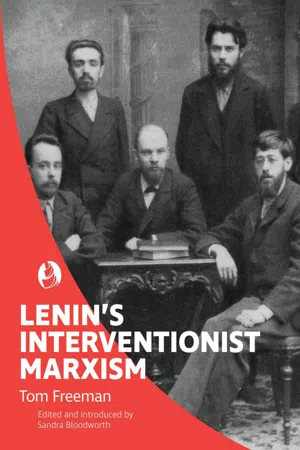
Lenin's Interventionist Marxism
Information
Chapter 1
INTRODUCTION: ECONOMIC DETERMINATION AND CONSCIOUS INTERVENTION IN MARXIST THEORY AND THE ADVANCE OF ST. PETERSBURG BETWEEN 1861 AND 1907
In the social production of their life, men enter into definite relations that are independent of their will, relations of production which correspond to a definite stage of development of their material productive forces. … At a certain stage in their development the material forces of society come into conflict with existing relations of production, or – what is but a legal expression for the same thing – the property relations within which they have been at work hitherto. From forms of development of the productive forces, these relations turn into fetters. Then begins an epoch of social revolution.
– Karl Marx, Preface to A Contribution to the Critique of Political Economy.1
The ruling ideas of each age have been the ideas of its ruling class.
– Karl Marx, Friedrich Engels, Manifesto of the Communist Party.2
We have said that there could not have been social democratic consciousness amongst the workers. It could only have been brought to them from without. The history of all countries shows that the working class exclusively by its own effort is able to develop only trade union consciousness… The teachings of socialism, however, grew out of the philosophic, historical, and economic theories elaborated by educated representatives of the propertied classes, by the intelligentsia.
– V.I. Lenin, What is to be done?3
… nothing will ever compare in importance with the direct training that the masses receive in the course of the revolutionary struggle itself.
– V.I. Lenin, What is Happening in Russia?4
Workers have the class instinct, and, given some political experience, they pretty soon become staunch Social-Democrats.
– V.I. Lenin, Speech on the Question of the Relations Between Workers and Intellectuals Within the Social-Democratic Organisations April 20 in The Third Congress of the R.S.D.L.P.5
These pairs of quotations embody an apparent contradiction in the Marxist understanding of working class consciousness and its transformation.6 On the one hand Marxism analyses society as divided into classes in which the rulers ideologically dominate the ruled. Yet at the same time Marx analysed human history as a series of revolutions in which ruled classes rose against their rulers and imposed a new order on society. This thesis is a case study to show how Lenin resolved this apparent contradiction through the role of struggle between the classes of capitalism in transforming workers’ consciousness.
By setting Lenin’s comments on worker consciousness and party organisation within the context of the class struggle which they addressed, I seek to show their relation to Marx’s fundamental conception of the working class as its own liberator. Due to its pivotal role, as well as the resource confines of a thesis, this case study is focused on the city of St. Petersburg7 between 1861 and 1907 – its economy and labour movement, the Marxist current within that movement, Lenin’s relations with that current, and finally the consequent conclusions he drew for workers’ class consciousness as well as the party organisation of Marxists. Yet such an argument presumes a framework concerning the relation between economic determination and conscious intervention in the Marxist understanding of historical transformation. That basic framework is outlined here, together with some preliminary observations concerning the economic development of the Russian empire over the period of the study, as well as the role of St. Petersburg within that development. Finally the overall structure of the thesis is outlined.
Marx and Engels on determination
Among Marxists there would be widespread agreement with the view that Marx saw the overall sweep of human history, and hence the consciousness of humans within that sweep, as being ultimately determined by the advance of the instruments they collectively use to secure their physical survival.8 This basic correspondence between the “forces of production”, the “relations of production” humans enter into in that production, and the general pattern of human relations in society, was plainly asserted by Marx in the well-known declaration:
In acquiring new productive forces men change their mode of production; and in changing their mode of production, in changing their way of earning a living, they change all their social relations. The handmill gives you society with a feudal lord; the steam mill society with an industrial capitalist. [my emphasis]9
Most of those who call themselves Marxists would accept that the “absolute” determinism, which has usually been taken from this sweeping declaration, has a growing validity as the historical and geographical focus broadens.10
It would also be widely accepted that Marx’s view emerged as the critique of a long predominant conservative materialism on the one hand, as well as the challenge to that view by the idealism of the Enlightenment and in particular Hegel’s idealist version of the dialectic.11 Within the former view human nature was regarded as negative and static due to its physical connection to nature. Within the latter, human nature was positive and changeable – but this change occurred through the mental activity of an elite among its members. Marx developed a materialist view that rejected both the earlier conservatism, but of even greater significance for the later development of Marxist ideas, as well as the argument of this thesis, also rejected the view that historical change could only result from the action or thought of an elite. For Marx such change must occur through the mobilisation of the majority of society, and involve humans changing themselves and hence the social structures through which they interacted.12 Such mobilisation must be premised on the prior development of a productive base sufficient to sustain a new type of society.
These most basic premises concerning human nature and historical change that were developed by Marx have generally not been controversial among subsequent Marxists. Yet such a broad framework provides little guidance to understanding the detail of transition between particular historical epochs. As such it provides little direct guidance to those Marxists seeking to understand the present transition from capitalism to socialism. In particular it leaves vague the organisational forms through which Marxists seek to facilitate that transition – what has become known as party organisation. The initial response of Marxists to this lack of clarity was to apply Marx’s general principles very directly and crudely to the detail of mobilisation within the present transition.
Thus the predominating position of Marx’s immediate heirs in the Second International became one of “absolute determination” in relation to the class struggle, based on an overriding primacy given to the “forces of production”. Based mainly on the writings of the recognised theoretical heir to Marx and Engels, Karl Kautsky, as well as the practice of the first mass Marxist party, the German Social Democratic Party (SPD), this position set a framework that was formally accepted by almost all other Marxists from the mid-1890s until the First World War, including those within the Russian Social Democratic and Labour Party (RSDLP). Reflecting a prolonged period of economic expansion, as well as relative peace between the classes, the role of class struggle was steadily reduced for Kautsky, and socialism came to be seen in practice as arising directly from the growing productive power of capitalism itself. This framework led most Marxists to see the rise of socialist consciousness as an inevitable process, and consequently confined their own role to that of abstracted propaganda divorced from direct intervention within the struggle of workers.
That Marx himself would not have drawn such passive conclusions from his own basic framework seems indisputable. “The history of all hitherto existing society is the history of class struggles”13 opens the Communist Manifesto, Marx and Engels’ best known political declaration. In the following paragraph they make clear that the outcome of these struggles was not predetermined but could be either “a revolutionary reconstruction of society at large, or the common ruin of the contending classes” [my emphasis]. Further, while they were still alive Marx and Engels expressed concern about the direction in which the German SPD was developing.14 Thus Marx wrote in a private letter of Kautsky:
He is a mediocrity with a small-minded outlook, superwise (only 26), very conceited, industrious in a certain sort of way, he busies himself a lot with statistics but does not read anything very clever out of them, belong...
Table of contents
- Cover
- Title Page
- Copyright Page
- Contents
- Acknowledgements
- Dedication
- Editor’s introduction
- 1 Introduction: Economic determination and conscious intervention in Marxist theory and the advance of St. Petersburg between 1861 and 1907
- 2 Economic determination and conscious intervention in recent Western scholarship on Lenin
- 3 St. Petersburg 1861–1905: Formation, emergence and containment of a “worker intelligentsia”
- 4 St. Petersburg 9 January 1905–3 June 1907: Formation, rise and containment of a layer of “worker activists”
- 5 St. Petersburg 1861–1905: Formation, emergence and containment of Marxism as the most class conscious section of the “worker intelligentsia”
- 6 St. Petersburg 9 January 1905–3 June 1907: Formation, rise and containment of the Bolsheviks as the most class conscious element of the “worker activists”
- 7 1893–1905: Lenin’s conception of the party as a “worker intelligentsia”
- 8 9 January 1905–3 June 1907: Lenin’s conception of the party as an organisation of “worker activists”
- 9 Conclusion
- References
- Bibliography
- Index
Trusted by 375,005 students
Access to over 1.5 million titles for a fair monthly price.
Study more efficiently using our study tools.
Frequently asked questions
Yes, you can cancel anytime from the Subscription tab in your account settings on the Perlego website. Your subscription will stay active until the end of your current billing period. Learn how to cancel your subscription
No, books cannot be downloaded as external files, such as PDFs, for use outside of Perlego. However, you can download books within the Perlego app for offline reading on mobile or tablet. Learn how to download books offline
Perlego offers two plans: Essential and Complete
- Essential is ideal for learners and professionals who enjoy exploring a wide range of subjects. Access the Essential Library with 800,000+ trusted titles and best-sellers across business, personal growth, and the humanities. Includes unlimited reading time and Standard Read Aloud voice.
- Complete: Perfect for advanced learners and researchers needing full, unrestricted access. Unlock 1.5M+ books across hundreds of subjects, including academic and specialized titles. The Complete Plan also includes advanced features like Premium Read Aloud and Research Assistant.
We are an online textbook subscription service, where you can get access to an entire online library for less than the price of a single book per month. With over 1.5 million books across 990+ topics, we’ve got you covered! Learn about our mission
Look out for the read-aloud symbol on your next book to see if you can listen to it. The read-aloud tool reads text aloud for you, highlighting the text as it is being read. You can pause it, speed it up and slow it down. Learn more about Read Aloud
Yes! You can use the Perlego app on both iOS and Android devices to read anytime, anywhere — even offline. Perfect for commutes or when you’re on the go.
Please note we cannot support devices running on iOS 13 and Android 7 or earlier. Learn more about using the app
Please note we cannot support devices running on iOS 13 and Android 7 or earlier. Learn more about using the app
Yes, you can access Lenin's Interventionist Marxism by Tom Freeman, Sandra Bloodworth in PDF and/or ePUB format, as well as other popular books in Politics & International Relations & Communism, Post-Communism & Socialism. We have over 1.5 million books available in our catalogue for you to explore.