eBook - ePub
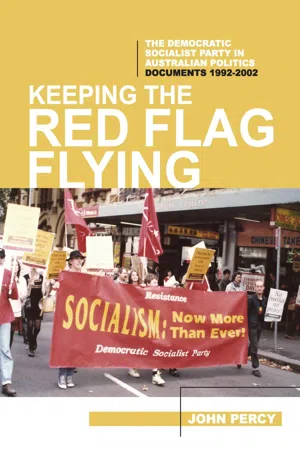
Keeping the Red Flag Flying: The Democratic Socialist Party in Australian Politics
Documents, 1992-2002
- English
- ePUB (mobile friendly)
- Available on iOS & Android
eBook - ePub
Keeping the Red Flag Flying: The Democratic Socialist Party in Australian Politics
Documents, 1992-2002
Information
1. DEVELOPING A NEW GENERATION OF REVOLUTIONARY ACTIVISTS
Report to the National Committee 6-8 June 1992
Following the collapse of the Stalinist regimes in Eastern Europe and the related decline of pro-Stalinist parties in Australia, the DSP had emerged as the country’s biggest socialist group, with the most popular left newspaper. The new situation brought new responsibilities and opportunities, but in a context in which the left generally was still small and weak. In this report, John Percy surveyed both the DSP’s situation and that of the rest of the left. With no short-term prospects of regroupments, in contrast to the unity attempts in the 1980s, members needed to focus on activities that would directly build the party and Resistance, mainly by recruiting and training the new layers of youth beginning to radicalise despite the right-wing propaganda offensive.
At our party conference in January, we really began to get the suspicion that there’d been a significant turn in the political tide. The success of the conference surpassed most of our expectations. There was a tremendously high level of morale and enthusiasm among comrades.
Perhaps many of us had unconsciously swallowed more of the capitalist propaganda on the ‘end of communism’ theme than we’d been aware of over the last few years. Individually, we’d been beaten back a little by the media offensive, and it required the gathering of the clan, the coming together of all comrades, for us to realise that no, nothing had fundamentally changed, capitalism was still rotten, and we were still there fighting.
The youthfulness of the conference of course was also a tremendous boost for all of us more experienced comrades. The new generation of socialists isn’t weighed down by past defeats or the strain of long campaigns, but brings a fresh energy and enthusiasm to the struggle.
A good year so far
We’ve helped produce 19 issues of Green Left Weekly, at an average size of 28 pages. Green Left has included supplements for AKSI,4 CISLAC,5 Cuba, International Women’s Day, EYA6 as well as Active Unionist,7 Fantastic Sex Facts.8 We’ve used it to produce two DSEL9 posters, the Indonesia tour poster, two Resistance conference posters, an EYA poster, Student Underground,10 the Resistance O Week broadsheet.
Green Left sales have increased over the last year, by more than 600 a week. We had a wonderful special sales week, when we sold 7,250, or, by adding in Melbourne, which was out of kilter because of the Wills [Victoria] by-election, 8,500! We had more than 70 new sellers mobilised by the special sales week.
Resistance has had its best growth for years. Even before the start of the university year, we’d joined up about 80 new members, the majority at high schools. Then very successful O Weeks took this tally to more than 700 new members. But the most important feature was that this year a much bigger proportion of these new members got active, renewed their monthly membership, started selling Green Left, came to meetings on campus, came to meetings at the Resistance Centre.
The DSP membership is rising again also. We’d been shrinking a little over the last few years, but that has now turned around. Currently we have about 40 more provisional members around the country than we had in December, just six months ago. If we look at a graph of our membership fluctuations over the last 10 years, you can see that we hit a high point in 1984, dwindled down to a low in 1988, rose rapidly for the next two years after we abolished provisional membership to reach our highest point in early 1990, but fell back quickly from that. We bottomed out again at the end of last year, and have started growing again.
The tremendous campaign around the sex diary and our own Fantastic Sex Facts raised Resistance’s profile and made local and national headlines. It was a model campaign of grabbing an opportunity, throwing the whole party and Resistance behind it and reaping the rewards: front-page coverage in many papers, features, interviews, debates and follow-up media requests on unrelated topics as well. The value of the publicity alone must have been worth tens of thousands of dollars, and we’ve made hundreds of great new contacts for Resistance, especially in high schools.
Our work to build EYA, which we projected as the major campaign for our tendency this year, has gone well. EYA had a very successful conference, committees are getting rebuilt in a number of cities, many EYA activists have joined Resistance, and the great new EYA paper now sets things up for a major expansion of EYA’s influence.
Our Indonesian solidarity work, our second projected area of campaigning, has also gone well so far. We’ve been able to stimulate and open out AKSI committees in some cities, and the national speaking tour by Helmi Fauzi [a member of a new progressive youth group in Indonesia] has now succeeded in greatly expanding the possibilities for this work, with several hundred new contacts gained, good attendances at public meetings and campus meetings, and now real prospects for more active AKSI committees.
International Women’s Day was a big success this year, in nearly all cities, and in nearly all of them our comrades played a crucial role, and sometimes it depended nearly entirely on us. There were bigger marches than in previous years in several cities. In many branches we organised well-attended Resistance or DSP forums associated with IWD. The broadsheet that we produced in Green Left was a great hit; some cities ran out very early.
We’ve participated in several election campaigns already this year – in the ACT, in Tasmania and the Wills by-election. Although our votes haven’t been high, the campaigns were useful for the branches that participated in them, raising our profile and getting out our policies.
And across the country and throughout the year we’ve been getting consistently high turn-ups for DSP, Resistance and Green Left functions – fundraisers, forums, film nights, dinners, camps.
Our forum crowds have been generally larger compared to previous years. Our meetings on campus have been very encouraging. Some of the forums have been stunning, like Melbourne branch’s forum on women’s liberation, which packed 130 people into the building. In Perth we’re running Politics in the Pub as well as our own forums, and they’re getting good crowds. Hobart got 60 to a Politics in the Pub on the APPM dispute11 last week.
Our dinner dances and social functions have gone well. Sydney’s dinner two weeks ago was attended by 230 and had a fantastic atmosphere. Canberra had a dinner of 90. Cultural Dissent12 functions are now occurring in Sydney, Brisbane, Adelaide and Wollongong. Adelaide crammed 60 into their headquarters for an African band night. Sydney had more than 100 here last Sunday for the women’s cabaret night. Film nights have been big successes. Canberra got 70 people to one, Sydney’s had 100 packed in here about three times.
We made a special effort on May Day marches and functions this year, and comrades felt good about them as well. Adelaide got 60 to the toast at their office; most of the active left was represented. Melbourne had a great toast.
We’ve played an important role in the Cuba tours and meetings. Some of the best meetings have been put on by us or depended on us. The Newcastle dinner was attended by 90 people, and everyone recognised the central role played by Resistance comrades.
During the last year or so we’ve stabilised CISLAC financially, and recently held a successful national consultation.
It’s been a very hectic but fruitful five months. This experience confirms several things.
Firstly, it indicates the beginning of a change in the nature of the political period, as we move out of a focus on the collapse of Stalinism in the Soviet Union and Eastern Europe and the working class defeats and imperialist victories of the last few years. We seem to be moving into a period in which capitalism’s crises move to the forefront of world attention again, when they’re not so easily masked – the Gulf War, the international recession, the LA riots, the upsurge in Thailand, the strikes in Germany.
The subjective response we’re getting to our functions, forums, events, and to Green Left must reflect partially that changed situation.
It also must reflect some things we’re doing right ourselves. Our success reaffirms the correctness of our party-building orientation that we’ve stressed over the last few years.
It’s worth quoting from the report Jim Percy gave to the party conference in January on ‘The DSP and the crisis of the left’. Comrades should reread that, as well as his report to the October 1991 National Committee meeting on ‘Party-building perspectives for the ’90s’. Jim pointed out:
In the last two years, and especially in the last year – 1991 – the party had passed through a rather difficult time. One might even use the word ‘crisis’. There are a couple of elements to this. One of them was the further difficulty in trying to develop any broad political formation, and specifically, the failure of the Green party process. But a more significant factor has been the end of perestroika and the developments in Eastern Europe and the Soviet Union – the so-called end of communism and the capitalist propaganda barrage surrounding it.
This affected the left in general and us as well, leading to a crisis in the party and a certain demoralisation and decline in numbers:
Over the last two years, and 1991 in particular, this meant the party had to go on a forced march to try to come to terms with what had happened in the world, to understand it, to review our own political thinking. Flowing from this, we began a discussion about the party itself, about our organisational project itself. This conference marks the end of that period. It’s a crisis we’ve come through. In my opinion, we’ve passed the test with flying colours.
We overcame the crisis by our conscious hard work in 1991, and seem to have turned the corner in the first five months of 1992, recruiting well, building Resistance, increasing sales of Green Left, and starting to grow again.
But we should not underestimate the very real difficulties still in front of us, the difficulties in recruiting, training and developing a new generation of socialists. These difficulties arise from the absence of a healthy mass movement. We can’t substitute for that, so we are not going to overcome these fundamental problems overnight.
The rest of the left
What about the rest of the left in this period?
Firstly, the New Left Party13 – although I still prefer to call them the ex-CPA, since the NLP really hasn’t properly got off the ground, and ‘ex-CPA’ encompasses the totality better.
They’ve finally made it out with Broadside Weekly.14 All comrades would have seen it. In fact, the bulk of their sales so far have probably been through newsagents in the Chippendale area [in Sydney].
It’s not a patch on Green Left Weekly. We were stunned. After all this time, we thought they’d labour and produce something that was slightly competitive.
Their 16 pages don’t stand up to our 28. Their drab cover doesn’t match our full colour. Their layout’s boring. Their full-time journalists don’t appear to be particularly scintillating, and there were few outside writers with names or authority. Their attempts at humour were embarrassing.
But their biggest handicap is their politics. Their link with the Labor left means they can’t say much about federal or state politics. Labor was mentioned only twice, and only in passing. There was not a word of criticism of Labor governments. Their coverage of green issues is very scant also.
Their distribution will be mainly through their sub base. They do have links with some trade unions, which will be an added avenue for distribution, but will find it hard to match the links with the movements that we’ve built up, with the wide range of special supplements that we’ve been able to include. They have ceded street sales to us, with their in-principle position of not selling on the streets.
The political profile of the New Left Party itself around the country is minimal. In many cities, comrades report that it’s literally non-existent. They don’t hold public meetings or forums, participate in their own name at rallies or pickets, put out press releases.
The NLP invisibility isn’t going to be improved with the appearance of Broadside either. They’ve made such a big point about not linking it to any party that it will be very awkward for them to promote the NLP and its activities. The alliance with some of the ALP fake left in the project is going to limit their options even further.
What about the NLP’s attempt to link up with the Democrats, Rainbow Alliance,15 some of the Greens and the Marxist Workers Organisation16 in Melbourne? They’ve been having discussions for ages to develop a ‘Work and Economic Justice Campaign’ and statement. They’re trying to work up a statement, and a broadsheet with articles contributed by each of the organisations. They also held a teleconference on 14 April, supposedly to finalise the broadsheet and make arrangements to launch it, but they weren’t ready.
Perhaps they were caught up and diverted by the euphoria over Phil Cleary’s election victory.17 It seems they had high hopes of bringing him behind their projects, and also perhaps getting some jobs in his office. Those hopes certainly seem to have been dashed; Phil’s own friends got the jobs.
Where is Cleary go...
Table of contents
- Cover
- Copyright Page
- Dedication
- Title Page
- Contents
- Introduction
- 1. Developing a new generation of revolutionary activists
- 2. The need for members to take ourselves even more seriously
- 3. A period of profound contradictions and openings
- 4. Leninism in Australia today
- 5. Combining reach-out and cadre building
- 6. Theory, practice and what unites them
- 7. Perspectives under the new government: building bases
- 8. National and international perspectives
- 9. Recent international work
- 10. Winning and keeping youth
- 11. A new period of recession and activism
- 12. Globalisation and the work of the DSP
- 13. Renewing the international socialist movement
- 14. 11 September and imperialism’s offensive
- 15. Why we got this far, and how we can go further
- Afterword
- Abbreviations
- Notes
- Name Index
Trusted by 375,005 students
Access to over 1.5 million titles for a fair monthly price.
Study more efficiently using our study tools.
Frequently asked questions
Yes, you can cancel anytime from the Subscription tab in your account settings on the Perlego website. Your subscription will stay active until the end of your current billing period. Learn how to cancel your subscription
No, books cannot be downloaded as external files, such as PDFs, for use outside of Perlego. However, you can download books within the Perlego app for offline reading on mobile or tablet. Learn how to download books offline
Perlego offers two plans: Essential and Complete
- Essential is ideal for learners and professionals who enjoy exploring a wide range of subjects. Access the Essential Library with 800,000+ trusted titles and best-sellers across business, personal growth, and the humanities. Includes unlimited reading time and Standard Read Aloud voice.
- Complete: Perfect for advanced learners and researchers needing full, unrestricted access. Unlock 1.5M+ books across hundreds of subjects, including academic and specialized titles. The Complete Plan also includes advanced features like Premium Read Aloud and Research Assistant.
We are an online textbook subscription service, where you can get access to an entire online library for less than the price of a single book per month. With over 1.5 million books across 990+ topics, we’ve got you covered! Learn about our mission
Look out for the read-aloud symbol on your next book to see if you can listen to it. The read-aloud tool reads text aloud for you, highlighting the text as it is being read. You can pause it, speed it up and slow it down. Learn more about Read Aloud
Yes! You can use the Perlego app on both iOS and Android devices to read anytime, anywhere — even offline. Perfect for commutes or when you’re on the go.
Please note we cannot support devices running on iOS 13 and Android 7 or earlier. Learn more about using the app
Please note we cannot support devices running on iOS 13 and Android 7 or earlier. Learn more about using the app
Yes, you can access Keeping the Red Flag Flying: The Democratic Socialist Party in Australian Politics by John Percy, Allen Myers in PDF and/or ePUB format, as well as other popular books in Politics & International Relations & Australian & Oceanian History. We have over 1.5 million books available in our catalogue for you to explore.